
MDF Global MDF Global
Apple’s iPhone boom highlights critical minerals powering smartphones•Presenting a united front for Queensland’s copper sector•Thailand seeks Myanmar mine access amid arsenic pollution•Egypt to set up state-backed company to license artisanal gold miners, free detainees•Brixton closes $7.4 million raise for Thorn, Langis projects•Heliostar banks record $78.7 million for Ana Paula push•Mining giants bet billions on 2030 supply crunch•Gunnison Copper reports Q3 output, revenue surge•Triumph Gold targets $15.46 million for Yukon push•African Rainbow Minerals faces a jobs dispute at Nkomati mine•Angola seeks 10% stake in De Beers under Anglo’s proposed exit•Gold price rebounds but heads for biggest weekly loss since June•Teck copper strike reaches BC port as operator sues union•Copper benchmark rocked by miner-smelter tug-of-war•Zimbabwe mining bill targets community, environmental safeguards•Mount Isa critical minerals hub secures Feasibility Study funding•Eramet initiates $814.5 million capital raise to reduce debt•Richemont backs natural gemstones, declines De Beers comment•‘Tis the season for administration as Comlek falls a second time•OceanaGold Philippines trials wireless blasting at Didipio mine Apple’s iPhone boom highlights critical minerals powering smartphones•Presenting a united front for Queensland’s copper sector•Thailand seeks Myanmar mine access amid arsenic pollution•Egypt to set up state-backed company to license artisanal gold miners, free detainees•Brixton closes $7.4 million raise for Thorn, Langis projects•Heliostar banks record $78.7 million for Ana Paula push•Mining giants bet billions on 2030 supply crunch•Gunnison Copper reports Q3 output, revenue surge•Triumph Gold targets $15.46 million for Yukon push•African Rainbow Minerals faces a jobs dispute at Nkomati mine•Angola seeks 10% stake in De Beers under Anglo’s proposed exit•Gold price rebounds but heads for biggest weekly loss since June•Teck copper strike reaches BC port as operator sues union•Copper benchmark rocked by miner-smelter tug-of-war•Zimbabwe mining bill targets community, environmental safeguards•Mount Isa critical minerals hub secures Feasibility Study funding•Eramet initiates $814.5 million capital raise to reduce debt•Richemont backs natural gemstones, declines De Beers comment•‘Tis the season for administration as Comlek falls a second time•OceanaGold Philippines trials wireless blasting at Didipio mine

Pitfield’s titanium Empire grows with billion-tonne resource

Empire Metals (OTCQX:EPMLF) has delivered a maiden resource at the Pitfield Project in Western Australia, totalling 2.2 billion tonnes @ 5.1% titanium dioxide for 113 million tonnes. 

The explorer and developer says the maiden resource makes Pitfield one of the “largest and highest grade” titanium resources reported globally. 

Pitfield’s maiden mineral resource comes from the Thomas and Cosgrove deposits and also contains an in-situ weathered zone of 1.26 billion tonnes @ 5.2% titanium dioxide for 65.6 million tonnes. 

Empire Metals notes the indicated resource, predominantly from the Thomas deposit, contains 697 million tonnes @ 5.3% titanium dioxide for 37.2 million tonnes. 

Thomas and Cosgrove contain the resources extend over 39km2 and 20km2 respectively. However, both deposits represent less than 20% of the known mineralised surface area, making it have potential for a multi-generational mine life. 
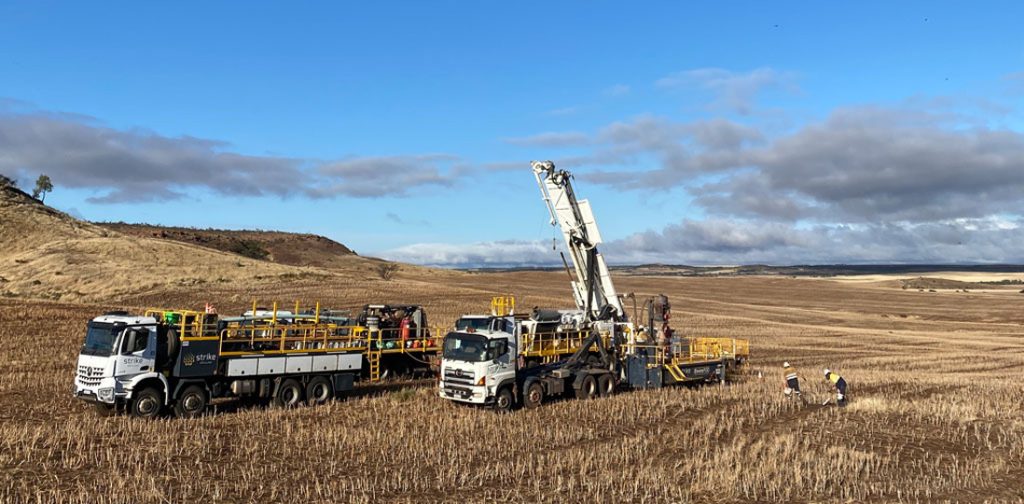
Further resource expansion is planned, with additional drilling expected to increase the size of the resource and upgrade portions of the resource into measured and indicated categories. 

Managing Director Shaun Bunn says the efforts achieved to date has spurred the team’s endeavours to untap the true potential of this project. 

“Pitfield is truly one of the natural geological wonders of the world: a district scale, giant titanium rich ore deposit which has remained hidden in plain sight until recently discovered by Empire,” Bunn says. 

“We remain focused on completing our processing optimisation testwork and moving rapidly into continuous piloting early next year. 

“We have already commenced engineering, environmental, and marketing studies when combined, will help confirm the next commercial viability of Pitfield and form the basis for a final investment decision.”

Pitfield, located within the Mid-West region of Western Australia, covers a combined area of 1,042km2 across four tenements. 

According to Empire, the titanium dioxide market is valued at US$24 billion and consumption is expected to grow at a rate of 3.7% per year. Titanium is listed as a critical mineral in the US, UK, European Union, Australia, and Japan. 

Titanium is used in a diverse range of products. It is depended on for its non-toxide, non-reactive, and luminous properties. It also has lesser-known qualities that make it an important component for tackling climate change and preventing skin cancer. 

Write to Aaliyah Rogan at Mining.com.au   

Images: Empire Metals

Add to Watch List:
Author Image
Written By Aaliyah Rogan
Originally from New Zealand, Aaliyah brings several years of experience covering the resources sector, with a focus on companies, commodities and global mining markets. Her reporting has spanned European markets and the evolving global mining landscape, with a focus on the stories and market forces driving change across the sector.