


African minerals explorer Peak Rare Earths (PEK) has reported the presence of ‘widespread and extensive high-grade’ fluorspar mineralisation within its Ngualla Project in Tanzania.
The $66.48 million market capitalisation company says the discovery comes from a trench sampling program completed in the Breccia Zone within the project area, which lies roughly 2km northeast of the Bastnaesite Zone that forms the basis of Ngualla’s ore reserves and mineral resources.
Peak previously collected 344 samples from 9 trenches across the Breccia Zone and has now reported top assays of 70m @ 36% calcium fluoride (CaF2), 114m @ 46% CaF2, and 34m @ 39% CaF2.
Moreover, Peak says the prospectivity of the Breccia Zone has been further enhanced thanks to some ‘significant’ rare earths mineralisation found in the northern trenches, with key sampling results including 68m @ 2.9% total rare earth oxides (TREO) from 24m, including 6m @ 6.9% TREO from 26m.
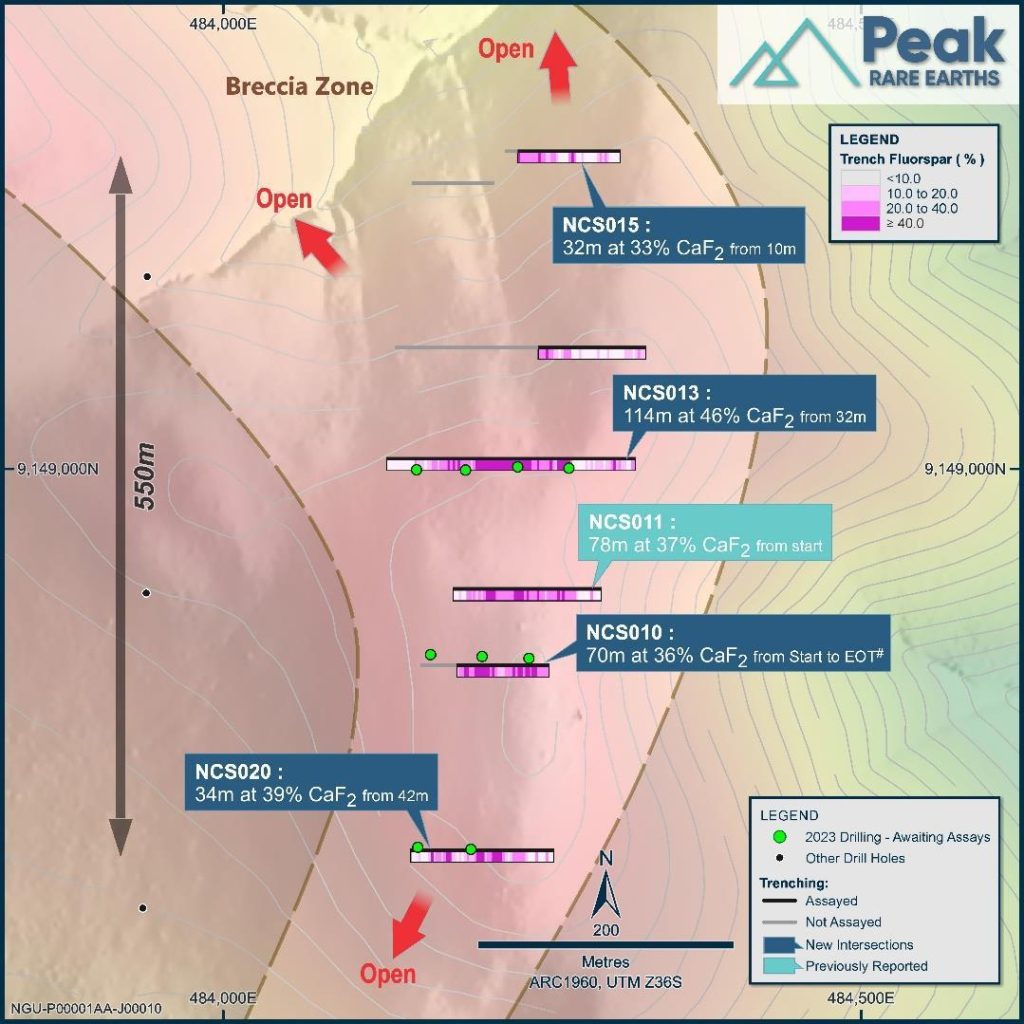
These results come as Peak awaits assay results from recent drilling completed across the Breccia Zone, which the company says could further define the extent and depth of the fluorspar mineralisation in the area.
The Breccia Zone drill assays are due before the end of March.
Peak Rare Earths CEO Bardin Davis says the company is ‘extremely excited’ by the new trench sampling results and upcoming assays.
“The fluorspar intercepts are very high-grade relative to other fluorspar projects, and the Breccia Zone has the potential to be a globally significant fluorspar deposit.
The rare earth mineralisation intercepted in the northern trenches is also very encouraging.
We remain of the view that the Ngualla deposit can support a world-class, multi-commodity, and multi-generational project.”
“We remain of the view that the Ngualla deposit can support a world-class, multi-commodity, and multi-generational project”
Peak says fluorspar is an increasingly ‘critical’ commodity due to its role as a key input in green energy and decarbonisation technologies.
The mineral is used in the manufacturing of aluminium, gasoline, steel, and uranium fuel products, as well as in ceramics and other chemical industries.
Previous trench sample assays from Peak’s maiden fieldwork within the Breccia Zone in 2017 showed fluorspar intersections as high as 62% CaF2. However, of these 12 trenches, samples from only 3 were originally sent for lab analysis.
It’s from the remaining 9 2017 trenches, then, that Peak has reported the new assays and fluorspar results. The company says it made the call to assay select samples from the remaining 9 trenches in 2023 based on its current critical minerals exploration strategy.
Peak Rare Earths had just under $15.3 million cash and cash equivalents at hand at the end of December 2023, according to its latest quarterly report.
Write to Joshua Smith at Mining.com.au
Images: Peak Rare Earths


