


Peak Minerals (ASX:PUA) is seeing evidence of PGEs ‘never seen before’ from drilling at the at Rixon prospect within the company’s 100% owned Green Rocks Project in Western Australia.
Peak CEO Jennifer Neild told Mining.com.au on the sidelines of the International Mining and Resources Conference (IMARC) in Sydney last week, the company has been looking for copper and nickel, and now PGEs within the Lady Alma Igneous Complex (LAIC) where the project sits.
Peak Minerals recently undertook a reverse circulation (RC) drilling program at the Lady Alma, Rixon, and Target B prospects at Green Rocks. The program was designed to follow up on geophysical anomalies and test favourable geology.
The CEO told Mining.com.au that the elevated values of platinum and palladium have now changed the company’s focus.
“When you look at these results you have to look at them as being part of a bigger system. It’s important to understand that we see evidence already of vanadium and titanium and if you look at our neighbours like Australian Vanadium (ASX:AVL), we know we have the ingredients.
“So, we’ve started seeing evidence of PGEs, which we’ve never seen before – the platinum and palladium – we have some quite elevated values”
So, we’ve started seeing evidence of PGEs, which we’ve never seen before – the platinum and palladium – we have some quite elevated values.
We’re really excited to see that we have a very fertile intrusion that we need to really map out a little bit better. We’ve only really scratched the surface.
Neild said that while the platinum and palladium values are not “big” so far, it’s still very exciting for Peak Minerals.
“We know we’re close to something.”
The RC drilling is the precursor to a planned diamond drilling program as part of the staged exploration strategy at Green Rocks. Three of the holes were surveyed using Downhole Electromagnetics (DHEM) to further resolve conductors and help guide planned diamond drilling (one hole at Target B, one hole at Lady Alma and one hole at Rixon).
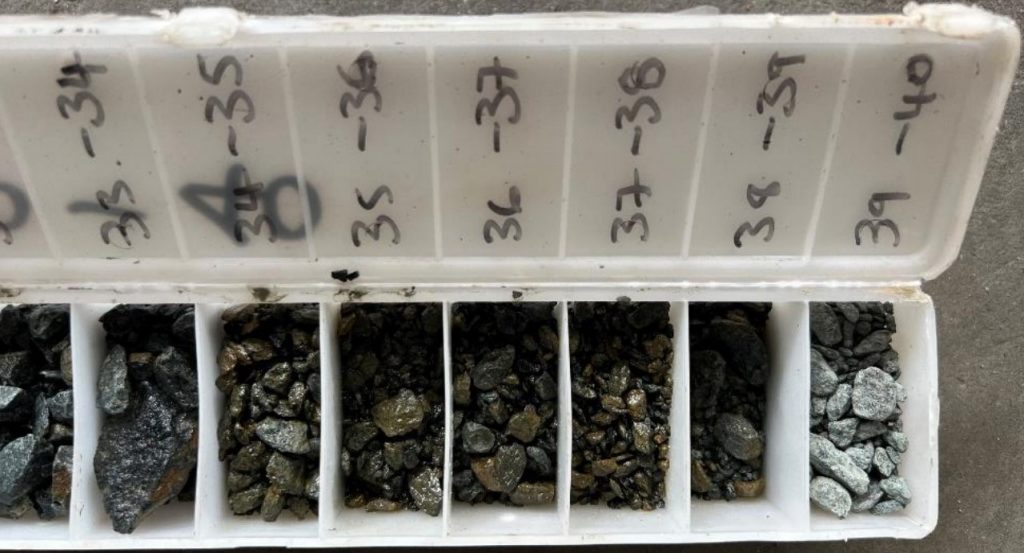
At Rixon, GRRC004 tested a ‘weakly conductive’ modelled EM plate. The hole intersected 1m of elevated Pt, Pd, and Au totalling 0.82g/t 3E with 0.54% Cu and 0.10% Co.
Neild noted that the Moving Loop Electro Magnetic Survey (MLEM) identified several weakly conductive plates. Disseminated copper mineralisation was intersected in GRRC004 above the expected depth with the assays results showing these ‘impressive’ platinum, palladium and gold values, which “have not been encountered in the LAIC before”.
Hole GRRC006 was drilled west from Rixon towards Lady Alma and ended in 15m at 0.29 g/t 3E, including 4m at 0.52g/t 3E, which will be extended with a diamond tail. This second intersection of Pt-Pd-Au further highlights the Cu-Ni-PGE potential of the LAIC, she added.
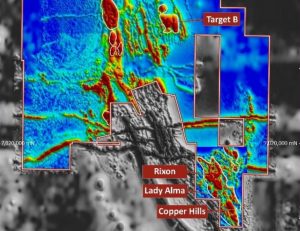
At Lady Alma, a moderate conductor was tested to the north-west of the 2021 diamond drilling program (which includes high-grade intersections of 0.13m at 4.95% Cu and 0.70% Ni and 0.20m at 4.18% Cu and 0.16% Ni2). Disseminated copper mineralisation was visualised throughout the hole. Anomalous copper values over 150m confirmed the logging of disseminated mineralisation, which could be mapping the top of more massive mineralisation.
Government funding
Meanwhile, the CEO also told Mining.com.au that Peak was a successful applicant in the Western Australian Government’s Exploration Incentive Scheme (EIS) and has been awarded a $180,000 grant. The funds will be used to, among other works, follow up the link between Rixon and Copper Hills; test magmatic sulphides seen in historic Copper Hills core; and test deeper anomalies picked up in VTEM and Heli-EM surveys.
The CEO added: “We decided to put that EIS application in as we knew we were going to drill there anyway, why not get the funding if we can ,to do so. We’re really looking to get more confidence in the geology at Copper Hills so we’ll go back there and get a better idea of the geology and keep looking at the conductivity that we’ve mapped there.”
Heading into 2023, the CEO said Peak is also looking to get more confidence in the geology at nearby Copper Hills and will keep assessing the conductivity that it has mapped there.
Magmatic sulphide mineralisation is controlled by the intrusive lithologies of the LAIC. Hydrothermal alteration and mineralisation overprints the LAIC along zones of structural weakness. Copper mineralisation within the LAIC is primarily chalcopyrite with pyrrhotite and lesser pyrite.
Near surface, malachite and azurite are present, often with carbonate and zones of gold. As depth increases, carbonate associated with veining disappears and veins are comprised of sulphide only. At Lady Alma, a sulphide gossan is present.
Copper Hills is defined by a 600m strike of disseminated mineralisation with zones of chalcopyrite veining in an interpreted contact shear zone of an intrusive gabbro.
Lady Alma mineralisation is hosted in a gabbro to peridotite and is comprised of fine-grained disseminated sulphide with chalcopyrite veins increasing in width at depth.
Rixon project is defined by 485m x 250m intrusion that is surrounded gossan with malachite mineralisation. The mineralisation is hosted in a fine grained ultramafic that intrudes into a dunite with magnetite veining.
Write to Adam Orlando at Mining.com.au
Images: Peak Minerals Limited & iStock