



As if the folks in pursuit of a deep sea mining industry weren’t already finding it hard to sidestep the apparent pointlessness of it all, they’ve sadly been dealt another blow. In addition to abyssal metals being (a) environmentally critical, (b) economically nonsensical, and (c) kind of not needed, they’re now thought to be (d) a critical source of oxygen for seafloor life.
That’s according to a study published in Nature Geoscience last week, led by Andrew Sweetman of the Scottish Association for Marine Science, who collaborated with 15 other researchers from around the world.
Until recently, oxygen was thought to be a process of life itself; produced by plants through photosynthesis. The production of ‘dark oxygen’, however, requires no sunlight, and is instead the result of an entirely separate process called ‘seawater electrolysis’.
It occurs when polymetallic nodules — the small seafloor rocks mining companies are looking to collect and process to obtain nickel, cobalt, copper, titanium, and other metals — produce an electrical charge, which then splits the seawater into hydrogen and oxygen.

While the confirmation of such a phenomenon is brilliantly new, it had in fact been observed by Sweetman in the Pacific Ocean’s Clarion-Clipperton Zone — the global hotspot for deep sea mining — back in 2013.
“I just ignored it, because I’d been taught — you only get oxygen through photosynthesis,” Sweetman told BBC News.
“Eventually, I realised that for years I’d been ignoring this potentially huge discovery.”
But what the breakthrough means, really, is that these polymetallic nodules are even more integral to the sustainability of deep sea environments than we thought, and that — by extension — deep sea mining just got even harder to pull off.
The study — ‘Evidence of dark oxygen production at the abyssal seafloor’ — was funded by The Metals Company (NYSE:TMC) subsidiary Nauru Ocean Resources Inc. (NORI), which has for years been campaigning to convince the world of deep sea mining’s cool and necessary potential.
But the results of the research NORI itself bankrolled are likely to make that job more of a challenge, and the folks at The Metals Company don’t plan to take it lying down.
In a statement, The Metals Company said it was surprised to see the “questionable” paper was published at all, noting it had originally been rejected by a number of other journals and citing its “flawed” methodology.
“Our team is preparing a comprehensive rebuttal to contribute to the scientific literature and ensure accurate information is available,” the company said.
“We are committed to scientific integrity and transparency, and will continue to provide accurate, peer-reviewed research to enhance our understanding of the deep sea.”
But Nature Geoscience is, of course, one of the world’s leading scientific journals. And Sweetman is more than prepared to stand by his team’s work.
“We were the worst critics of this paper for a long time,” he says.
“For eight years I discarded the data showing oxygen production, thinking my sensors were faulty. Once we realised something may be going on, we tried to disprove it, but in the end we simply couldn’t.
“Following the publication of this paper, I have been approached by other researchers with similar data sets also showing evidence of dark oxygen production that they discarded thinking equipment was faulty.”
Indeed, it’s not the first time The Metals Company has sought to swing both the public and scientific narrative in its favour.
In 2020, Greenpeace published a report “on how mineral exploration of the deep sea . . . has become monopolised by a concentrated number of private companies headquartered in the Global North, working through subsidiaries, shell companies and subcontractors in a bid to maintain the illusion that deep sea mining can be a global public good.”
It was a legitimate enough assessment, given the extent to which deep sea mining companies have profited from operations often deemed total failures.
“The first time Gerard Barron” — CEO of The Metals Company — “tried to mine the sea floor, the company he backed lost a half-billion dollars of investor money, got crosswise with a South Pacific government, destroyed sensitive seabed habitat and ultimately went broke,” the Wall Street Journal wrote in 2021.
That company was Nautilus Minerals. The South Pacific government was Papua New Guinea, whose support for the Solwara 1 Project — described by current PNG Prime Minister James Marape as “a total failure” — left it $157 million out of pocket. Barron, meanwhile, watched his $226,000 investment in Nautilus balloon to $31 million in six years.
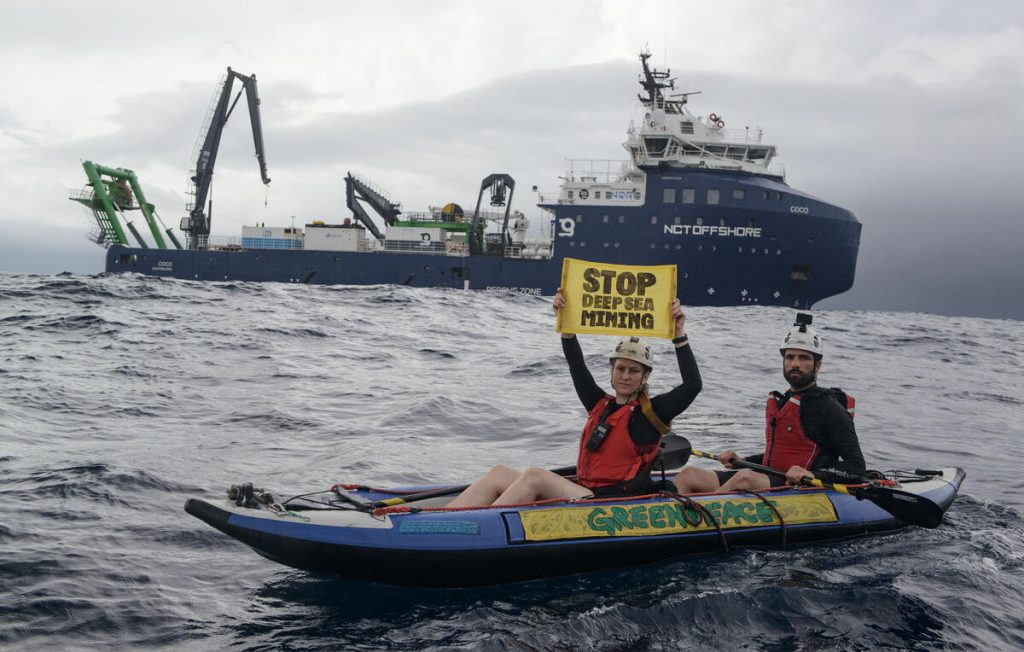
In response to Greenpeace’s report, The Metals Company asserted that the conservation group had “fundamentally” misunderstood the nature of the deep sea mining industry, including the relationships it requires.
“To bring together international financing and pioneer new technologies across multiple disciplines involves building trust-based alliances with companies and entities from around the world,” the company said.
“This is simply the reality of developing such large-scale international projects — we can’t do it alone.”
Perhaps that is itself an explanation for The Metals Company’s most recent rejection of science; that its monumental PR campaign has failed to generate sufficient support, and now time is running out.
Governments are meeting this month at the International Seabed Authority in Kingston, Jamaica, to elect a new secretary-general (who may not be as tacitly pro-mining as the last) and more broadly determine whether deep sea miners can put their hooks into the sea floor.
Add to that pressure a declining share price and a loss of US$73.8 million ($112.5 million) last year, and you can see why things might be feeling a bit tense at The Metals Company.
“TMC’s current situation is dire,” Andy Whitmore, Finance Advocacy Officer for the Deep Sea Mining Campaign, said in April.
“They’re in a race against time — desperate to gain approval for commercial mining in July 2024 before they run out of funds.”
In the end, The Metals Company and those of its ilk might simply work best as champions of science. They are, after all, prolific funders of deep sea research, which originally sought to affirm the scruples of abyssal exploitation.
But what they perhaps didn’t anticipate — what looks very much like some cosmic twist of irony — is that this same research could be the very thing that kills their deep sea mining dreams.
Write to Oliver Gray at Mining.com.au
Images: The Metals Company, Our World in Data, Greenpeace


