

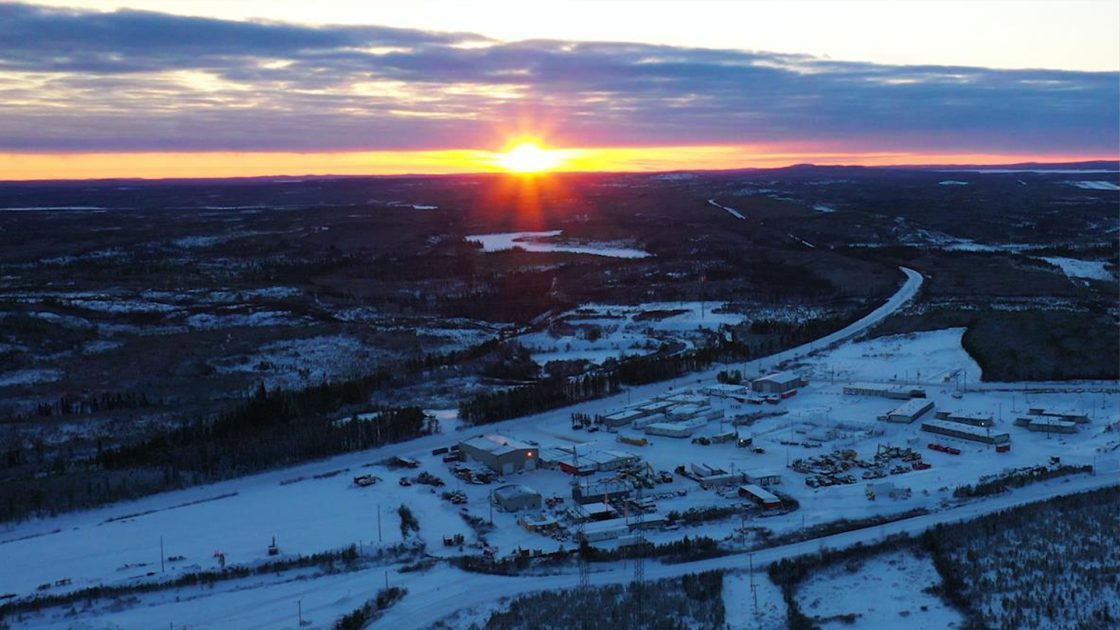
Power Nickel (TSX-V:PNPN) has announced a short-term plan to explore potential offsets at the polymetallic Lion Zone discovery after promising results were returned from just outside the main zone.
Initial assay results have been returned for five holes that were drilled as part of the summer 2024 drilling campaign, including up to 0.73 grams per tonne (g/t) gold, 37.9g/t silver, 7.41% copper, 8.59g/t palladium, 9.26g/t platinum, and 0.50% nickel.
CEO Terry Lynch says the company now realises these results were obtained from targets that were outside the main Lion Zone in what is referred to as the Halo area.
“Holes 63, 66, and 67 still delivered great value to the project,” Lynch says.
“Five metres of 5.93% copper-equivalent is excellent in holes 63 and 66-67 both showed a very sizeable section of 12m of 2.97% copper-equivalent and 2.36% copper-equivalent respectively.
“After this set of holes we retargeted the drills at a lower pitch further west and once again found the main Lion Zone.”
During September, Power Nickel revealed that its summer drilling campaign had extended the ‘high-grade’ polymetallic Lion Zone by 50%.
Power Nickel says the complete set of assays show a “tremendous success rate”, which contributes to a continuously increasing level of confidence about the continuity of the zone.
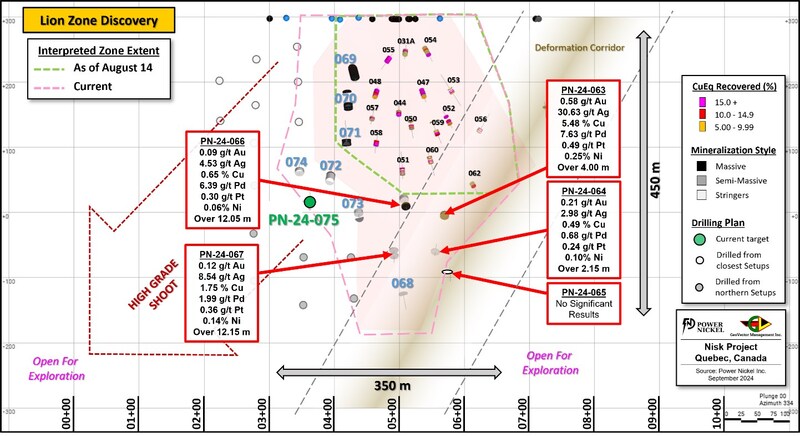
Vice President of Exploration Ken Williamson says in the short-term the company is planning to step out a few hundreds of metres from the discovery zone and explore for potential offsets.
“As we have previously described, the thickness of the massive chalcopyrite zone within the core area is ranging from up to 5-10m true width, but decreases less than 1m laterally,” he says.
“The new results, combined with the ongoing structural interpretation and 3D modelling, suggest an inverse relation between thickness and strain intensity.
“Results obtained at depth below the current zone show a decreasing thickness, suggesting that the zone could be transposed into a deformation corridor (fault); in such scenario, the possibility that the zone regains in thickness on the other side of the fault is very real.”
The drilling campaign comprised 20 holes totalling 8,000m targeting additional zones of copper, platinum, palladium, gold, silver, and nickel at the Lion Zone.
Assays from the remaining holes are now in the laboratory, and Power Nickel expects to release these to the market this month.
The Lion Zone is part of the Nisk Project in Québec, Canada, and comprises 20km of strike length, with numerous ‘high-grade’ intercepts.
Power Nickel is focused on expanding the historical high-grade nickel-copper platinum group element mineralisation with a series of drilling programs designed to test the initial Nisk discovery zone and to explore the land package for adjacent potential nickel deposits.
Write to Aaliyah Rogan at Mining.com.au
Images: Power Nickel