
MDF Global MDF Global
Apple’s iPhone boom highlights critical minerals powering smartphones•Presenting a united front for Queensland’s copper sector•Thailand seeks Myanmar mine access amid arsenic pollution•Egypt to set up state-backed company to license artisanal gold miners, free detainees•Brixton closes $7.4 million raise for Thorn, Langis projects•Heliostar banks record $78.7 million for Ana Paula push•Mining giants bet billions on 2030 supply crunch•Gunnison Copper reports Q3 output, revenue surge•Triumph Gold targets $15.46 million for Yukon push•African Rainbow Minerals faces a jobs dispute at Nkomati mine•Angola seeks 10% stake in De Beers under Anglo’s proposed exit•Gold price rebounds but heads for biggest weekly loss since June•Teck copper strike reaches BC port as operator sues union•Copper benchmark rocked by miner-smelter tug-of-war•Zimbabwe mining bill targets community, environmental safeguards•Mount Isa critical minerals hub secures Feasibility Study funding•Eramet initiates $814.5 million capital raise to reduce debt•Richemont backs natural gemstones, declines De Beers comment•‘Tis the season for administration as Comlek falls a second time•OceanaGold Philippines trials wireless blasting at Didipio mine Apple’s iPhone boom highlights critical minerals powering smartphones•Presenting a united front for Queensland’s copper sector•Thailand seeks Myanmar mine access amid arsenic pollution•Egypt to set up state-backed company to license artisanal gold miners, free detainees•Brixton closes $7.4 million raise for Thorn, Langis projects•Heliostar banks record $78.7 million for Ana Paula push•Mining giants bet billions on 2030 supply crunch•Gunnison Copper reports Q3 output, revenue surge•Triumph Gold targets $15.46 million for Yukon push•African Rainbow Minerals faces a jobs dispute at Nkomati mine•Angola seeks 10% stake in De Beers under Anglo’s proposed exit•Gold price rebounds but heads for biggest weekly loss since June•Teck copper strike reaches BC port as operator sues union•Copper benchmark rocked by miner-smelter tug-of-war•Zimbabwe mining bill targets community, environmental safeguards•Mount Isa critical minerals hub secures Feasibility Study funding•Eramet initiates $814.5 million capital raise to reduce debt•Richemont backs natural gemstones, declines De Beers comment•‘Tis the season for administration as Comlek falls a second time•OceanaGold Philippines trials wireless blasting at Didipio mine
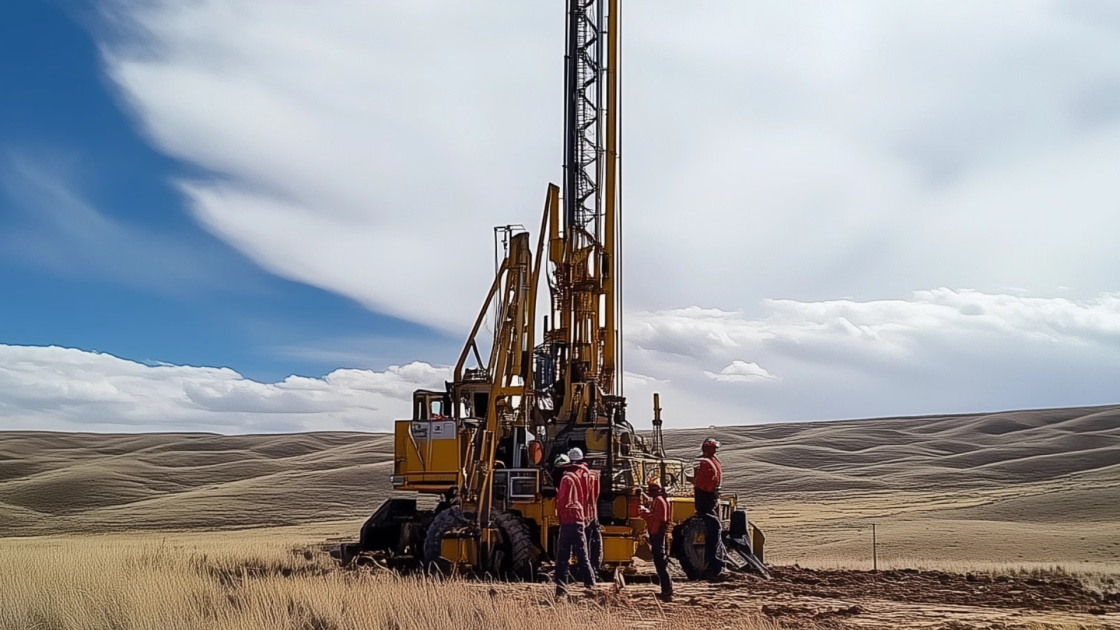
Noble Plains Uranium Shirley Central Project in Wyoming, US

Noble Plains finds treasure in Shirley Central’s past

Noble Plains Uranium (TSX-V:NOBL) has completed digitisation of historical drill data at its Shirley Central Project in Wyoming.

The company used artificial intelligence-powered computer vision to process 1,211 historical drill holes acquired from Ur-Energy (TSX:URE), identifying 341 uranium intercepts to guide upcoming confirmation drilling.

This program converted decades-old files and scanned gamma logs into a modern geological model.

The digitised dataset has informed placement of seven confirmation drill holes designed to advance Shirley Central toward a potential mineral resource.

“At Duck Creek, we proved that historical drilling can be converted into a compliant, scalable resource faster and more economically than starting from scratch,” CEO Drew Zimmerman says.

“At Shirley Central, we are aiming to do it again with over 1,200 historical drill holes, data that would have cost in excess of US$6 million [$8.6 million] to generate through new drilling alone.”

The Shirley Central Property consists of 30 mineral claims covering 665 acres directly adjacent to Ur-Energy’s producing Shirley mine.

Noble Plains acquired the raw historical drill data from Ur-Energy, though the dataset existed only as old, scanned gamma logs unusable in modern resource-estimation workflows.

NOBL engaged Geomorphic AI to systematically extract, standardise, and analyse the full 1,211-hole dataset. The dataset accurately extracted gamma-ray traces across multiple historical log formats and converted CPS readings into estimated uranium oxide grades.

Of the 1,211 historical holes reviewed, 341 intercepts qualified above a cut-off grade of 0.02% equivalent uranium oxide (eU3O8) and a minimum thickness of two feet.

These intercepts average 0.055% eU3O8 over an average thickness of 13.7ft (4.17m), with more than 57% returning grades above 0.05% eU3O8.

Standout results include a 4ft (1.2m) intercept grading 0.58% eU3O8 from 185–189ft (56.4–57.6m) in hole TX-2763, and a 6.3ft (1.9m) intercept, grading 0.53% eU3O8 from 448.6–454.9ft (136.7–138.7m) in hole SX-683.

The company has selected seven drill locations for a confirmation program focused on two prospective intercept clusters characterised by nose features associated with ‘higher-grade’ uranium accumulation.

The targeted approach mirrors the strategy that delivered a 90% hit rate across Noble Plains’ 148-hole confirmation programme at Duck Creek.

Shirley Central sits between Ur-Energy’s Shirley Basin in-situ recovery project, which hosts a measured and indicated resource of 8.816Mlb eU3O8 at 0.23%, and Uranium Energy’s operations.

Ur-Energy has commenced full-scale uranium production operations at Shirley Basin.

Noble Plains Uranium is a Wyoming-focused uranium explorer advancing the Shirley Central project adjacent to Ur-Energy’s producing Shirley mine.

Write to JC Villarba at Mining.com.au

Images: Noble Plains Uranium

Add to Watch List:
Author Image
Written By JC Villarba
JC is an editor with a decade of experience shaping digital content for worldwide audiences. He has spent time embedded in the construction industry, producing content for some of Australia's leading construction and equipment platforms. A Political Science graduate, he has developed a long-standing habit of following global affairs too closely. Outside of work, JC can be found behind a camera, hunting for a good meal, or deep in a book about film or history.