

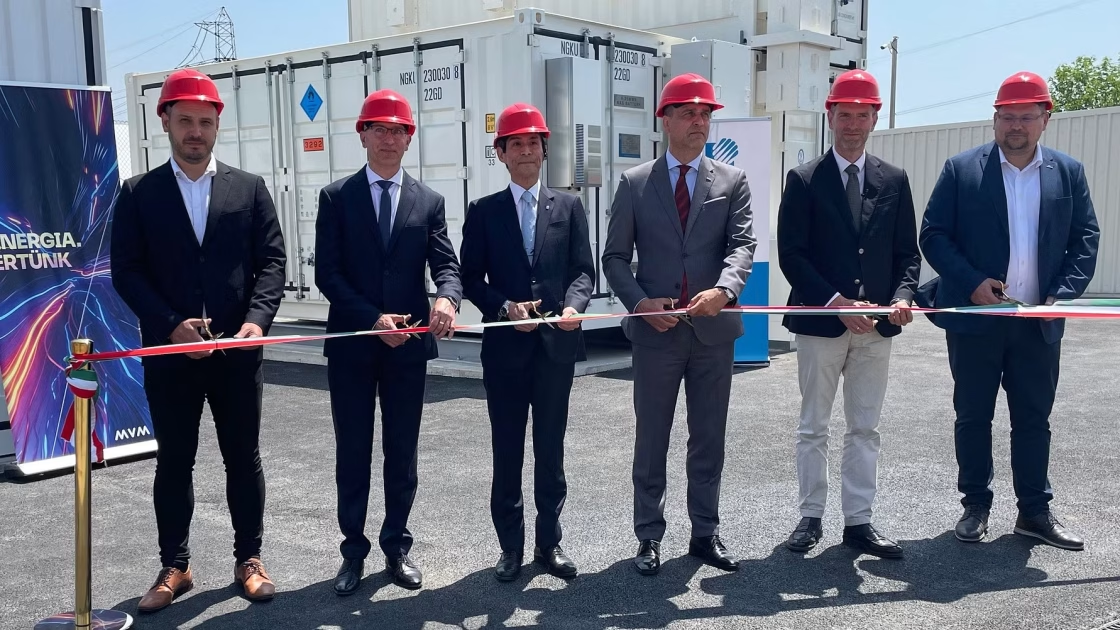
Battery manufacturer NGK Insulators recently held a handover ceremony after completing the installation and test operation of NAS batteries for storing electric energy ordered by MVM Balance, a subsidiary of the Hungarian state-owned energy company MVM Group.
NAS Batteries — made from sodium and sulphur — are used in various applications including stabilising renewable energy, electric power demand and supply balancing, as well as emergency power sources.
The batteries are megawatt class large-capacity storage batteries that feature a long-life and can provide a stable supply of electric power with a high output over long periods. They have a total output of over 740 megawatts and a total capacity of 5,000 megawatts per hour.
At the ceremony — held at MVM Balance’s power station in Litér, Hungary — State Secretary of the Ministry for Energy of Hungary Attila Steiner says the batteries will enable rapid and flexible response to electric power demand, while also contributing to increasing energy stability and security.
“The Ministry of Energy aims to secure one gigawatt of electric energy storage capacity within Hungary by 2030,” Steiner says.
“This demonstration project is a further step toward achieving this goal. At the same time, it will contribute to energy autonomy, sustainability, and technology reform.”
The NAS batteries have been installed inside the power station of MVM Balance for use in a grid storage battery demonstration project for stabilising the electricity grid.
The project will confirm the use of grid storage batteries for storing energy during times of surplus and discharging it when there is a shortage, to boost the earliest social implementation.
NGK says it will examine the provision of adjustment capacity to the ancillary service market, which trades energy supply to eliminate gaps in supply and demand of electric energy.
MVM Group has adopted a policy of full-scale advancement of storage battery installation as a measure for adjusting renewable energy supply and demand. MVM Group also plans to examine the performance standard for grid storage batteries to be introduced in the future.
Hungary — which has legislated the achievement of carbon neutrality by 2050 — has established a goal of converting 90% of its generated power to low-carbon sources by 2030. Installed capacity of solar power generation equipment has reached eight gigawatts, accounting for over 25% of Hungary’s domestic electricity supply.
Since Hungary’s terrain is mostly flat, NGK says it is difficult to construct pumped storage hydroelectricity stations, which require a difference in elevation. As a result, demand for high-capacity storage batteries such as NAS batteries is increasing as an alternative, and their adoption is expected to expand.
NAS batteries have been installed at over 300 locations globally and were originally developed as the alternative technology to the pumped hydroelectric storage in urban areas.
Write to Aaliyah Rogan at Mining.com.au
Images: NGK Insulators