



There are few names in the financial space as prestigious as Michael Howell.
He’s a 40-year veteran of markets and publishes the number one paid Substack in the UK. His readership is global.
That’s why his latest message is notable for resource investors.
Howell specialises in analysing global liquidity. This is the flow of money and credit throughout the world economy and asset markets.
His track record is enviable.
Howell forecast the breakout in gold before the yellow metal soared in 2024 and 2025.
He positioned his readers for the upswing in the Nasdaq and tech after the 2022 bear market.
Now he’s telling his readership to position for a strengthening commodity market.
He writes:
“Early-cycle upswings are triggered by central bank easing; late-cycle downswings tend to begin when economies strengthen and liquidity migrates from financial markets into the real economy.
“That shift is usually bad for government bonds — pushing yields higher — but good for industrial commodities, as inventories are rebuilt and capex plans move from spreadsheet to order book.”
This current dynamic can be seen in the following chart too:
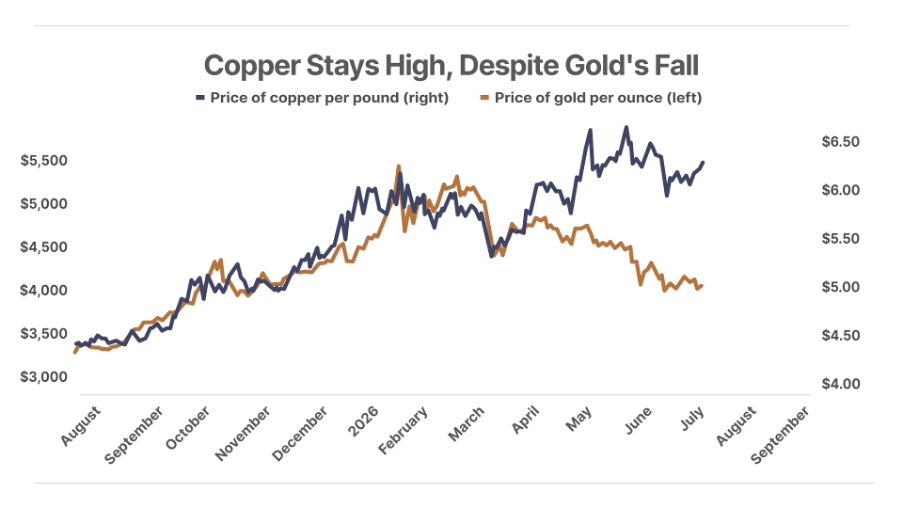
The correlation between gold and copper broke down in April. Surprisingly, considering the catalyst for the shift — the US attack on Iran — it’s copper that’s held up and not gold.
That suggests real-world demand is solid.
It makes sense, too, given the current capital expenditure boom is driven by the AI trade.
The forecast spending out to 2030 for chips alone could be as high as US$1.4 trillion ($2 trillion).
Then there’s the struggle for the mining industry to hit previous supply guidance.
The Australian Financial Review reports:
“Volumes from BHP’s (ASX:BHP) best copper mine, Chile’s Escondida, will decline by between 13% and 20%, because of a long-predicted trend for copper grades to decline as the 36-year-old mine works through less attractive geology.”
As it happens, the mining industry has warned of the declining ore grades around copper for a long time.
It’s only now that the demand pull is starting to bring this to the market’s attention.
Howell says investment booms are inflationary. He adds that “commodities thrive” in inflationary economies while bonds suffer, at least historically.
He observes:
“In practical terms, precious metals and industrial commodities tend to move differently across the liquidity cycle.
“At the beginning of the cycle, precious metals rise first and push gold/commodity ratios higher. Later, as financial liquidity migrates into the real economy, industrial commodities rise and pull those ratios lower.”
That leads to the conclusion that industrial commodities like base metals should do very well as the cycle continues.
One example is Polymetals Resources (ASX:POL). The company released its latest quarterly report this week.
Revenue and cash went up as operational metrics improved as the resource sector heats up.
Its major production is silver but it also produces lead and zinc.
Howell’s work suggests POL’s restart of the Endeavor Mine 12 months ago is now moving into a favourable mining environment indeed.
Write to Callum Newman at Mining.com.au
Images: Unsplash, Porter & Co


