


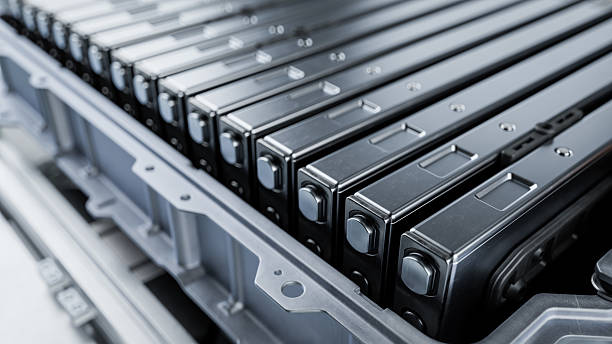
As lithium-iron-phosphate (LFP) batteries gain ground across electric vehicles and energy storage, the mining industry is shifting from asking how much lithium the world needs to what type it needs and where it will come from.
That shift was a key discussion point at the S&P Global Energy conference, where the rise of LFP batteries was highlighted as a potential catalyst for changing the dynamics of the lithium market and creating new opportunities for Australia to move further into value-adding, as reported by White Noise Communications.
LFP batteries are rechargeable power sources known for being high-safety, long-life, and low-cost; and as such, are gaining popularity in a market once dominated by nickel-rich batteries. Unlike nickel-manganese-cobalt chemistries, LFP batteries primarily rely on lithium carbonate rather than lithium hydroxide.
Australia remains central to that supply chain, with the nation being one of the largest lithium producers, accounting for nearly half of the global production.
At the S&P Global Energy conference, Singapore-based nonferrous metals price reporter Louissa Liau says that recent maintenance shutdowns across China’s lithium salt sector have tightened supply availability, lithium carbonate inventories continue to decline, and downstream new energy demand remains robust — leading to a sustained improvement in market fundamentals.
In June alone, Australia provided nearly 50% of China’s spodumene imports, totalling 370,964 tonnes of the 768,411 tonnes imported. During the same time, China recorded its first spodumene import from the Democratic Republic of the Congo, but imports from Zimbabwe were down 58.5% year-on-year due to the country’s export ban, as White Noise reported.
According to the Department of Industry, Science and Resources’ (DISR) June 2026 Resources and Energy Quarterly, critical minerals export earnings are forecast to rise from around $17 billion in 2025–26 to $19 billion by 2030–31. This is driven largely by higher lithium exports.
The nation’s lithium export earnings are forecast to increase from $9.9 billion in 2025–26 to $13 billion in 2026–27, before moderating to $10 billion in 2030–31.
For Australian miners, developers, and explorers, the changing battery mix raises a broader strategic question: Is the next phase of the lithium boom going to be about finding more resources, or finding the right resources and building the processing capacity to put them into the right supply chains?

Exploration: TG Metals
For companies seeking to develop the next generation of lithium deposits, the emergence to an already challenging investment equation.
Australia holds the world’s second largest lithium reserves, totalling 8.4 million tonnes (Mt). The country’s lithium comes from hard-rock spodumene ore, primarily concentrated in Western Australia.
One company looking to advance such a resource is TG Metals (ASX:TG6), which owns the Lake Johnston Project located between two Western Australian greenstone belts.
The Lake Johnston Greenstone Belt hosts defined lithium-caesium-tantalum pegmatites — a source of about one-fourth of the world’s lithium production and most of the tantalum production.
In May 2024, an exploration target estimated Lake Johnston to contain between 15.6 million to 20.1Mt @ 0.97–1.19% lithium oxide.
The project hosts the Burmeister lithium deposit, which comprises a series of stacked shallow-dipping spodumene-bearing pegmatites. In early June 2026, TG Metals applied for a mining lease for the deposit, materially advancing its development potential.
CEO David Selfe previously told Mining.com.au that the company has completed extensive work to define pathways to production, including the processing flowsheet for direct shipping ore (DSO) product from simple crushing and ore sorting onsite at Lake Johnston.
“Metallurgical test work and the shallow nature of the Burmeister pegmatites support the potential for a high-grade and low-capital DSO development pathway at Lake Johnston,” Selfe says.
The advantage the company has for DSO at Burmeister is that the Port of Esperance is located close to where the company is based — 77km to get the product to the highway and then to port.
“It’s a lot shorter than most pegmatite lithium projects in Western Australia, and this presents a very low capex and more immediate opportunity for us without having to build a full DMS and flotation plant in order to get a returnable, saleable product,” Selfe adds.

Production: PLS and Liontown
The shift is also being felt among Australia’s established lithium producers.
PLS Group (ASX:PLS) owns the Pilgangoora operation, a hard-rock lithium asset located in Western Australia’s Pilbara region. The project has a 1 million tonne per year capacity over a 31-year mine life. Pilgangoora also contains a resource of 445Mt and an ore reserve of 207.2Mt.
Earlier this year, the company received up to $38.1 million in funding for a midstream demonstration plant to help cover the project’s operating costs.
As previously reported, the spodumene concentrate plant is designed to have a 27 kilotonne (kt) annual capacity with low emissions. The plant will produce 3kt of lithium phosphate and test the feasibility of more efficient and lower carbon processing pathways for hard-rock lithium.
The plant will be powered from Pilgangoora’s integrated on-site energy system, which includes gas-fired generation, solar, and battery storage. PLS expects the first product to be delivered during Q3 2026.
At the Diggers & Dealers Mining Forum in Kalgoorlie, Western Australia, PLS also revealed the expansion of its P2000 Project, building on the existing Pilgan Plant with a potential to produce 2Mt annually.
“We’re already a scale producer, but what’s really exciting is where we’re heading. If the P2000 was built today, we would have the largest lithium operation,” CEO Dale Henderson said at the forum.
Liontown Resources (ASX:LTR) is another Australian lithium producer, which owns the nation’s first underground lithium operation — the Kathleen Valley Mine.
Kathleen Valley contains a 150Mt resource @ 1.33% lithium oxide. The mine is expected to ramp up production to 2.8Mt per year by the end of FY2027, though establishing a consistent mill feed from open-pit mining.
“Our underground mine is progressing to plan, with the flexibility to prioritise high-margin ore and scale efficiently in response to market demand,” CEO Tony Ottaviano previously said.
The rise of LFP batteries does not spell the end of Australia’s lithium opportunity, but it does unveil how quickly the battery supply chain is evolving. For explorers, developers, and producers, the opportunity lies in developing projects with the right mineralogy, processing pathways, infrastructure, and economics to meet changing market demand.
Write to Aaliyah Rogan at Mining.com.au
Images: iStock, TG Metals, & Liontown Resources


