
MDF Global MDF Global
Apple’s iPhone boom highlights critical minerals powering smartphones•Presenting a united front for Queensland’s copper sector•Thailand seeks Myanmar mine access amid arsenic pollution•Egypt to set up state-backed company to license artisanal gold miners, free detainees•Brixton closes $7.4 million raise for Thorn, Langis projects•Heliostar banks record $78.7 million for Ana Paula push•Mining giants bet billions on 2030 supply crunch•Gunnison Copper reports Q3 output, revenue surge•Triumph Gold targets $15.46 million for Yukon push•African Rainbow Minerals faces a jobs dispute at Nkomati mine•Angola seeks 10% stake in De Beers under Anglo’s proposed exit•Gold price rebounds but heads for biggest weekly loss since June•Teck copper strike reaches BC port as operator sues union•Copper benchmark rocked by miner-smelter tug-of-war•Zimbabwe mining bill targets community, environmental safeguards•Mount Isa critical minerals hub secures Feasibility Study funding•Eramet initiates $814.5 million capital raise to reduce debt•Richemont backs natural gemstones, declines De Beers comment•‘Tis the season for administration as Comlek falls a second time•OceanaGold Philippines trials wireless blasting at Didipio mine Apple’s iPhone boom highlights critical minerals powering smartphones•Presenting a united front for Queensland’s copper sector•Thailand seeks Myanmar mine access amid arsenic pollution•Egypt to set up state-backed company to license artisanal gold miners, free detainees•Brixton closes $7.4 million raise for Thorn, Langis projects•Heliostar banks record $78.7 million for Ana Paula push•Mining giants bet billions on 2030 supply crunch•Gunnison Copper reports Q3 output, revenue surge•Triumph Gold targets $15.46 million for Yukon push•African Rainbow Minerals faces a jobs dispute at Nkomati mine•Angola seeks 10% stake in De Beers under Anglo’s proposed exit•Gold price rebounds but heads for biggest weekly loss since June•Teck copper strike reaches BC port as operator sues union•Copper benchmark rocked by miner-smelter tug-of-war•Zimbabwe mining bill targets community, environmental safeguards•Mount Isa critical minerals hub secures Feasibility Study funding•Eramet initiates $814.5 million capital raise to reduce debt•Richemont backs natural gemstones, declines De Beers comment•‘Tis the season for administration as Comlek falls a second time•OceanaGold Philippines trials wireless blasting at Didipio mine

Kairos plans more Black Cat testwork on high rare earth recoveries

Kairos Minerals (ASX:KAI) says metallurgical testwork has shown it can achieve high recoveries of rare earths from the Black Cat prospect, part of the Roe Hills Project in Western Australia.

Tests undertaken on drill samples of rare earths-mineralised clay demonstrated recoveries of between 89.9 and 97.4% using hydrochloric acid. 

The four samples ranged between 2,072 and 5,686 parts per million total rare earth oxides. 

The company’s goal was to prove up the economic potential of the prospect before drilling out a large resource. 

Managing Director Peter Turner says Kairos needs to make sure it can beneficiate or upgrade the mineralisation to a saleable product for the market.

“These early tests demonstrate that there are no refractory components to the mineralisation that are often seen with clay-hosted REE projects,” he says. 

“We now have good reason to be very confident with our Roe Hills REE project, with high in-situ grades of the clay-hosted mineralisation and large areas interpreted from the gravity results to be underlain by enriched syenites that will be tested in the next round of cost-effective aircore drilling.”

Simple screen beneficiation results demonstrate that the fine fraction contains over 70% of the total rare earths, with recoveries averaging 68.2 to 74.8% total rare earth elements. 

A 500g sub split was prepared from each of the four samples and screened at 106, 75, 53 and 20 microns. 

Kairos says the high-value magnet REEs neodymium (Nd) and praseodymium (Pr), as well as the lesser known but valuable samarium (Sm), were upgraded in the finer fraction (20 microns) in two of the four samples.

Samarium is used in partnership with cobalt to create strong magnets, though not quite as strong as neodymium magnets.
“Several samples also show the REEs reporting to the finer fraction of the clays, especially in the valuable rare earths Sm, Nd & Pr,” Turner says. 

“This gives us encouragement to review a second stage of test work.”

The individual sizing analysis tests allow $31.5 million market capitalised Kairos to identify potential beneficiation routes to upgrade the mineralisation prior to leaching by simple sizing/sieving.

Kairos is planning to undertake further hydrochloric acid leach testing at reduced concentrations to determine if the rare earths can be more economically recovered.

The company will also organise heritage surveys ahead of a potential 8,000m aircore drilling program over Black Cat and surrounding targets.

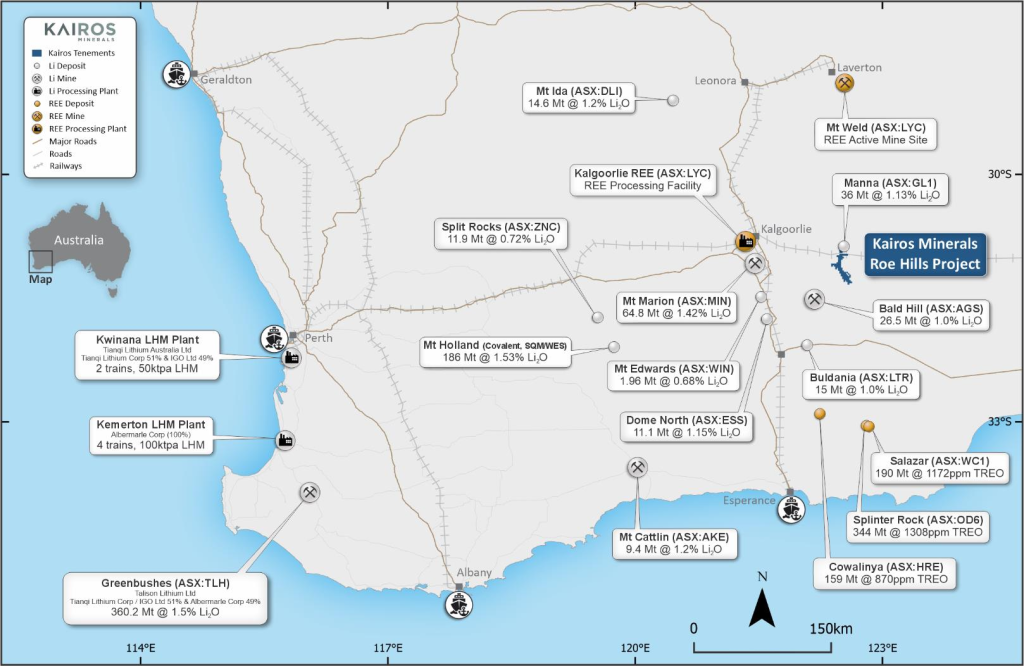
The Black Cat prospect sits 120km east of Lynas Rare Earths’ (ASX:LYC) rare earth processing facility in Kalgoorlie, Western Australia.

Write to Angela East at Mining.com.au 

Images: Kairos Minerals

Add to Watch List:
Author Image
Written By Angela East
Content Director Angela East is an experienced business journalist and editor with over 15 years spent covering the resources and construction sectors and more recently working as a communications specialist handling media relations for junior resources companies.