
MDF Global MDF Global
Apple’s iPhone boom highlights critical minerals powering smartphones•Presenting a united front for Queensland’s copper sector•Thailand seeks Myanmar mine access amid arsenic pollution•Egypt to set up state-backed company to license artisanal gold miners, free detainees•Brixton closes $7.4 million raise for Thorn, Langis projects•Heliostar banks record $78.7 million for Ana Paula push•Mining giants bet billions on 2030 supply crunch•Gunnison Copper reports Q3 output, revenue surge•Triumph Gold targets $15.46 million for Yukon push•African Rainbow Minerals faces a jobs dispute at Nkomati mine•Angola seeks 10% stake in De Beers under Anglo’s proposed exit•Gold price rebounds but heads for biggest weekly loss since June•Teck copper strike reaches BC port as operator sues union•Copper benchmark rocked by miner-smelter tug-of-war•Zimbabwe mining bill targets community, environmental safeguards•Mount Isa critical minerals hub secures Feasibility Study funding•Eramet initiates $814.5 million capital raise to reduce debt•Richemont backs natural gemstones, declines De Beers comment•‘Tis the season for administration as Comlek falls a second time•OceanaGold Philippines trials wireless blasting at Didipio mine Apple’s iPhone boom highlights critical minerals powering smartphones•Presenting a united front for Queensland’s copper sector•Thailand seeks Myanmar mine access amid arsenic pollution•Egypt to set up state-backed company to license artisanal gold miners, free detainees•Brixton closes $7.4 million raise for Thorn, Langis projects•Heliostar banks record $78.7 million for Ana Paula push•Mining giants bet billions on 2030 supply crunch•Gunnison Copper reports Q3 output, revenue surge•Triumph Gold targets $15.46 million for Yukon push•African Rainbow Minerals faces a jobs dispute at Nkomati mine•Angola seeks 10% stake in De Beers under Anglo’s proposed exit•Gold price rebounds but heads for biggest weekly loss since June•Teck copper strike reaches BC port as operator sues union•Copper benchmark rocked by miner-smelter tug-of-war•Zimbabwe mining bill targets community, environmental safeguards•Mount Isa critical minerals hub secures Feasibility Study funding•Eramet initiates $814.5 million capital raise to reduce debt•Richemont backs natural gemstones, declines De Beers comment•‘Tis the season for administration as Comlek falls a second time•OceanaGold Philippines trials wireless blasting at Didipio mine

Jupiter positions Critica with stars

Critica’s (ASX:CRI) wholly owned Jupiter Project in Western Australia is the country’s ‘largest and highest-grade’ clay-hosted magnetic rare earth oxides (MREO) resource from its MREO cut-offs, following a review of the company’s resource. 

The project hosts a resource of 640 million tonnes at 490 parts per million (ppm) MREO with a cut-off of 400ppm, as well as a 2,100ppm total rare earth oxides (TREO) within the greater 1.8 billion tonnes global resource.

Critica, which has a market capitalisation of $40.47 million, is now streamlining a focused development approach by including MREO review results into technical and commercial work for Jupiter, which will prioritise rare earths based on user demand.

Upcoming metallurgical testwork will test the potential for the project to produce mixed rare earth carbonate, with bulk sampling and a resource update to support this program.

A pilot program under scaled operations intends to validate beneficiation and leach performance before progressing to a Scoping Study.
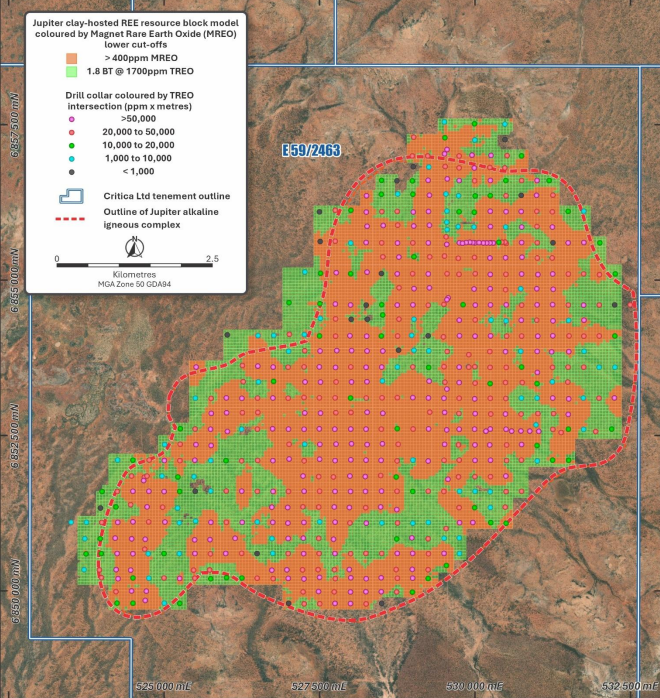
CEO Jacob Deysel says while Jupiter’s resource has always been “compelling”, this update confirms the project’s significance in the neodymium, praseodymium, terbium, and dysprosium space.

“This is a turning point in the Jupiter story. This makes Jupiter Australia’s largest and highest-grade clay-hosted rare earth deposit by both total tonnage and contained MREOs,” Deysel says.

“What sets Critica apart is our approach. We are applying a smarter, more targeted strategy, starting with a beneficiation stage that has upgraded high-value REEs into a small-volume stream while rejecting ~95% of the mined mineralised mass.

“This isn’t just good for economics – it’s the right way to build a modern rare earths business: scalable, responsible, and strategically aligned. Jupiter has the potential to become a cornerstone of Australia’s rare earth supply chain, and we are shaping it for that role from day one.”

Critica is focused on developing its Jupiter Project to meet the global demand for minerals needed in modern technology and for the green energy transition.

Write to Maddison Elliott at Mining.com.au   

Images: Critica

Add to Watch List:
Author Image
Written By Maddison Elliott
Maddison holds a Bachelor of Communication and Journalism, a Bachelor of Business, and a Master of Writing, Editing and Publishing. She enjoys transforming complex information into clear, engaging stories that inform, educate, and connect with readers. Outside of the newsroom, Maddison spends her time reading, exploring new places, catching a game, or spending time with friends and family.