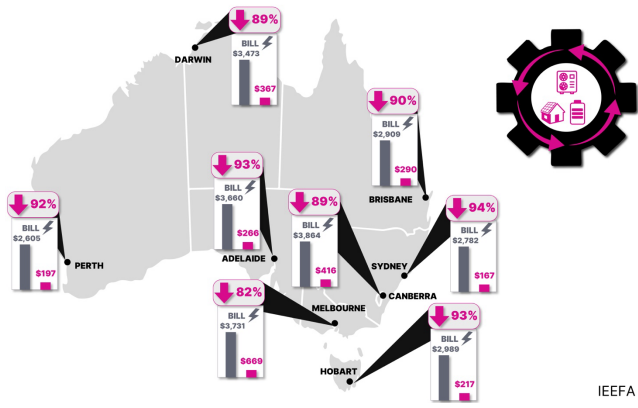
The Institute for Energy Economics and Financial Analysis (IEEFA) has identified a new energy upgrade model that could save households by more than 90% of their residential bills.
By introducing thermal upgrades, efficient electric appliances, solar, batteries, and load-shifting, IEEFA declares this as an effective strategy to mitigate the growing cost of living crisis and reduce greenhouse gas emissions.
IEEFA Energy Finance Analyst Jay Gordon’s model indicates that a large portion of gas-run households are wasting significant amounts of energy to meet basic needs, boosting residential bills and diminishing the country’s gas supply.
“Rapid take-up of solar has driven daytime wholesale electricity costs to record lows, but a combination of rising fossil fuel prices, high network costs and an ageing generation fleet means Australian households continue to see rising energy bills,” says Gordon.
“The response has been dominated by short-term fixes, such as one-off power bill subsidies, or even debates over slowing the rollout of large-scale renewables, in favour of alternatives that would actually increase power prices.
“These debates ignore the fact that our energy bills are not just a product of the price of energy, but also the amount of energy we are purchasing. And reducing the energy households consume from the grid – while using it more smartly – is one of the most effective ways to reduce energy costs.”
Beyond households for greater good
The model extends beyond the intended residential effects and decreases the average household costs, bolstering the country in a time of diminishing gas supply and a changing climate.
Speaking to Mining.com.au, Gordon predicts areas in Australia that rely on residential gas such as Victorica, will see the greater effects of this change expand into local businesses.
“If we’re able to wind that down and reduce that gas consumption, that can actually benefit some industrial users who might not have the option to switch away from gas,” Gordon tells this news service.
“It means even though we’ve got this situation where we might be facing supply shortfalls of gas in the near future, if we can reduce the demand that households are using, that frees up more gas for those businesses to use.”
Call for action
With any drastic lifestyle shift comes barriers, where many are expected to be skeptical or simply unable to cater this household change due to upfront costs or tenancy agreements.
Gordon adds that the federal government is missing an opportunity to broaden general upgrades within its current rebate schemes to install rooftop solar, batteries, and efficient hot water systems, providing greater cost savings and benefits to the energy system.
“One of the benefits of doing these sorts of upgrades at a household level is that it’s often a much lower cost way to transition your whole energy system,” Gordon tells Mining.com.au.
“The more we can do at this household level means we can actually accelerate that transition and potentially reduce some of the need for that large-scale investment in a way that’s really cost-effective for consumers.”
The IEEFA aims to accelerate Australia’s transition into a sustainable energy economy by examining current market trends and policies.
Write to Maddison Elliott at Mining.com.au
Images: Unsplash & Institute for Energy Economics and Financial Analysis