



This article is a sponsored feature from Mining.com.au partner Skyharbour Resources. It is not financial advice. Talk to a registered financial expert before making investment decisions.
Skyharbour Resources (TSX-V:SYH) has spent more than a decade assembling one of the largest and most strategically positioned uranium portfolios in Canada’s Athabasca Basin. The company has ownership interest in 44 projects across 682,100 hectares, including its advanced Moore and Russell Lake uranium projects.
With high-grade targets, major infrastructure nearby, and partnerships with industry heavyweights, including Denison Mines (TSX:DML) and Orano, the company is rolling through 2026 with one of Athabasca Basin’s most active exploration schedules.
Skyharbour and its partner companies have planned more than 30,000m of drilling in 2026, alongside continued portfolio expansion, new joint venture (JV) agreements, a growing prospect generator business, and the addition of top-tier talent across management and the technical team.
As uranium prices strengthen, Skyharbour’s hybrid model — combining focused exploration with a robust prospect-generator platform — is positioning the company for multiple discovery pathways and corporate-scale growth.
President and CEO Jordan Trimble explains that for the better part of the 2010s, the company was able to take advantage of a depressed uranium market.
“That afforded us the opportunity to start building out our project portfolio in the Athabasca Basin in northern Saskatchewan, which is the highest-grade depository of uranium in the world,” Trimble says.
“We were able to acquire these projects at attractive valuations and work towards building one of the most dominant land positions in the region.”
Skyharbour’s projects range from early-stage grassroot exploration properties right through to more advanced-stage exploration assets. The company is actively advancing this portfolio through this hybrid exploration and project generator model.
“We know that there is the potential for these conventional, high-grade, multi-hundred pound uranium deposits, which are quite unique to the Athabasca Basin,” Trimble says.
“You don’t find these kinds of deposits anywhere else in the world.”
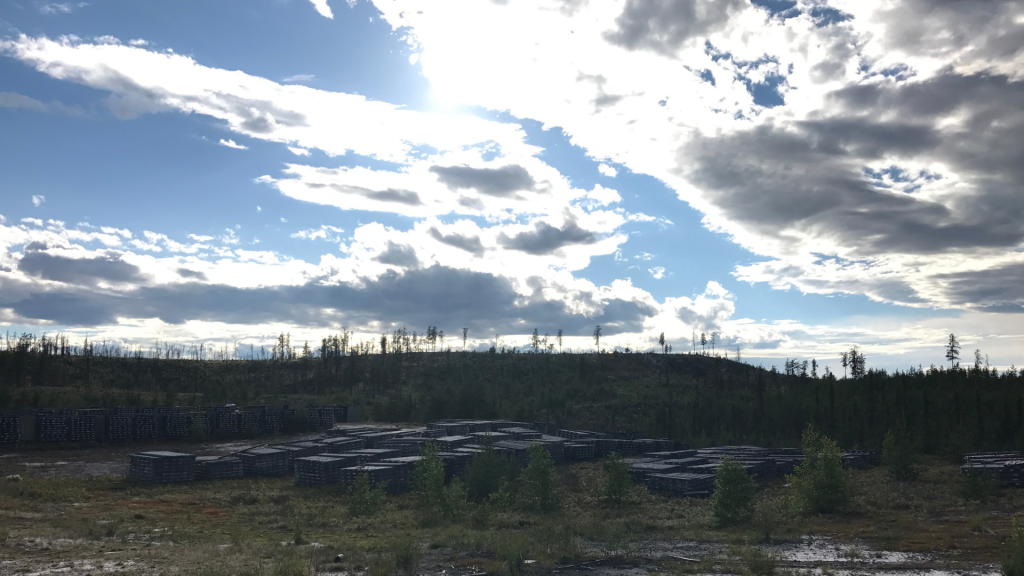
Targeting resource growth at Moore’s Maverick Zone
Exploration work is primarily focused on the company’s two co-flagship projects, Russell and Moore Lake.
Skyharbour owns a 100% interest in Moore, which comprises 12 contiguous claims covering 35,758 hectares. The property itself has seen significant historic exploration with around 140,000m of diamond drilling across over 390 holes.
Trimble points out that the company is focused on the Maverick zone, a small ‘high-grade’ deposit at Moore, where previous drilling returned 6.0% triuranium octoxide (U3O8) over 5.9m, including 20.8% eU3O8 over 1.5m, starting at a depth of 265m.
Skyharbour is planning an 8,000–10,000m multi-phased drill campaign over 15–25 holes at Moore in 2026.
“We’re looking to add pounds there, to expand and delineate that resource, ultimately working towards a development scenario,” Trimble says.
The company has recently completed the first phase of that drill campaign, with a summer/fall program set to commence within the next few months.
Trimble notes that Skyharbour is working on updated technical reports and an internal evaluation for Moore to determine what a development scenario could potentially look like, with new proprietary surface mining methods as part of that consideration.
“We are starting to think about early stage development, but our endgame is to build the company up and ultimately position it for a larger corporate transaction,” Trimble says.
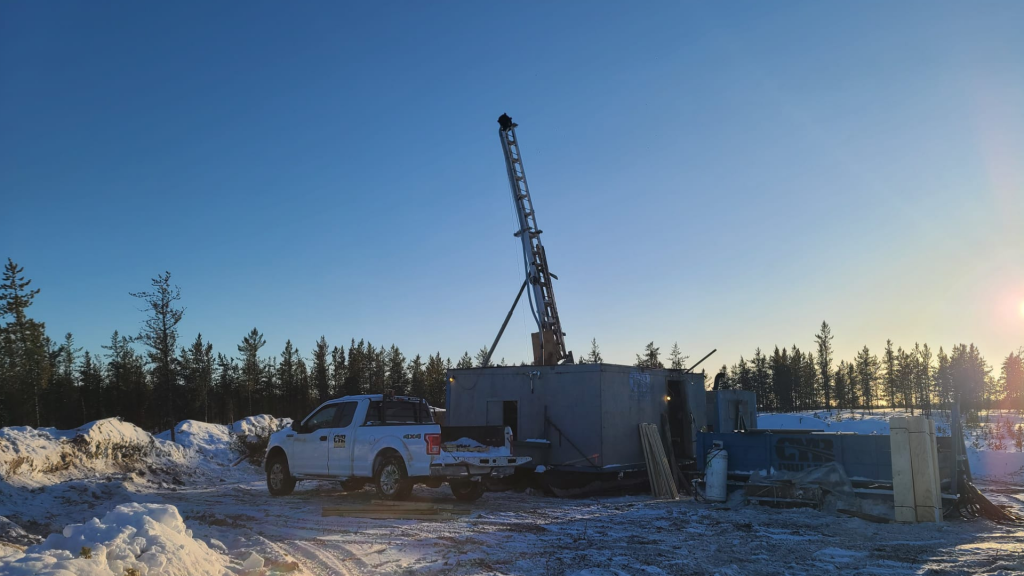
Russell Lake JV supercharges Basin discovery potential
Adjacent to Moore is the Russell Lake Uranium Project, which is another advanced-stage exploration asset covering 73,293 hectares in the southeastern portion of the basin.
In December 2025, Skyharbour closed a definitive strategic agreement at Russell with Denison Mines, representing up to C$61.5 million ($62.7 million), which included C$10 million to buy out Rio Tinto’s (ASX:RIO) minority interest in the project.
Russell has been divided into four separate JVs, including RL (80% owned Skyharbour), Getty East (initial 70% owned by Skyharbour), Wheeler North (initial 51% owned by Skyharbour), and the Wheeler River Inlier Claims (30% owned by Skyharbour). The JV agreement allows for Denison to earn up to 70% interest in Wheeler North and Getty East through option agreements.
Trimble notes that the majority of the funding will help to advance exploration over the coming years, through non-dilutive means.
“Skyharbour and Denison will work collaboratively as JV partners, with the geological teams from both companies coming together as a unit to expedite the discovery process with as little equity dilution as possible to Skyharbour,” Trimble explains.
“Having a multibillion-dollar strategic partner in Denison alleviates the need for us to continuously raise money to fund exploration at the project.”
“It’s a fantastic deal for our shareholders and it helps to clear the path forward for much larger annual exploration programs at the Russell Lake Project.”
Trimble says that Russell Lake is in a premier area, strategically situated between Cameco’s (NYSE:CCJ) Key Lake mill to the south and its McArthur River mine to the north, the Moore Uranium Project to the east, and Denison’s Wheeler River Project to the west.
A key advantage is Russell Lake’s proximity to Denison’s Wheeler River Project, home to the high-grade Phoenix deposit, which is expected to become the next new major uranium mine in the Athabasca Basin.
“Phoenix is less than 1km from our property boundary and so there’s a strategic importance in the location,” Trimble says.
Russell Lake also benefits from road access via Highway 914, which runs through the western extent of the property, along with a high-voltage power line and a sizable exploration camp.
In 2026, Skyharbour and Denison are planning more than 15,000m of combined drilling across three of the four JVs at Russell Lake — Wheeler North, RL, and Getty East.

Prospect generator model powers Basin-wide activity
Skyharbour’s prospect generator business is a key differentiator from its peers, enabling the company to advance its other projects through strategic partners.
“We bring in partner companies that we can option, JV, or sell our secondary and tertiary projects to,” Trimble says.
“We now have 10 partner companies spending around C$120 million in combined project consideration including exploration funding across these projects.”
Through these agreements, Skyharbour typically receives cash and share payments from its partner companies.
In addition to Denison, one of Skyharbour’s other large strategic partners is Orano, France’s largest nuclear and uranium mining company. Orano is planning a summer drill program at the Preston Lake Uranium Project in the southwestern Athabasca Basin, where it holds a 79.2% interest, with Skyharbour owning the remaining 20.8%.
Trimble stresses that the benefits of Skyharbour’s prospect generator business are extensive.
“First, it ensures that this vast portfolio of projects is actively being advanced, generating more news flow and catalysts, and the potential for a rerate of Skyharbour’s valuation,” Trimble says.
Receiving cash and share payments from partner companies helps keep Skyharbour’s equity dilution in check.
“It also allows us to collaborate with other geological and technical teams, working hand-in-hand with our partners which usually leads to increased success and better odds of making a discovery,” Trimble says.
“Last, but not least, this hybrid corporate strategy is a unique feature and offers an investment proposition that not many other uranium companies can offer.”
The optionality provided by the prospect generator business gives investors exposure to the significant upside associated with ‘high-grade’ discoveries of the large deposits only found in the Athabasca Basin.
Trimble does stress though that even with this hybrid strategy, Skyharbour is first and foremost an exploration company.
“The most meaningful value appreciation will come from new discoveries and drilling, in addition to rising uranium prices,” Trimble notes.
The prospect generator business evolved over the last decade as Skyharbour Resources built its large property package and initiated a focus on unlocking value across its portfolio with limited equity dilution.
Pro-nuclear policy strengthens Canada’s uranium sector
This focus on building a strong exploration business is helped by the Canadian Government’s positive stance on nuclear energy. Nuclear power supplies around 15-20% of the country’s electricity including over 50% of Ontario’s electricity. The province is also building its first small modular reactor at the Darlington Nuclear Generating Station, north of Lake Ontario, which is expected to add significant capability to the grid in the coming years.
“Canada is very pro-nuclear,” Trimble says.
“The federal government announced its aim to boost the nuclear sector recently, with up to 10 new domestic reactors, and to expand the country’s international nuclear footprint.”
Canada is also one of the largest global producers of uranium, with all of it coming out of Saskatchewan’s Athabasca Basin.
Trimble highlights that the basin, and Saskatchewan in general, is a great place to work, with a clear and process-driven permitting system. There is also the benefit of flow-through financing and tax breaks for exploration, whereby juniors can raise money at lower costs of capital.
“Most of our financings over the last decade or so have been through flow-through raises, whether it’s traditional flow-through or charity flow-through, it’s at premiums to the prevailing market prices,” Trimble says.
“This provides a big boost, especially for exploration and early-stage development companies.”
Building momentum in the Athabasca Basin
Skyharbour’s near-term milestones are anchored by its immense drill programs, with over 30,000m across six projects planned in 2026.
Roughly one-third of that is already completed, with the remainder scheduled through year-end. Trimble says that investors can expect steady news flow as assays are released, JV programs advance, and additional property transactions are negotiated and announced.
Skyharbour continues to expand its portfolio through low-cost online staking using its proprietary in-house platform, allowing the company to monitor all the claims in the Athabasca Basin including exploration spending on them and their expiry timelines.
Corporate development is also accelerating, with a plan to uplist in the USA, all while strengthening its leadership team with new appointments, including a new CFO, Amanda Chow, and a new director, Rob Chang.
Chang brings nearly 30 years of experience to the role, having previously served as managing director and head of metals and mining at Cantor Fitzgerald and as director of Fission Uranium prior to its US$1.1 billion ($1.6 billion) acquisition by Paladin Energy (ASX:PDN) in 2024.
Trimble notes that one of the biggest catalysts at the moment is the strengthening uranium market.
“As a junior uranium company, Skyharbour is poised to benefit quite a bit in the latter part of the bull market,” Trimble says.
“As a one-stop shop for high-grade uranium exploration and prospect generation in the Athabasca Basin, Skyharbour provides investors additional torque and leverage to that rising uranium price.”
Trimble emphasises that Skyharbour’s value proposition is rooted in the scale and quality of a project portfolio built patiently over more than a decade. The company also offers exposure to potential ‘high-grade’ discoveries capable of rapidly transforming an explorer into a multibillion-dollar developer — a dynamic that has played out before in the Athabasca Basin.
The company’s strategic partners provide institutional validation, while management’s active purchasing of shares and Denison’s position as Skyharbour’s largest shareholder underscore confidence in the company’s trajectory.
With a strengthened technical team led by former Denison geologist Serdar Donmez, a robust prospect-generator platform, and multiple advancing exploration fronts, Skyharbour Resources is positioning itself as a go-to name for high-grade uranium exploration in Canada’s Athabasca Basin.
Write to Amy Rotman at Mining.com.au
Images: Mining.com.au, Skyharbour Resources


