
MDF Global MDF Global
Apple’s iPhone boom highlights critical minerals powering smartphones•Presenting a united front for Queensland’s copper sector•Thailand seeks Myanmar mine access amid arsenic pollution•Egypt to set up state-backed company to license artisanal gold miners, free detainees•Brixton closes $7.4 million raise for Thorn, Langis projects•Heliostar banks record $78.7 million for Ana Paula push•Mining giants bet billions on 2030 supply crunch•Gunnison Copper reports Q3 output, revenue surge•Triumph Gold targets $15.46 million for Yukon push•African Rainbow Minerals faces a jobs dispute at Nkomati mine•Angola seeks 10% stake in De Beers under Anglo’s proposed exit•Gold price rebounds but heads for biggest weekly loss since June•Teck copper strike reaches BC port as operator sues union•Copper benchmark rocked by miner-smelter tug-of-war•Zimbabwe mining bill targets community, environmental safeguards•Mount Isa critical minerals hub secures Feasibility Study funding•Eramet initiates $814.5 million capital raise to reduce debt•Richemont backs natural gemstones, declines De Beers comment•‘Tis the season for administration as Comlek falls a second time•OceanaGold Philippines trials wireless blasting at Didipio mine Apple’s iPhone boom highlights critical minerals powering smartphones•Presenting a united front for Queensland’s copper sector•Thailand seeks Myanmar mine access amid arsenic pollution•Egypt to set up state-backed company to license artisanal gold miners, free detainees•Brixton closes $7.4 million raise for Thorn, Langis projects•Heliostar banks record $78.7 million for Ana Paula push•Mining giants bet billions on 2030 supply crunch•Gunnison Copper reports Q3 output, revenue surge•Triumph Gold targets $15.46 million for Yukon push•African Rainbow Minerals faces a jobs dispute at Nkomati mine•Angola seeks 10% stake in De Beers under Anglo’s proposed exit•Gold price rebounds but heads for biggest weekly loss since June•Teck copper strike reaches BC port as operator sues union•Copper benchmark rocked by miner-smelter tug-of-war•Zimbabwe mining bill targets community, environmental safeguards•Mount Isa critical minerals hub secures Feasibility Study funding•Eramet initiates $814.5 million capital raise to reduce debt•Richemont backs natural gemstones, declines De Beers comment•‘Tis the season for administration as Comlek falls a second time•OceanaGold Philippines trials wireless blasting at Didipio mine

Heavy Minerals halts trade ahead of announcement

Heavy Minerals (ASX:HVY) is in a trading halt pending the release of an announcement and expects to be trading again on the Australian Securities Exchange (ASX) on Wednesday 14 February.

The company’s 100% owned flagship Port Gregory Garnet Project is a 226km-square Western Australian tenement containing a JORC compliant Mineral Resource Estimate (MRE).

Heavy is embarking on a Prefeasibility Study (PFS) of the project with project permitting now underway and a wors program being finalised for Q2 2024.

The Port Gregory Garnet Project is in the established mineralogical terrain of the Hutt River Garnet area within the Shire of Northampton in the mid-west coastal region of Western Australia.

It is situated some 45-60 km north of Geraldton, 45-65 km south of Kalbarri, and 40 km north-west from Northampton. The Port Gregory Garnet Project borders GMA’s active Port Gregory garnet mine and the RDG Lucky Bay mine.

The tenements are located over an area of heavy mineral deposits in Western Australia which are ultimately, but indirectly, derived from the weathering of crystalline igneous rocks in the Archean Yilgarn Block.

Heavy mineral grains derived from the Yilgarn Block were initially deposited in thick sequences of Mesozoic sediments that filled the Perth Basin. The tenement area lies in the most northerly part of the basin, on the western side of the Northampton Block.

The Tamala Limestone, a belt of coastal limestone extends up to 8km inland. It is composed of eolianite, which accumulated originally as coastal sand dunes in the late Pleistocene. This has developed over a basement of late Cretaceous age Winning Group sediments which can be seen outcropping near Yanganooka Well.

A number of erosional scarps have been developed on the seaward side of the Tamala Limestone, one of which is equivalent to the strand-line mineralisation to the south. Fossil crescent dunes can also be distinguished on top of the large, massive limestone area which may be of early Pleistocene age.

The sands contain significant localised enrichments of heavy minerals, notably garnet (almandine variety) and to a lesser extent ilmenite. The heavy minerals are thought to be derived from garnet-bearing Precambrian Granulites and migmatites of the Northampton Shield. The sands appear to have been deposited when the sea level was about 6m higher than today, possibly during the last interglacial peak.

Write to Adam Orlando at Mining.com.au

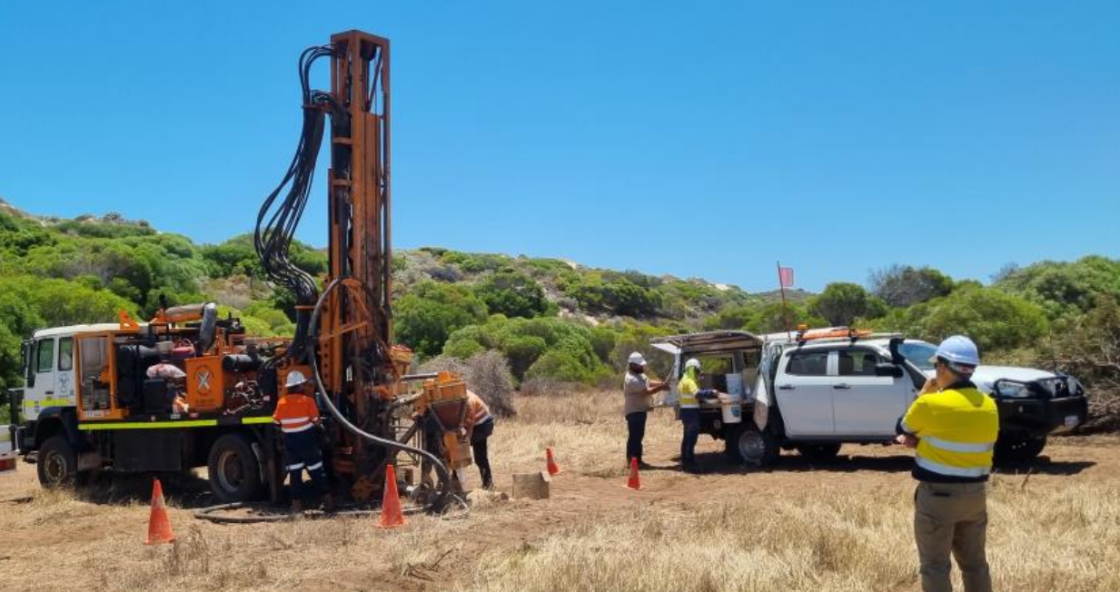
Images: Heavy Minerals

Add to Watch List:
Author Image
Written By Adam Orlando
Mining.com.au Editor-in-Chief Adam Orlando has more than 20 years’ experience in the media having held senior roles at various publications, including as Asia-Pacific Sector Head (Mining) at global newswire Acuris (formerly Mergermarket). Orlando has worked in newsrooms around the world including Hong Kong, Singapore, London, and Sydney.