



Hamelin Gold (ASX:HMG) is taking a modern exploration approach to a prospective yet largely underexplored landholding in the Tanami Gold Province in Western Australia.
Speaking to Mining.com.au on the sidelines of the Brisbane Mining Investor Conference, Managing Director Peter Bewick says the region has had ineffective historical drilling and needs new exploration techniques to better understand the regolith and structural controls of the area.
The MD tells this news service the company fortuitously discovered ‘high-grade’ gold mineralisation in the first diamond drillhole at the Sultan prospect at its West Tanami Gold Project. Drillhole TSD0007 was designed to test for a bedrock gold source beneath the western end of the 2 surface gold anomalies along the southern limb of the Afghan antiform, and to provide information on the geological and structural architecture in this underexplored region.
TSD0007 collared in coarse clastic sediments before intersecting zones of faulting and brecciation, and zones of quartz veining and granitoid intrusives. Bewick says gold mineralisation is hosted within a series of brecciated and deformed quartz veins with best results coming in at 7.6m @ 3.2g/t Au from 326.2m, including 1.1m @ 15.9g/t Au from 329.7m. This has strong bismuth association of 100ppm Bi per 1g/t Au.
The mineralised quartz veins intersected in TSD0007 represent a new zone of ‘high-grade’ gold mineralisation along a geological contact not targeted by previous explorers, which the MD adds further validates Hamelin’s exploration strategy.
“The question is – were we just the luckiest guys in the world and just stuck one hole into one part of this system, or is it just part of a much bigger footprint?”
“The question is – were we just the luckiest guys in the world and just stuck one hole into one part of this system, or is it just part of a much bigger footprint? And my view is that you can’t get that lucky that quickly. Our view is that we are lucky to find results like that and I expect many more. Probably better and probably some worse. But that’s a gold system and we think we’re onto one and we think it’s really exciting.”
Hamelin started an R&D program in 2022 to evaluate the effectiveness and applicability of novel surface geochemical techniques to its gold exploration. A second study program investigated the mobility and behaviour of potential pathfinder elements in the deeply weathered and leached regolith profile in the West Tanami.

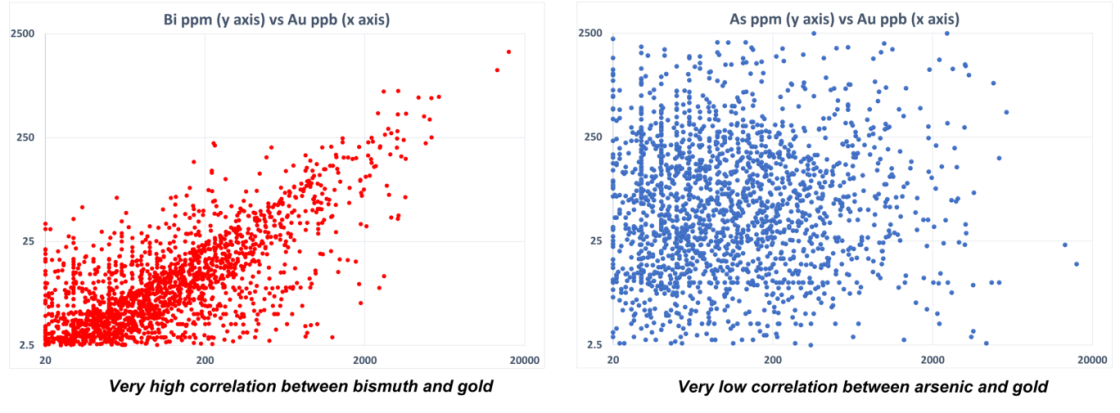
Historically arsenic has been the preferred gold pathfinder element of past explorers. Hamelin recently conducted a review of available geochemical data demonstrating that arsenic correlates very poorly with gold mineralisation in the Tanami and does not offer a reliable or accurate indicator.
Analysis of all multi-element geochemical data instead identified that primary gold mineralisation in the West Tanami has a ‘remarkably’ high correlation with bismuth. About 30% of all surface geochemical and drillhole samples in the company database have been analysed for bismuth. Bismuth is highly immobile in the weathering environment, meaning it does not get extensively leached away or reprecipitated during weathering processes, and is considered a proven pathfinder element to gold mineralisation.
Given the company’s large 2,500km-square tenure in the region, the MD notes to Mining.com.au that this unique bismuth-gold correlation in a province prospective for tier-one gold and for rare earth element deposits is exciting.
The region hosts Newmont’s (NYSE:NEM) 14 million-ounce Callie operations and the Browns Range REE deposit. Hamelin’s West Tanami project is a belt-scale greenfields opportunity hosting the same geology and key structures as Callie with minimal modern exploration completed across the company’s landholdings.
“We do hold a very large land position in an extremely well-endowed goldfield, but the goldfield we’re in is actually not that well known globally. So, the Tanami region of the Northern Territory and WA hosts one of the world’s absolute giant gold deposits in Newmont’s Callie mine. It’s the lowest cost gold producer in the world, over half a million ounces per annum, up to 700,000oz coming up with their expansion studies. So, it’s a truly world-class giant.
“This is the sort of place in Australia where you will find the next giant”
But it’s still an unknown belt. And I think our story is a little bit emerging and unknown because of that sort of lack of position, of that of nuanced operations in the market itself. This is the sort of place in Australia where you will find the next giant. It’s a very underexplored part of the world and we’re changing that story with some smart, really modern exploration into a belt that’s really been unloved.”
To date, Hamelin has drilled a 10km section of ground never drilled before on the concept of the bismuth and gold association. The company managed to hit high grades early, which he says is incredible given it’s the first test of this new idea and concept.
“We’re in the desert country of the Tanami, so a lot of very little rock sticking out of the ground, lots of flat sand in long directions. You really have to understand what one of these big deposits would look like in the sort of environment that we’re exploring in. It’s a very subdued gold footprint, very, very low levels. You can see the same in other desert environments, so lots of sand washing through that area means that everything gets diluted and quite subdued.
So, the gold footprint at surface is subtle, but what we found is that these deposits have a very, very high bismuth footprint. It’s an association of metals and the bismuth doesn’t get washed away, doesn’t get sort of knocked out of the system as quickly as gold does. We’ve identified a suite of these strong bismuth anomalies. We know bismuth and gold are one for one. They occur almost uncannily in really local conditions together.
We’ve now identified a suite of these surface bismuth anomalies that we know have a gold footprint or gold halo. And we’re drilling some of the first drillholes into basement rock, into some of these big anomalies and we’ve learned a lot about how to explore up there, we’ve learned know what to look for. Now this year is going to be really testing some of those ideas.”
The company’s 2023 field program starts in April initially with RC drilling and surface geochemical programs at Sultan and Fremlins prospects. Regional aircore programs are then planned for a number of the new, high priority camp scale targets across the project. The initial 2023 campaign includes RC drilling up dip and along strike of TSD0007 at Sultan; RC drilling of the Eastern Corridor at Fremlins; surface geochemical programs at Fremlins South and along the Sultan and Far SW Corridors; and aircore drilling at Newkirk and Olsen prospects.
On 16 March, the company reported a series of new camp scale gold targets identified in the West Tanami. Bewick adds that Hamelin will have a drill rig on site more days than not in the next 6 months, starting from late April, with a potential second rig on site for a period of time.
“The idea is to be consistently active for the next 6 months. It’s the best time of year to be operating up there and 25,000m of drilling will go on the ground. As I said, a lot of air core and RC shallow drilling with some targeted deeper diamond drilling and deeper RC as well. So, yeah, some really good ideas and really good and really large-scale targets here.”
Longer term, the MD says Hamelin’s primary goal is to become a gold producer and ultimately, the company is looking for multimillion-ounce scale projects.
Write to Adam Orlando at Mining.com.au
Images: Hamelin Gold Ltd


