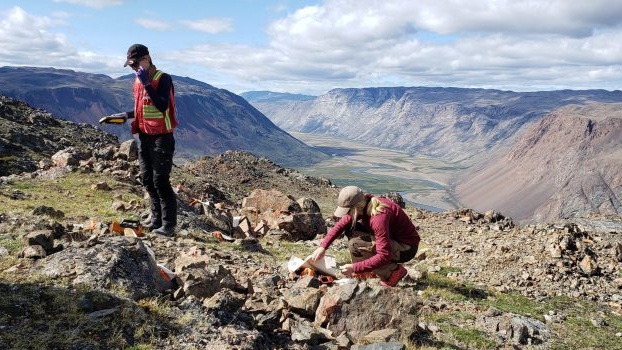
Greenland Mines (NASDAQ:GRML) has released a new resource estimate for its Sarfartoq Rare Earths Project, further strengthening its position as a potentially significant source of neodymium-praseodymium (NdPr) outside China.
According to the company, the update marks Sarfartoq’s first indicated resource under US Securities and Exchange Commission (SEC) reporting standards in the project’s more than 15-year exploration history.
It also provides the first resource estimate combining open-pit and underground mining scenarios for the ST1 deposit.
Previous technical work at Sarfartoq assessed ST1 under separate open-pit and underground scenarios, with the underground scenario reporting indicated resources only under Canadian standards.
The latest technical report, prepared by Tetra Tech Canada and GeoSim Services, combines the potential mining scenarios under the SEC’s S-K 1300 reporting standards.
“This is a defining moment for Greenland Mines and for Sarfartoq,” President Bo Møller Stensgaard says.
“Working with the most respected independent names in the industry, we have converted a project with tremendous historical promise into a modern, S-K 1300-compliant resource for the ST1 deposit.”
Resource grows
Under the hybrid mining scenario, which Greenland Mines describes as the “most representative view of Sarfartoq’s development potential”, ST1 hosts an indicated resource of 6.9 million tonnes (Mt) grading 1.6% total rare earth oxides (TREO).
A further 5.3Mt grading 0.96% TREO sits in the inferred category.
Based on the new estimate and 2025 consumption levels, Greenland Mines calculates that the project contains approximately 40,700 tonnes of neodymium and praseodymium (NdPr) oxide across all resource categories. This would be equivalent to roughly five years of NdPr oxide refined outside China in 2025.
Previous technical reports completed in 2012 outlined an indicated resource of 5.88Mt grading 1.77% TREO and an inferred resource of 2.46Mt grading 1.59% TREO.
Larger system
The company notes that the new resource covers only the ST1 zone, representing less than 1% of Sarfartoq’s 191km² licence area in southwest Greenland.
Five other known occurrences — ST40, ST19, ST24, ST31, and ST43 — have returned significant rare earth results but remain largely untested and undeveloped, according to the North Carolina-based miner.
Greenland Mines says additional early-stage exploration targets have also been identified across the broader complex.
The company acquired the Sarfartoq project licence in May from stakeholders including Canada‘s Neo Performance Materials (TSX:NEO).
As part of the transaction, Neo will become a Greenland Mines shareholder and retain offtake rights over up to 60% of future production from Sarfartoq.
The Government of Greenland approved the transfer of the licence last week.
Initial assessment next
Greenland Mines now plans to complete an updated initial assessment, the S-K 1300 equivalent of a preliminary economic assessment (PEA), incorporating the latest resource.
Stensgaard says the project could eventually play a role in diversifying Western supplies of rare earth magnet materials.
“Sarfartoq has the potential to change the Western rare earths landscape for the magnet metals the world’s electric vehicle, wind, and defence industries urgently need,” he says.
“With an indicated resource now on the books for the first time, a validated hybrid mining approach, and a clear line of sight to our initial assessment, we believe Sarfartoq can move quickly through its next stages of development.”
Greenland Mines is also focused on the exploration and development of the Skaergaard Project in southeast Greenland.
Write to Jackson Chen at Mining.com.au
Image: Hudson Resources