



Kinross Gold (TSX:K) is taking the next steps in permitting process approvals having completed a Preliminary Economic Assessment (PEA) for the Great Bear Project located in Red Lake, Ontario in Canada.
The PEA supports the company’s acquisition thesis of a “top tier high-margin operation in a stable jurisdiction with strong infrastructure”, Kinross Gold reports.
Kinross is continuing to progress work across the project for both the advanced exploration program (AEX) and the main project. Both remain subject to permitting, which continues to advance.
AEX permitting is a provincial process and Kinross is working with the authorities on finalising permits.
The main project’s permitting is mainly a federal review process driven by the Impact Assessment Agency of Canada (IAAC), with some provincial permitting components. An Impact Statement is currently in process and is expected to be submitted to the IAAC next year.
The company is targeting to start surface works in 2024, subject to receiving provincial permits.
Kinross has also actively engaged and consulted with Indigenous communities and organisations and has started negotiations of a project agreement with its First Nations partners Lac Seul and Wabauskang.
Based on mineral resources drilled to date, the PEA outlines a “high-grade” combined open pit and underground mine with an initial planned mine life of about 12 years and production cost of sales of C$594 per ounce.
The project is expected to produce more than 500,000 ounces per year at an all-in sustaining cost (AISC) of US$800 ($1,201) per ounce during the first eight years through a conventional, modest capital 10,000-tonne-per-day (tpd) mill.
The total initial construction capital is forecast to be US$1.2 billion. Capitalised mine development prior to commercial production is expected to be about US$250 million, comprising US$105 million related to open pit mining and US$143 million related to underground capital development, which will support higher production in the early years.
The majority of the capitalised open pit mining is driven by the strategic decision to pull forward mining of the Viggo pit during construction to provide low-cost construction rock, early mill feed and a robust in-pit solution for the tailings concentrate.
The company says the project’s capital requirements are expected to be manageable for Kinross and are forecasted within its planned annual capex profile in the range of US$1 billion.
“Kinross is confident it can continue to prioritise its investment grade balance sheet and comfortably fund Great Bear, along with other planned capital spending,” the company reports.
Kinross has also released an updated mineral resource estimate increasing the inferred resource by 568,000oz to 3.884Moz, which is in addition to the existing measured and indicated resource estimate of 2.738Moz.
The PEA demonstrates an initial life-of-mine of some 12 years with total production of 5.3Moz of gold.
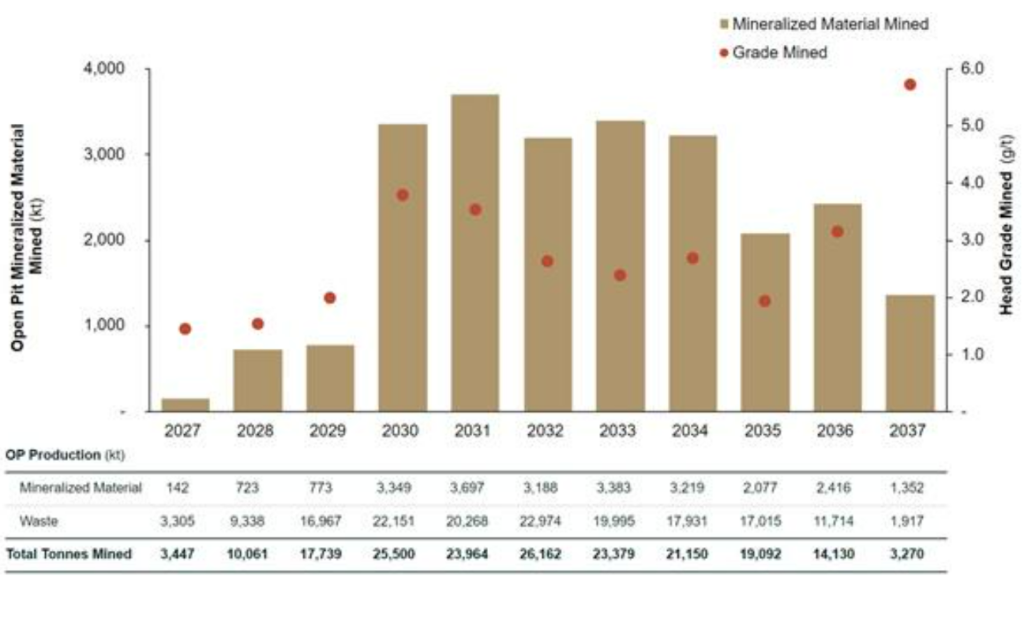
The open pit will be mined with a dual fleet strategy to provide selective mining of the high-grade material and lower cost mining of the waste, mining a peak of 26Mt of material, and providing a peak of 9,000 tpd of mineralised material.
For the underground, the primary mining method is long hole open stoping with paste backfill and cemented rock fill.
First stope production is expected to begin in 2029, subject to permitting, and to continue for 12 years with a peak production rate of 6,000 tpd, with potential to expand beyond this run rate as extensions to the underground resource are targeted.
Write to Adam Orlando at Mining.com.au
Images: Kinross Gold Corp


