



Consider it a tricky spot to be running a pure gold fund right now.
That’s where the team at the L1 Capital Gold Fund (ASX:LGF) finds itself right now.
Gold prices have fallen over the last three months. That makes delivering investors any ‘alpha’ almost impossible.
Resource market participants can’t help but wonder: is the gold structural bull market over?
It could be. Nothing is certain in financial markets.
Yet LGF is maintaining that the current dip is a temporary setback. It sees the longer term gold uptrend reasserting itself at some point.
Let’s look at some of the evidence it presents.
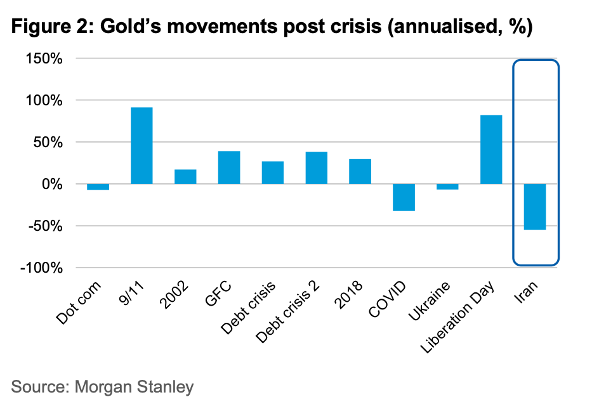
LGF attributes the current gold sell-off to the elevated volatility in markets that the Iran conflict induced. This reversed expected US rate cuts in 2026 and led to a strengthening US dollar.
It also sees the drawdown as atypical compared to previous ‘crises’ over the last 25 years.
You can see that in the graph below:
Two countries also contributed to the pressure on the gold price via sales (Türkiye) and higher import taxes (India).
A dominant driver of gold’s bull run over 2024 and 2025 was the ‘debasement’ trade. Higher rates and a stronger US dollar negate this narrative — for now.
That’s not all.
The excitement and profit in the US AI sector has drawn in record levels of foreign investment.
The gold trade — and many others, for that matter — is taking a back seat. Gold exchange traded funds (ETFs) have leaked investors, at least in North America.
What about the longer term?
All the factors mentioned above are clearly present but not necessarily enduring indefinitely.
LGF sees the biggest consideration of all to be the state of US federal debt. US interest payments on the federal debt are already US$1 trillion ($1.4 trillion) per year. This should make it difficult for the Federal Reserve to raise rates precipitously.
Implied in this view is that real rates are likely to be negative over the longer term, a factor that’s traditionally a tailwind for gold.
This also helps sustain a strong driver of the current gold market, which is central bank buying, especially in China. LGF sees this trend continuing.
Nobody can know whether time will prove LGF correct. As it stands today, the Australian dollar gold price at approximately $5,760 per ounce remains well above the Australian industry cost of production of between $2,500–3,000.
That leaves free cash flow to fund further gold developments and exploration.
It’s not just via gold production that the gold mining sector can create value. There’s also exploration and development too.
Some ASX gold projects in this sector include Sunshine Metals (ASX:SHN) in North Queensland, Antipa Minerals (ASX:AZY) in Western Australia, and Aguia Resources (ASX:AGR) in South America.
Juniors like these are likely to remain of high interest to precious metal investors if the gold price holds steady or, as LGF expects, reasserts higher in time.
Write to Callum Newman at Mining.com.au
Images: L1 Capital & Antipa


