

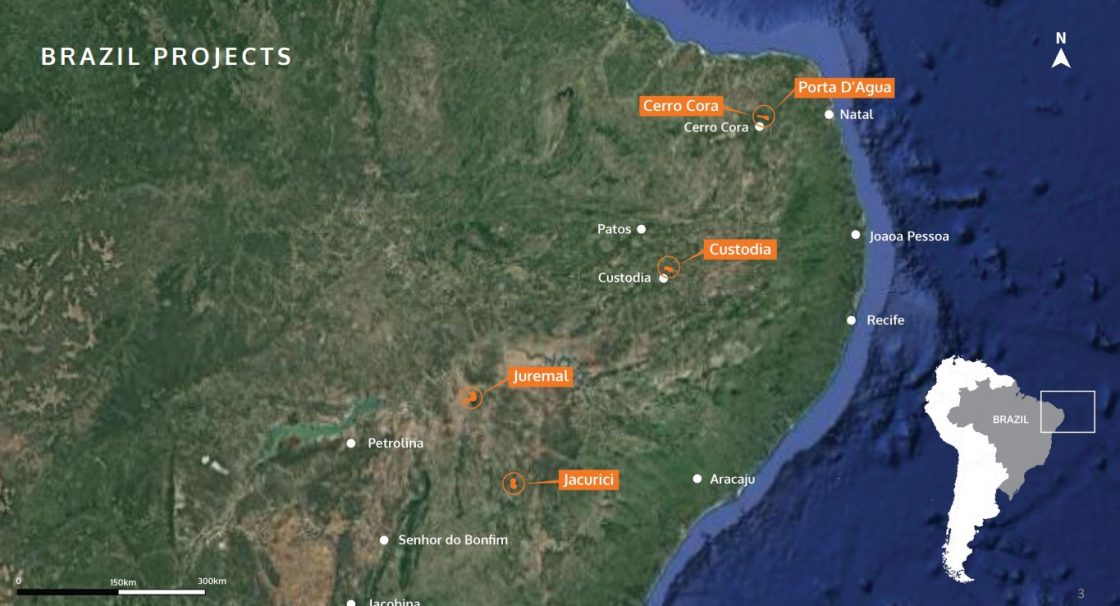
Gold Mountain (ASX:GMN) reports 10 of 28 rock chip samples collected from the Juremal, Cerro Corá and Porta D’Agua projects by Mars Mines geologists from an initial due diligence program in October 2022 contain values of greater than 100ppm Li2O.
The company reports the values when surface leaching and weathering is taken into account, are considered to be anomalous.
These results support the results released by Gold Mountain in November 20221 which indicate that LCT bearing pegmatites are prevalent in all the JV project areas.
Results also indicate that trace elements (Ce, Ta, Nb) related to LCT pegmatites are associated with the anomalous Li2O, samples but their concentrations vary between project areas and within each project area, which is a function of pegmatite field zoning and also the differences between pegmatite fields and the progenitor granite intrusive.

Addressing the results, Gold Mountain’s Chief Executive Officer and Executive Director Tim Cameron says: “This is a good start for the Mars Mines and Gold Mountain JV. These results combined with the results we announced in November 2022 for the Juremal and Custodia projects show that the tenements we have picked up have the potential to host LCT bearing pegmatites.
This is early days in our exploration program, but it is encouraging to see several anomalous rock chip results returned from the initial reconnaissance program with samples assaying up to 0.08% Li2O. I am especially encouraged by the statement by the Mars geologists that with additional mapping and rock chip sampling both the Juremal and Custodia projects can be rapidly advanced towards drill testing.
“I am expecting that 2023 will be a pivotal year for GMN and with lots of effort and commitment the company will advance its Brazilian lithium projects towards a significant discovery”
I am expecting that 2023 will be a pivotal year for GMN and with lots of effort and commitment the company will advance its Brazilian lithium projects towards a significant discovery.”
Gold Mountain notes in order to determine the optimum and most cost-effective sample methodology, the rock chip samples were analysed using both sodium peroxide fusion and ICP (ICP90A) and by 4 acid digest and ICP methods (ICM40B) by 2 different laboratories.
Results were similar from both laboratories using both methods. The 4-acid digest methodology does not necessarily extract all the lithium from the rock samples and can give slightly lower Li readings than the sodium peroxide fusion method, but it is considered by Mars Mines geologists to be appropriate for all early-stage exploration.
However, the more accurate ICP90A methodology should be used for assaying drill samples which may later be used for resource estimation.
The company says on analysing and interpreting the assay data, it was noted that the degree of weathering, the amount of erosion as well as the depth from surface a sample was collected from, makes an impact on what constitutes an important anomalous result in a particular area.
Each area must be treated on its own merits when interpreting the lithium results.
The results for Juremal and Custodia are considered by Mars Mines geologists to be very encouraging and indicate that with focused mapping and sampling campaigns the Juremal and Custodia Projects could rapidly be progressed to the drilling stage.
Gold Mountain says samples taken in the Porta D’Agua project were of fresh rock from one pegmatite and show that, although the pegmatites are LCT type, the sampled pegmatite is not in the highly lithium productive zone that may exist in the large swarm of pegmatites confirmed on the ground.
It is likely that more fractionated pegmatites do occur in the tenement and a planned stream sediment sampling program will assist the company in identifying them. The sample taken on the Cerro Cora tenement was from a pegmatite situated adjacent to the granite contact and was not expected to contain significant mineralisation, provided the granite adjacent to the pegmatite was the source of the pegmatites.
Assay results showed this to be the case, however these results will assist in identifying which parts of the Cerro Cora tenement may contain mineralised pegmatites, thereby focusing future exploration activities.
A stream sediment sampling program planned for Cerro Cora should allow the Company to focus on the parts of the pegmatite field with the most potential for identifying lithium deposits.
Of note is that these samples were collected on a wide spaced short field reconnaissance program, with only a very small portion of the JV project areas being visited. The fact that LCT pegmatites have been identified on the tenements is very encouraging and with more detailed exploration planned, it is considered likely by Mars and Gold Mountain geologists that additional LCT pegmatites will be identified.
Gold Mountain is a mineral explorer with projects based in Brazil and Papua New Guinea (PNG). These assets, which are ‘’highly prospective’ for a range of metals including lithium, copper and gold, are now actively being explored.
Write to Adam Orlando at Mining.com.au
Images: Gold Mountain Ltd