



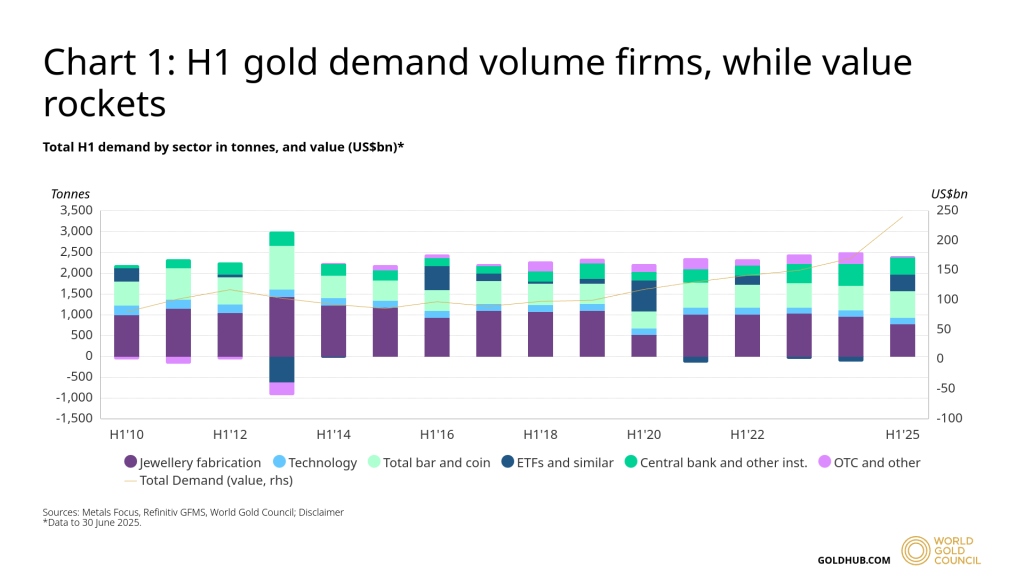
The World Gold Council’s Q2 2025 Gold Demand Trends report reveals that total quarterly gold demand (including OTC) reached 1,249 tonnes, a 3% increase year-on-year amid a high price environment.
Strong gold investment flows largely fuelled quarterly growth, as an increasingly unpredictable geopolitical environment and price momentum sustained demand.
Gold ETFs remain a key pillar of investment demand in Q2 2025, as strong inflows in April and June more than offset a modest pullback in May.
This led to a net quarterly gain of 170 tonnes in global holdings. Asian-listed funds were major contributors at 70 tonnes, keeping pace with US flows.
Combined with record inflows in Q1 2025, global gold ETF demand reached 397 tonnes, the highest first half total since 2020.
Total bar and coin investment also increased 11% year-on-year, adding 307t. Chinese investors led the way with demand reaching 115 tonnes, while Indian investors continued to add to their holdings, totalling 46 tonnes in Q2.
Divergent trends emerged in Western markets as European net investment more than doubled to 28 tonnes while US bar and coin demand halved to 9t in the second quarter.
“Central banks continued to buy, albeit at a slower pace, adding 166 tonnes in Q2 2025,” the World Gold Council reports.
“Despite this deceleration, central bank buying remains at significantly elevated levels due to ongoing economic and geopolitical uncertainty. Our annual central bank survey shows that 95% of reserve managers believe that global central bank gold reserves will increase over the next 12 months.
“Jewellery demand continued to decline with the volume of consumption down 14% and nearing low levels last seen in 2020 during the covid pandemic. Jewellery demand in China was down 20% and Indian demand fell 17% year-on-year.”
However, in value terms the World Gold Council says the global jewellery market increased to a total of US$36 billion.
Total gold supply increased 3% to 1,249 tonnes, with mine production up marginally to a new second quarter record. Recycling increased 4% year-on-year but stayed relatively subdued considering the high price environment.
World Gold Council Senior Markets Analyst Louise Street says global markets have navigated a volatile start to the year marked by trade tensions, unpredictable US policy shifts and frequent geopolitical flashpoints.
“The robust investment activity we have seen in the first half of 2025 underscores gold’s role as a hedge against economic and geopolitical risks,” Street says.
“Ongoing market volatility, coupled with gold’s impressive price performance in recent months, has also generated significant momentum, drawing capital from investors around the globe.
“Gold recorded a remarkable 26% appreciation in the first half of the year in dollar terms, outperforming many major asset classes. With such an impressive start to the year, it is possible that gold could trade within a relatively narrow range in the latter half of 2025.”
Street adds that on the other hand, the macroeconomic environment remains highly unpredictable, which may underpin further gains for gold. Any material deterioration in global economic or geopolitical conditions could further amplify gold’s safe-haven appeal, potentially pushing prices higher still, she continues.
Australian investors embrace gold
Australian gold ETFs saw continued inflows in Q2 2025, adding US$169 million, or 2 tonnes in the quarter. Sustained gold ETF demand in Q2 lifted Australian gold ETFs’ total assets under management (AUM) to US$5 billion and holdings to 47.3 tonnes, both reaching their month-end peaks.
Over the course of H1 2025, demand for Australian gold ETFs totalled 4.8 tonnes while inflows accumulated to US$426.5 million.
During this period, Australian gold ETFs’ total holdings rose by 11.3% and their AUM jumped 39% thanks to a significantly higher gold price and notable inflows.
“Bar and coin demand in Australia also climbed 18% in Q2 year-on-year, underscoring robust retail investment appetite, though it still trails demand depth in more gold-mature Asian markets,” according to the World Gold Council.
“By contrast, Australian jewellery demand fell 10%, a more modest decline than the sharper drops experienced across many Asian markets, highlighting the relative resilience of Australian consumers.
Together, these dynamics contributed to a 6% increase in total gold consumption in Australia during the quarter, year-on-year.”
Shaokai Fan, Head of Asia-Pacific (ex-China) and Global Head of Central Banks at the World Gold Council, says structural shifts continue to favour gold.
These include regulatory approval for Chinese insurers to invest in gold, a persistently weaker US dollar, and a passing of the demand baton from central banks to ETF investors. These factors helped drive a 78% year-on-year surge in global gold investment.
“The investor base for gold is evolving, as are the nature and scale of risks that concern them. ETF investors, typically more passive, are now actively embracing gold as traditional assets appear increasingly vulnerable to a broader set of global risks,” says Fan.
“The old ‘fear of missing out’ is being superseded by a deeper ‘fear of asset debasement’. In Australia and around the world, investors are adapting to a new and far less predictable market regime.”
Write to info@mining.com.au at Mining.com.au
Images: Aguia & World Gold Council

