



Global business leaders are assessing risk management strategies with an emphasis on compliance amid increasing regulations and macroeconomic uncertainty.
BDO’s 10th edition of its global risk landscape report surveys 500 C-suite executives across Asia-Pacific, Europe, Africa, and the Middle East. The report highlights current approaches and responses to the global events altering their risk landscape.
The firm’s findings include businesses now taking a more compliance-led approach to risk management, although the report suggests this can stymie growth opportunities and overshadow real risk management strategies.
According to the report, companies in Asia-Pacific are navigating a risk landscape increasingly defined by crisis and regulatory complexity. However, despite this many are ‘cautiously optimistic’, particularly when it comes to embracing AI as a strategic opportunity to mitigate risk.
Some 74% of global executives believe embedding real risk thinking and strategies into corporate culture might take their risk management from a “box-ticking exercise to real strategies that offer value”.
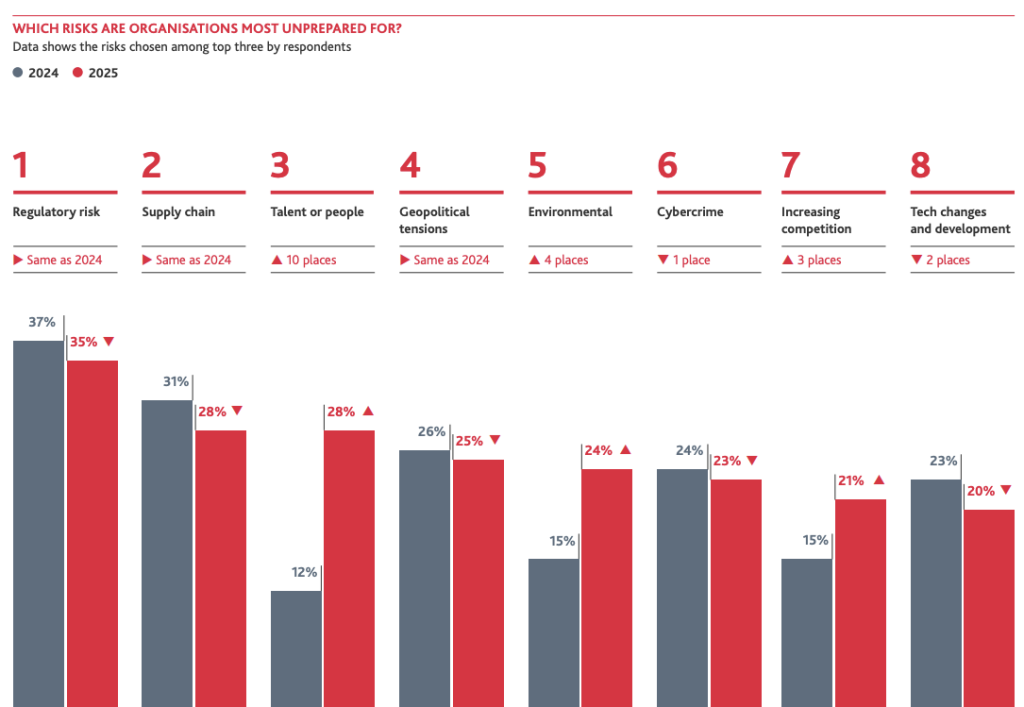
BDO says regulators’ demands for information on risk can help drive risk reduction but only up to a point.
“Companies must not create a box-ticking environment that can distract from real risk management strategies,” the firm says.
Within the region, 84% of Australian businesses ‘alarmingly’ believe the overall risk landscape is fraught by crises more than ever.
BDO’s report highlights Australian companies facing threats from all sides – from increasing regulatory burdens, protracted geopolitical tensions, as well as cyber and fraud risks.
“Interestingly, the perceived risks to businesses in Australia and the APAC region may be easing, with 41% stating their risk velocity increased compared to 54% in 2024,” the report notes.
“This does not mean however, that organisations should become complacent. Due to the uneven regulatory environment, regulatory risk remains a top concern for executives in the APAC region.
“Shifting from a tick-the-box culture to embedding risk thinking into business strategy will assist in aligning risk priorities in upper levels of management and unlock potential growth opportunities for the business.”
BDO reports that while some businesses in the region feel a little unprepared, demands from regulators in terms of risk reporting have rather helped reduce real risk. This is a somewhat different outcome to those surveyed in the Americas and Europe.
Unsurprisingly, ‘people risk’ continues to concern everyone. The most significant change to BDO’s survey results in 2025 is worries about skilled labour. More than 25% of global executives flag this as a top three risk – double the 12% in 2024.
These concerns vary by sector, with healthcare and life sciences, real estate, construction, and technology, media and telecommunication most concerned globally.
Write to Adam Orlando at Mining.com.au
Images: BDO & Unsplash


