


Mining giant Glencore (ASX:GLC) is now trading on the ASX.
This is what’s called a ‘secondary’ listing because Glencore is already listed on the London Stock Exchange (and in Johannesburg).
Glencore is a big firm, with a market capitalisation around $130 billion.
It’s heavily exposed to the ‘real’ economy because it makes its money from a mix of coal and industrial metals.
This gives anyone interested in resources a further way to gain insight or exposure to its core commodities.
Coal is coming back into focus
The energy angle is likely welcome in the current environment. Thermal coal is trading for around US$150 ($215) a tonne.
Both China and India are increasing consumption to help offset high demand and rising LNG costs. Thermal coal was around US$116 in February before the conflict in the Middle East.
The Australian reported recently:
“Global coal demand is forecast to rise by 1.2% in 2026, hitting a new high of 8.94 billion tonnes due to rampant demand from China and ructions caused by the Strait of Hormuz shipping stalemate.”
There’s potential for the coal price to stay elevated because Australian supply is expected to fall sharply by 2030. Australia is the second largest exporter of thermal coal after Indonesia.
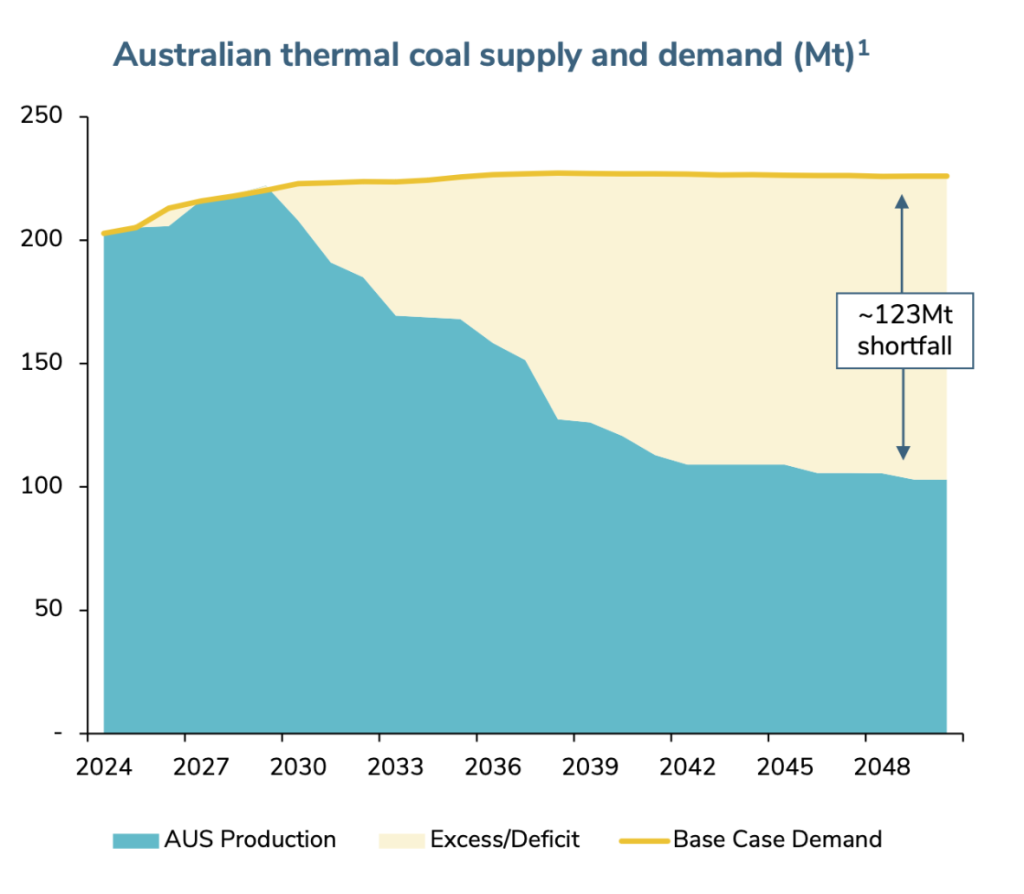
Source: New Hope
2030 may be some time away, but energy consumer concerns around future supply are rising generally.
An elevated coal price, sustained for longer, would help Glencore grow its earnings.
It’s also a trend unlikely to slow down anytime soon, considering conflicts in both Ukraine and the Middle East show no credible signs of stopping.
Glencore has ‘future-facing’ metals too
Glencore is also a significant producer of copper and zinc, particularly.
The bull case for copper is well-known. It’s required for the electrification of the economy and a key input into new data centre construction. So, copper remains around US$14,500 a tonne for now.
Glencore’s business plan is to increase its copper output to 1 million tonnes (Mt) by the end of 2028. By way of comparison, BHP produced 1.95Mt in FY26 as the largest copper producer globally.
Zinc is less well understood but still profitable, with demand tied primarily to steel galvanisation.
Demand for steel — and, therefore, zinc — follows from lots of construction, whether new cars, buildings, or bridges.
That looks positive currently.
Then the World Trade Organization (WTO) recently said it has now doubled its expected growth in global goods to 3.9% this year, as AI boosts cross-border commerce. The WTO is forecasting it to be 4.1% next year.
The AI investment boom is also very capital intensive too.
Meanwhile, the International Lead and Zinc Study Group expects both Chinese and rest-of-world demand to increase this year.
There’s a similar story for zinc as there is for copper. Smelters are paying miners for concentrate because of a shortage of feedstock.
As a result, zinc is up 26% over 2026 to around US$3,800 currently.
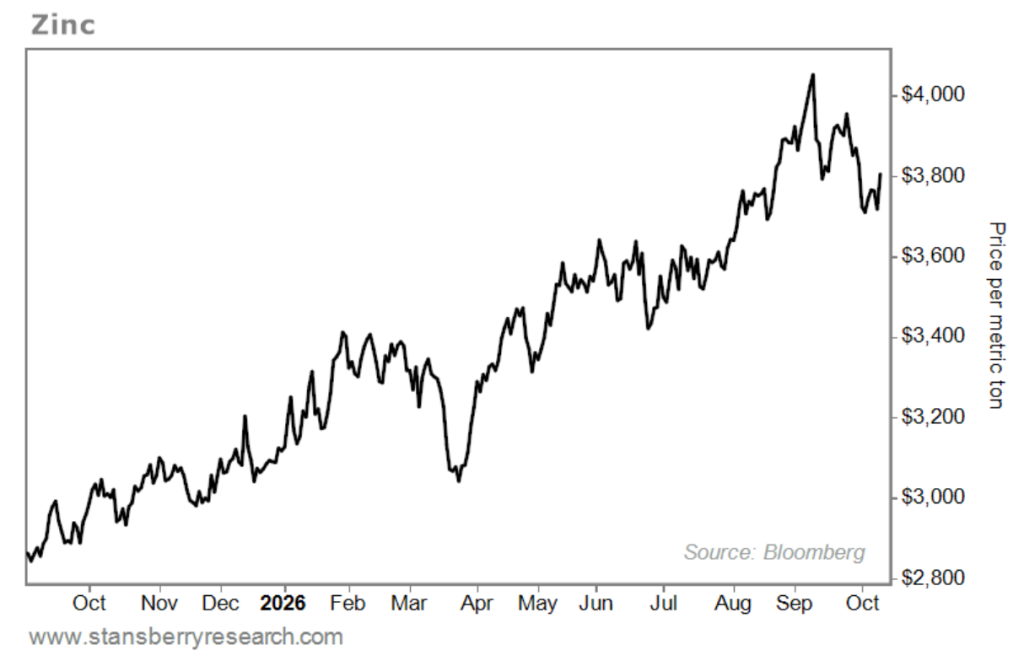
Source: Stansberry Research
Glencore is now the largest zinc producer listed on the ASX. Its average realised zinc price in the first six months of the year was US$3,350.
The Australian Department of Industry, Science and Resources (DISR) doesn’t expect this high price to be sustained for long, with the spike over US$4000 a potential high water market.
Of course, it’s not a ‘pure’ play, and its earnings are subject to many different variables and markets.
Glencore is exposed to commodity prices that can swing in big big directions
The forecast for Glencore is 25% earnings growth in 2026 before moderating in 2027.
It trades on a 12x price-to-earnings (P/E) ratio with a 3.5% yield. Most brokers covering the firm have a strong buy. It also has a $500 million buyback in place.
Nobody can forecast commodity prices too far out with a high degree of confidence. That makes Glencore a cyclical, volatile proposition.
However, it looks well placed to navigate today’s economy.
Write to Callum Newman at Mining.com.au
Main image: Unsplash


