


Gladiator Resources Ltd (ASX:GLA) is reporting that mapping and sampling is underway at its Eland Hill Prospect in Tanzania, where work in 2008 by Western Metals and Uranium Resources (ASX:WMT) identified uranium mineralisation together with tantalum and niobium.
Gladiator Executive Chairman James Arkoudis said the prospect has not been explored by Gladiator.
“Eland Hill Prospect has not been previously explored by the Company, however with the benefit of the 2008 Western Metals results showing a very promising combination of elevated Uranium and possibly Tantalum and Niobium, we can’t wait to get to site and conduct further testing and better understand the potential of all.
“This is an ideal time of year to maximise accessible outcrop, before the wet season kicks in around November”
“This is an ideal time of year to maximise accessible outcrop, before the wet season kicks in around November.
“We expect this work at Eland Hill to take about 2 weeks onsite and look forward to potentially identifying drill targets for after the wet season finishes in Q2 next year.
“These are exciting times for the Company, with a new and invigorated board focused on delivering for the benefit of our shareholders.”
The current fieldwork will focus on mapping and the collection of samples across anomalous zones in a systematic manner to provide an indication of the potential grade and dimensions of the anomalous zones.
Samples will be analysed for uranium, tantalum, niobium and rare earth metals (REE’s) and are expected to be submitted to the laboratory in November.
In 2008 Western Metals carried out geological mapping, grab sampling and scintillometer traversing.
The areas of radiometric anomalism closely coincide with the areas mapped as being of syenitic rocks, coarse-grained light grey igneous rocks composed mainly of alkali feldspar and ferro-magnesian minerals such as hornblende, deficient in quartz.
The Western Metals mapped geology of the full target area outlines the syenitic rocks in the primary Eland Hill Prospect, the smaller Kudu syenite and a third unnamed zone (around 250m south of Eland Hill).
The syenitic rocks are surrounded by felsic gneiss, with the following rock types record:
- Syenite- granular uniform white syenite with wispy trails of biotite
- Melange- chaotic mixture of syenite and blocks of altered frosted gneiss
- Frosted gneiss- slabby gneiss with distinct biotite banding, frosted appearance due to abundant disseminated nepheline and albite
- White alteration- believed to be albitite rock
- Pegmatoidal alteration- irregular patches of very coarse (mm sized) albite and nepheline crystals
- Country rock- banded biotitic felsic gneiss with amphibolite layers
A close up of the Eland Hills Syenite shows mapping in greater detail.
At its widest the syenitic rocks cover 270m by 160m with an inner core of syenite and outer zone of a melange of syenite with altered gneiss.
The syenite has a north west, south east oriented long axis.
The main anomaly is a north west, south east oriented zone of >300cps, associated with the contact of the syenite and the adjacent melange rock.
Ground spectrometer results showed a range of 50 to 200ppm equivalent uranium, extending to the south east under cover of rubble and soil.
Within the syenitic rocks are patches of white albite altered rock and on the margins are small patches of pegmatoidal textured rocks.
At the smaller Kudu anomaly, ground spectrometer and scintillormeter traverses defined a 50m by 50m area of anomalism with up to 250ppm equivalent uranium, coincident with the syenite.
Western Metals report that the three grab samples returned 141ppm, 440ppm, and 1,080ppm U3O8.
Gladiator Resources is an exploration and mining company with a focus on uranium and gold.
It holds 7 exploration licences covering over 1,764km-square in Tanzania, ‘highly prospective’ for uranium.
Three of the licences are contiguous, forming the Mkuju Project which has the following Uranium deposits:
Likuyu North Deposit:
- Indicated MRE of 3.1Mt at an average grade of 333ppm U3O8 containing 2.3Mlbs of U3O8.
- Inferred MRE of 4.6Mt at an average grade of 222ppm U3O8 containing 2.3Mlbs of U3O8.
- Located ˜30km south of Uranium One’s ‘world-class’ Nyota deposit which has a measured and indicated MRE of 187Mt at an average grade of 306ppm U3O8 containing 124.6Mlbs U3O8.
- Likuyu North is ‘on trend’ from Nyota, in a similar geological setting of the same age and structurally bounded by the same major NE-SW fault.
Mtonya Deposit:
Foreign estimate of 3Mt at an average grade of 293ppm U3O8 containing 1.9Mlbs of U3O8, all in the inferred category.
Prepared in 2013 by Rocoe Postle Associates of Toronto using the Canadian Institute of Mining, Metallurgy and Petroleum definitions, and reported in accordance with the Canadian National Instrument 43-101 (NI 43-101).
Gladiator also holds three exploration licences in Australia, highly prospective for gold in the Murchison district of Western Australia near Meekatharra, and the historically prolific Lachlan Ford Belt of Victoria at Rutherglen and Bendoc.
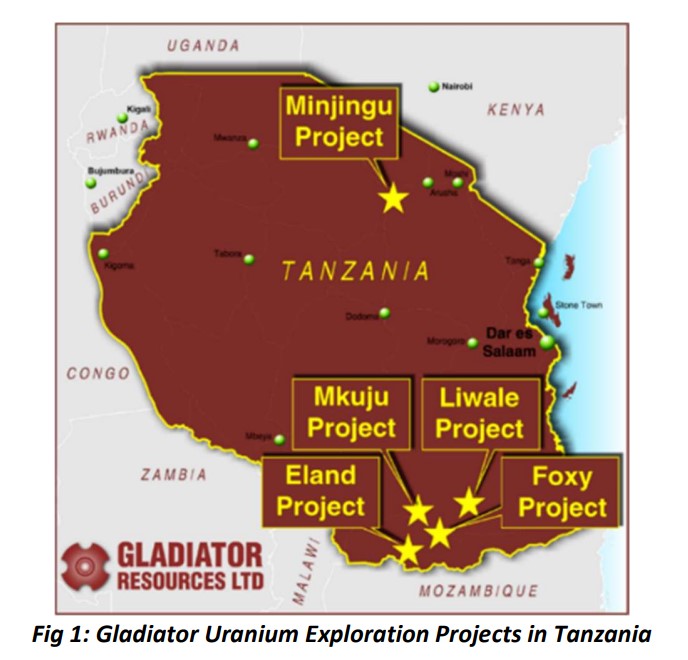
The Eland Project is in the south western corner of PL 11703/2021 in the south of Tanzania, approximately 7km from the Mozambique border.
The project is accessed from Tunduru on the main T6 paved road running inland from the coast and Dar es Salam into and through the project area in the dry season (April-November).
Eland Project is on the south eastern margin of the Karoo Supergroup in the Permian-Jurassic Luwegu sub-basin.
The sub-basin covers approximately 60,000km-square of the Permian-Triassic Selous Basin, a typical Mesozoic intra-cratonic rift basin with north eastern trend, 180km long and 60km wide.
The basin is filled primarily with sediments formed by the erosion of the underlying paloe-Proterozoic Usangaran-Ubendian (felsic gneiss, meta-granite, meta-syenite with pegamites).
Some are enriched in uranium, especially the alkaline intrusions and associated pegmatites.
In 2008, Western Metals carried out geological mapping and scintillometer surveys to follow up on a pronounced airborne U channel radiometric anomaly.
This worked to define 3 to 4 areas with between 250 and 100cps and spectral equivalent uranium of 100 to 500ppm.
The largest area referred to as Eland Hill has a zone of approximately 150 by 30m with >250cps.
Grab samples reported between 141 and 1,080ppm U3O8 from a >400m long radiometric anomaly corresponding to a nepheline syenite.