



This article is a sponsored feature from Mining.com.au partner Future Metals. It is not financial advice. Talk to a registered financial expert before making investment decisions.
The Panton PGM (platinum group metals) Project in Western Australia’s Kimberley region has been around for decades, with a Feasibility Study and a pilot plant investigating its PGM potential way back in 2003. However, its most recent owner has recently reworked the economics of the asset to deliver a more viable, lower-risk project.
Future Metals (ASX:FME) has reviewed all the historical work — including its own Scoping Study completed in 2023 — and found a myriad of ways to optimise the project.
One of the outcomes of this review was an updated mineral resource estimate (MRE) using a net smelter return concept to have a more robust methodology for the estimate. The MRE now stands at 82.3 million tonnes (Mt) at 1.6 grams per tonne platinum equivalent (PtEq) for 4.24 million ounces (Moz) of contained metal.
That includes 40Mt in the indicated category at 2.06Moz PtEq and 42.3Mt in inferred resources at 2.18Moz PtEq.
Managing Director Keith Bowes says while the mineralisation hasn’t changed, the way the company has evaluated it has.
“We took the cost information from the 2023 Scoping Study, looked at current prices for PGM metals, and applied those metrics to define Whittle pit shells for the open cut mine and optimised stopes for the underground. We then defined the mineral resource as the material contained within these shapes, which therefore met the criteria for Reasonable Prospects for Eventual Economic Extraction (RPEEE),” he says.
“From an outside person looking at it now, we’ve got a resource that’s a lot more robust than the previous one and I think is a much better resource for us to be able to use for an updated Scoping Study.”
What this amounts to is a resource that considers the full economic contribution of all five payable commodities — platinum, palladium, gold, nickel, and chromite.
But it’s the ‘high-grade’ platinum component of the resource that really excites Bowes.
“One of the unique characteristics of Panton within the PGM mix is that it’s got a much higher platinum component than the majority of other PGM projects here in Australia,” he says.
“Our platinum makes up about 45–50% of our PGM mix, while if you look at some of the other PGM projects out there, their platinum is only 10–20%.”
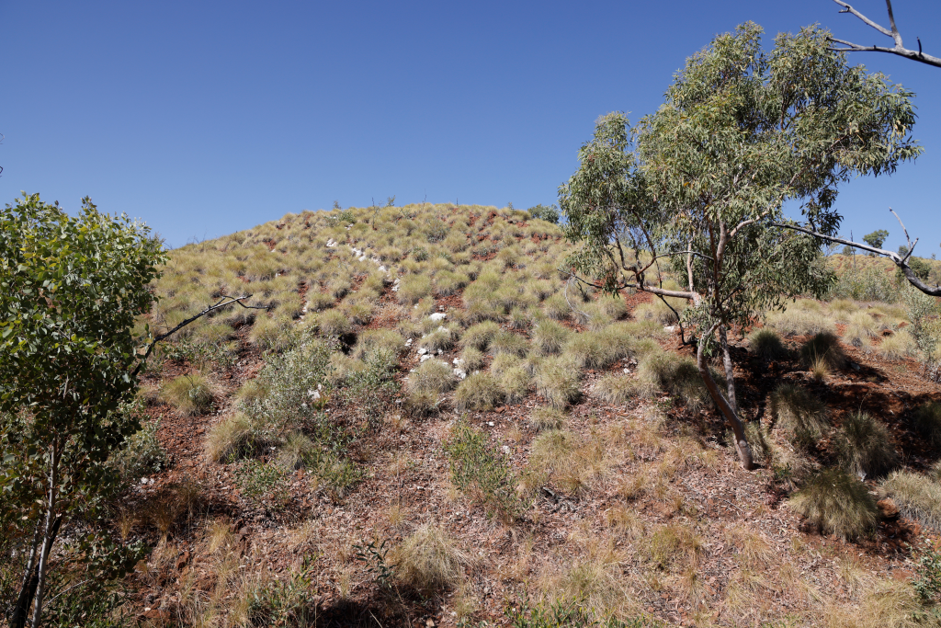
Comparable to South African PGM grades
Bowes notes that the geology of the project, i.e. the chromite reef which hosts the majority of the PGMs, is more comparable to South African platinum resources rather than Australian resources, but of course the Panton resource occurs in a mining-friendly jurisdiction with low geopolitical risks.
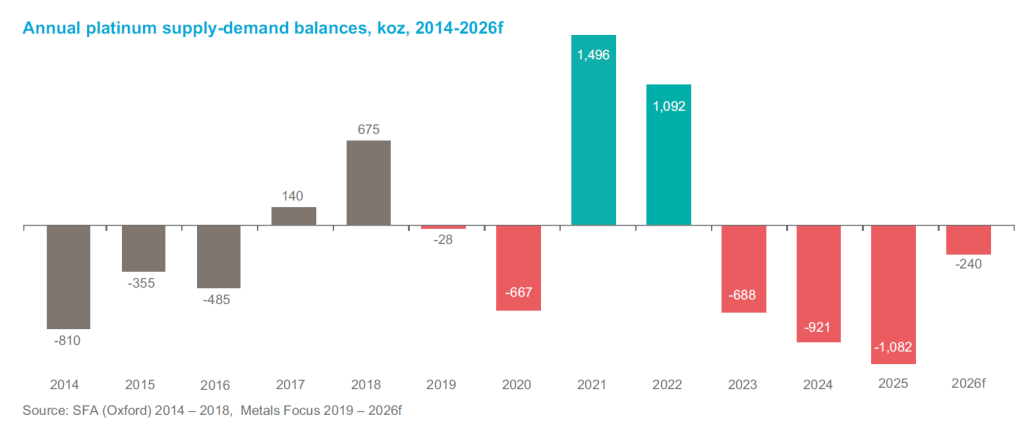
“When you look at the market today, the platinum market is a lot stronger than the palladium market and we’re seeing much higher platinum prices than what we’re seeing for palladium.”
“The majority of the world’s platinum comes from South Africa and Zimbabwe and most of the world’s palladium supply comes from Russia,” he says.
“And when you look at the South African producers (Impala Platinum or Sibanye-Stillwater), they mine what’s called the UG2 Reef which is a chromite-hosted PGM orebody — and that’s exactly what the high-grade material at Panton is.
“Our high-grade chromite-hosted material grades at around 5–7g/t of PGM which is a very similar grade to what the chromite ores in South Africa grade.
“I think everybody recognises that from a geopolitical risk view, the current PGM producers are in higher-risk countries, and we know in the South African context that their production is falling with insufficient funding on sustaining current operations or developing new PGM mines.
“With the output from those mines going to drop off moving forward, having a Western supplier coming online to fill that gap would be very beneficial.”
Platinum still in demand and commanding high prices
Another bonus is the rise in prices. The basket price for the concentrate produced from the project is currently sitting at around US$2,150 ($3,072) per ounce — well above the 2023 Scoping Study assumptions of US$1,556 per ounce.
“When they did the original Scoping Study, they were talking about producing about 120,000 ounces per year of PGM which is quite a significant scale project,” Bowes says.
“And when you look at the markets for palladium versus platinum both are used in autocatalysts and there was certainly a period a few years ago where it looked like there was going to be a big move away from internal combustion engines to electric vehicles and that was one of the reasons why the platinum and palladium prices dropped off.
“But I think now that hybrid vehicles are much preferred to straight electric vehicles and because they do have internal combustion engines, you do need to have the autocatalyst as well.”
Essentially, the predicted fall in demand hasn’t really happened. And in terms of platinum demand, Bowes points to the higher proportion of platinum in diesel autocatalysts, and with diesel vehicles less susceptible to substitution by electric vehicles, the market for platinum looks strong.
“We’re not going to see in the short or even medium term a drop off in the amount of diesel vehicles around. They’re still used for haulage, they’re used in the mining industry, so I certainly can’t see platinum dropping off,” he says.
Plus, it has other applications, including industrial (e.g. catalysts for green hydrogen production), in jewellery, and even as a store of wealth.
“There’s quite a wide range of platinum uses out there which I suspect will be able to support the platinum price moving forward,” Bowes says.
Scoping Study to consider processing at Savannah plant
The next step now for Future Metals is to update the Scoping Study, with the plan to save on pre-production capital by modifying the nearby Savannah nickel plant owned by Panoramic Resources, which is currently in care and maintenance.
Luckily, Panoramic is owned by Zeta Resources (ASX:ZER), who FME signed an MoU (memorandum of understanding) with last year to look at options to work together, including the opportunity to process Panton material at Savannah.
The revised project costs (including refurbishments and modifications at Savannah) are expected to total $193 million, down from $267 million in the 2023 Scoping Study which considered building a new plant at Panton. That’s a saving of $74 million, or around 28%.
“The Savannah nickel concentrator is only located about 60km away from Panton, and the configuration is very similar to what’s required to be able to float out a PGM concentrate,” Bowes said.
“We had engineers go up to site in February and March this year to complete a detailed inspection of that plant and we’re confident that we can refurbish and modify it to become a PGM concentrator with a lot lower capital than would be required if we were to develop a greenfield project.
“But importantly, they already have a tailings dam, a camp, and easy site access. They have a power plant, they have workshops and admin buildings, all things that cost significant amounts for greenfield projects.”
Bowes is confident the company’s review of all the historical work at the project will leverage opportunities to improve the economics even further.
“We believe there are some additional opportunities that we could incorporate into a new flowsheet to make it more robust, to reduce the capital, and hopefully reduce operating costs as well — all of which will be incorporated into the new Scoping Study,” he says.
The study is expected to consider high-grade material outcrops at Panton, as this represents an opportunity to start the operation with an open-pit operation and then progress to underground mining at a later date.
And the project already sits within granted mining leases, leaving the company well advanced down the pathway to development and potential offtake discussions for its ‘high-grade’ PGM concentrate.
Write to Emma Davies at Mining.com.au
Images: Future Metals & SFA (Oxford)


