

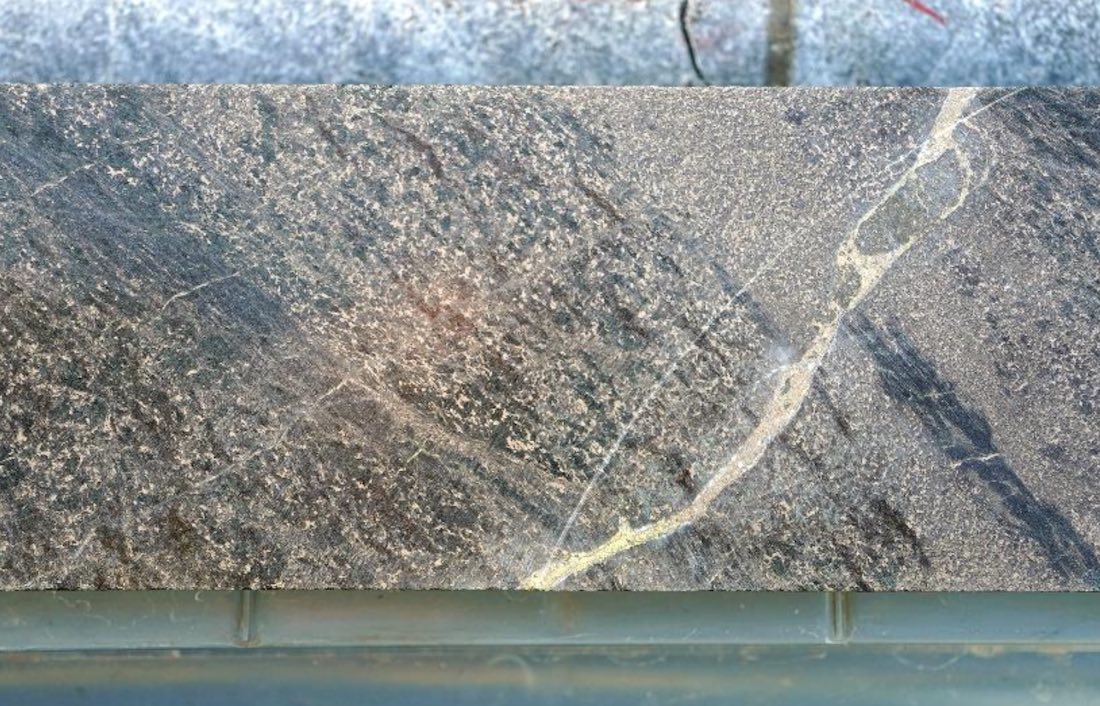
Future Metals (ASX:FME) reports diamond drilling has intersected near-surface sulphide mineralisation, providing evidence for a ‘large’ new nickel-copper-PGE sulphide system at the Panton Project in Western Australia.
The company says it has completed an additional 3 diamond drillholes for around 540m in its ongoing drilling program with sulphide mineralisation intersected in each hole, bringing the total drilled metres for the 2022 exploration season to around 1,340m across 6 holes with confirmed sulphide mineralisation. These intersections range from fine grained to weakly disseminated to very locally, semi massive.
“Our advanced gravity inversion modelling, EM surveys and recent drilling have uncovered what is a highly prospective zone”
Future Metals Managing Director and CEO Jardee Kininmonth said it is encouraging to have the company’s sulphide exploration program continue to be validated with positive results.
“PS411 and PS412 open up a completely new target zone in the south, an area which was previously overlooked due to minimal outcropping chromite reef relative to the resource area in the northeast.
Our advanced gravity inversion modelling, EM surveys and recent drilling have uncovered what is a highly prospective zone which is interpreted to be an extension of the keel position identified under the chromite reefs.
Further, in hole PS410 we have drilled over 350m of magmatically emplaced disseminated sulphides near the chromite reefs, in the outer area of the keel position.
This is again extremely encouraging as it aligns with multiple analogues for this style of mineralisation, with disseminated sulphides forming a cloud or halo around the keel position which is more heavily mineralised.
This provides us with confidence that the keel position will ultimately be shown to host a large sulphide body.”
Future reports PS411 and PS412 were targeting EM conductors in the south of the Panton Project area, and the EM targets are broadly coincident with the large gravity anomaly in the south, identified through a recent gravity survey.
Similarly the targets are coincident with fold line of the Panton intrusion in an area of significantly ‘high’ strain.
Both holes intersected heavily disseminated to matrix-textured sulphide mineralisation within a broader zone of disseminated sulphides, and these sulphides have been confirmed by both visual inspection and portable X-Ray Fluorescence (pXRF) analysis to be chalcopyrite (copper sulphide mineral) bearing but are not significantly nickel enriched.
The company says this sulphide mineralisation is clearly hosted by a ‘high’ strain shear zone and it interprets this may represent structural-hydrothermal remobilising from an underlying primary magmatic source.
Within hole PS411, 2 zones of ‘significant’ mineralisation were intersected a 2m zone of 20% massive pyrrhotite and a 5cm band of 50% semi-massive sulphide mineralisation, and in both intervals pyrrhotite is dominant with lesser chalcopyrite, and the company says this mineralisation encompasses these intervals with up to 5% disseminated pyrrhotite with minor chalcopyrite over a 39.3m interval.
In hole PS412, the main zone of mineralisation extends for 10.7m with blebby to disseminated pyrrhotite and minor chalcopyrite with an increase in matrix sulphide up to 20% in a ‘high-strain’ zone.
In this context, the company says it is ‘significant’ that these sulphide intersections are spatially coincident with a large gravity anomaly, which potentially shows an extension of the keel position, 4km to the southwest of the keel zone identified near the chromite reefs in the northeast of the project area, and these ‘encouraging’ visual results from initial drilling confirm this southern area as a new target zone.
Future Metals reports hole PS410 was drilled in the Lower Zone of the Panton Intrusion in the northeast near the chromite reefs, testing a large magnetic anomaly distal to the interpreted keel position in this area, and the hole intersected over 350m of fine grained weakly disseminated to disseminated sulphides.
It states these have a clear magmatic origin with pXRF analysis confirming the presence of chalcopyrite and nickel-bearing mineralisation and this provides further evidence of a potentially significant mineralised keel position near the chromite reefs.
Future states although the mineralisation appears to be remobilised, it is significant in that sulphides are present in gabbriotic to anorthositic lithologies which overlay the dunite and chromite reefs of the complex, and these drillholes are over 4km to the southwest of hole PS410 which intersected over 350m of disseminated intercumulus magmatic sulphide in dunite.
This demonstrates the potential for the Panton Intrusion to host a significant sulphide system in addition to its chromite-hosted PGM reefs.
The company has commenced drilling into the keel position into the north and will shortly begin running DHEM on each of the completed drillholes to identify further targets, and complete ground-based EM surveys over the gravity anomaly areas.
Future Metals is an Australian based exploration company focused on advancing its Panton Project in the eastern Kimberly region of Western Australia.
The 100% owned Panton Project is located 60km north of the town of Halls Creek, and consists of 3 granted mining licences.
Images: Future Metals NL