

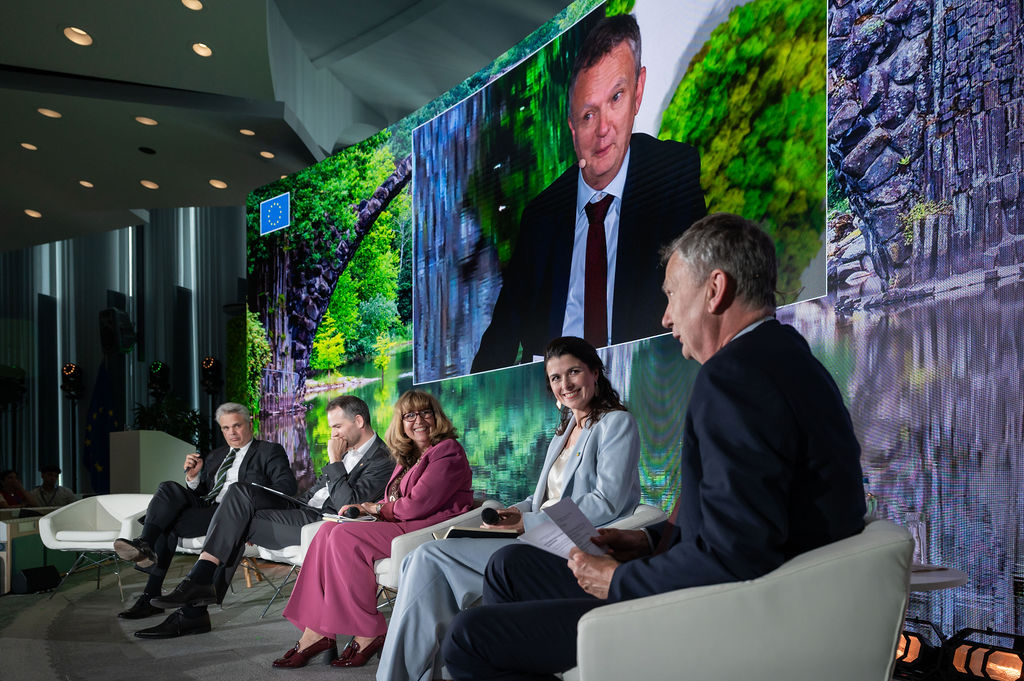
IN KOTOR: Following this year’s European Union (EU) Green Week, Commissioner for Environment, Water Resilience, and a Competitive Circular Economy Jessika Roswall says restoring ecosystems can unlock billions in sustainable growth and resource security at the same time as mitigating severe climate risks.
At Green Week, policymakers, investors, businesses and civil society came together around a growing understanding that healthy ecosystems are fundamental to Europe’s competitiveness, resilience, security, and long-term prosperity.
According to the European Commission, climate and biodiversity inaction are already a massive drain on Europe’s economy, with extreme heatwaves, severe droughts, and destructive floods costing the EU billions last summer alone. Costs are expected to soar to well over €100 billion by 2029.
The commission notes that the returns on nature restoration are also compelling, with every euro invested in restoring degraded ecosystems generating up to €38 ($62.35) in economic returns.
The European Commission is looking at innovative financing models such as nature credits to explore ways to reward actions that restore ecosystems, while providing investors with confidence, transparency and credibility.
As reported earlier this month, EU Green Week 2026 focuses on building a nature-positive economy, bringing together policymakers, business executives, environmentalists, investors, scientists, farmers, innovators, and civil society.
Over the two-day event, speakers and participants focused on regenerative and profitable farming models, financial tools, restoring nature at scale, regenerating soil, greening cities, tackling rural decline through nature-based development, and how businesses are integrating nature into economic strategy and risk management.
Environmental importance
The news comes after World Environment Day (5 June), during which the mining and resources industry was called upon to supply vast quantities of critical minerals while reducing environmental footprints from extracting them.
According to the World Economic Forum, around 80% of energy consumption is still fossil fuel-based, while electricity’s share of final energy use in the EU has stagnated at roughly 21%. This figure needs to be 60% by 2050 if the bloc is to meet its climate and electrification targets.
EY reports that to meet global electrification goals, around 115% of additional copper needs to be mined over the next 30 years.
Copper is a key critical mineral in electrification and decarbonisation efforts. It is used in renewable energy systems to generate power from solar, hydro, thermal, and wind energy. Renewable energy sources provide nearly one-quarter of the world’s power, and copper plays a key role in making it as efficient as possible.
Solar power systems can contain 5.5 tonnes of copper per megawatt (MW). The Copper Development Association projects that 262 gigawatts (GW) of new solar installation during 2018–2027 in North America alone will require 1.9 billion pounds of copper.
Meanwhile, a 3MW wind turbine can contain up to 4.7 tonnes of copper, with 53% of that demand coming from the cable and wiring, 24% from the turbine and power generation components, 4% from transformers, and 19% from turbine transformers.
Onshore wind farms use 7,766 pounds of copper per megawatt, while offshore wind installation uses 21,068 pounds of copper per megawatt.
Write to Aaliyah Rogan at Mining.com.au
Images: European Union Green Week