



The duality of global energy markets has been highlighted with data showing growth in renewables and production of minerals critical for decarbonisation in parallel with record consumption of fossil fuels and emissions in 2023.
Production of minerals critical to the global energy system continues to grow on average at about 4% per annum with copper growth just under 2% over the past decade after dropping by 1.6% in 2023.
The production growth of key minerals was in parallel with renewables continuing to scale at pace, with record highs last year driven by increasingly competitive wind and solar energy, and China increasing renewable generation at a higher rate than the rest of the world combined.
However, the second installment of the Energy Institute’s 2024 Statistical Review of World Energy shows the dichotomy and complexity of the market as record consumption of fossil fuels and record emissions from energy were reported in 2023. The statistical review analyses data on global energy markets from the prior year.
According to the latest report, while inroads are being made towards decarbonisation, CO2 emissions from the combustion of fossil fuels is still by far the largest source of energy-related greenhouse gas emissions contributing around 87% of the total.
“As a result, the share of fossil fuels in world energy demand remained stubbornly stuck around the 80% mark. With record CO2 emissions as well in 2023, this recent data should serve as a timely reminder for the world to redouble efforts to reduce carbon emissions and reach net zero. In particular, we should do more to provide finance and capacity to support the building of more low-carbon energy sources in the Global South, where demand is growing at a rapid pace,” the Energy Institute reports.
Global primary energy consumption reached a new all-time high for the second consecutive year with non-OECD countries dominating both the share and annual growth rates. Fossil fuels continue to underpin development of such countries accounting for 84% of their energy mix, the Energy Institute reports.
“With global temperature increases averaging close to 1.5°C, 2023 was the warmest year since records began, and the increasingly severe impacts of climate change were felt across all continents,” the institute says.
Dynamic: Key minerals contrast
“(Last year) saw a second consecutive record year for global primary energy consumption as it grew by 2%, reaching 620 EJ (exajoules). Its growth rate was 0.6% above its 10-year average and over 5% above its 2019 pre-COVID level.
“Whilst a new record in the consumption of fossil fuels (in absolute terms) was recorded. In 2023, it fell to 81.5% compared to almost 81.9% in 2022. With demand for natural gas, a relatively low carbon-intensive fossil fuel, remaining flat, the increased use of more carbon-intensive oil and coal meant that energy-related greenhouse gas emissions also reached a record high, exceeding 40 GtCO2 e (gigatonnes carbon dioxide equivalent) for the very first time.”
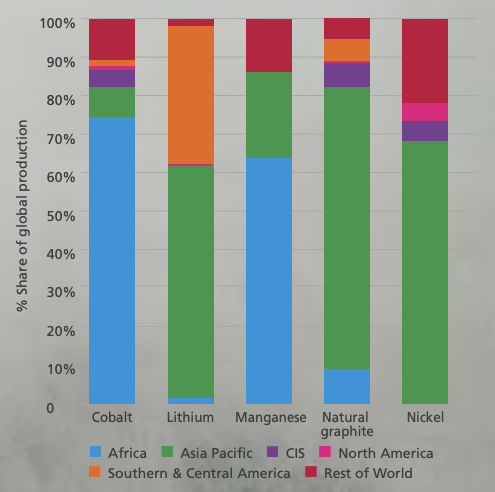
In terms of key minerals, the Asia Pacific region produced nearly 70% of the metals and materials critical to the manufacture of lithium-ion batteries.
The prices for metals and materials have fallen across the board from 2022 highs, lithium carbonate prices, however, hovered at 400% higher than 2019 pre-covid levels and copper some 140% above it.
China has been both the global leading producer of refined cobalt and the world’s leading consumer of it, with nearly 87% of consumption used by the lithium-ion battery industry.
“As well as producing nearly 20% of the world’s lithium production, China also produced around 74% of its graphite supply. Portugal holds the largest lithium reserve in Europe (around 60,000 tonnes). Whilst historically it has primarily focused on ceramics for glassware production, it is increasingly looking to enter the lithium market,” the Energy Institute’s 2024 Statistical Review of World Energy shows.
Across the board, prices for key metals and materials fell by about 26% in 2023 with the biggest declines in cobalt down 47%, pet needle coke dropping 36%, and lithium carbonate down 32%. Prices for copper and natural graphite dropped by 4% and 15% respectively.
The Energy Institute notes in 2023 coal prices fell 46% from the record levels reported in 2022, with European delivered prices settling about US$130 ($190) per tonne and delivered prices in Asia averaging US$125.
In 2023, global coal production reached its highest ever level (179 EJ), surpassing the previous high set in 2022. Global coal consumption continued to increase and breached 164 EJ for the first time ever.
“Whilst China is by far the largest consumer of coal (it beat its own record set in 2022 and now accounts for 56% of the world’s total consumption), in 2023 India exceeded the combined consumption of Europe and North America for the first time ever. Coal consumption in both Europe and North America fell below 10 EJ each and has been in constant decline over the past 10 years,” the Energy Institute adds.
Meanwhile, solar and wind capacity continued to grow rapidly in 2023 beating the previous year’s record of 276 GW by about 186 GW – a 67% increase. Solar accounted for 75% (346 GW) of the capacity additions with China responsible for around 25% of the growth.
The Energy Institute is the membership body for the world of energy. The EI Statistical Review of World Energy analyses data on world energy markets from the prior year. It has been providing timely, comprehensive and objective data to the energy community since 1952.
Write to Adam Orlando at Mining.com.au
Images: Energy Institute & Our World in Data


