



“It is fingers crossed for dealmakers.”
That is the assessment of S&P Global in its M&A Equity Offerings Market Report for Q1 2024, which details the overall consensus that M&A and equity issuance will continue to pick up.
The report provides an overview of global M&A and equity issuance trends, offering insights into the sectors and geographies that are experiencing the most activity. While looking promising, what is evident is that global transactions trends are far from being certain.
Questions still linger around interest rates as 2024 started with high optimism for a reduction in rates with the Federal Reserve hinting that cuts were on the horizon.
S&P Global notes continued reports of elevated inflation have diminished hopes of near-term cuts, although dealmakers are crossing their fingers. Why? Lower interest rates would add fuel to dealmaking by lowering acquisition financing costs and potentially boosting equity prices.
In Q1 2024, the number of global M&A announcements fell to 9,022, the lowest since Q2 2020 when 8,871 were recorded at a time when global markets were being disrupted by the onset of the covid pandemic.
However, during the first quarter of 2024 the total value of announced deals reached US$594.47 billion, an 18.5% increase over the most recent low point of $501.54 billion in Q1 2023.
S&P Global notes the value of M&A transactions is well below levels recorded in H2 2020 and throughout 2021 when quarterly totals ‘routinely’ topped US$1 trillion.
Yet there are signs that M&A activity could pick up in 2024.
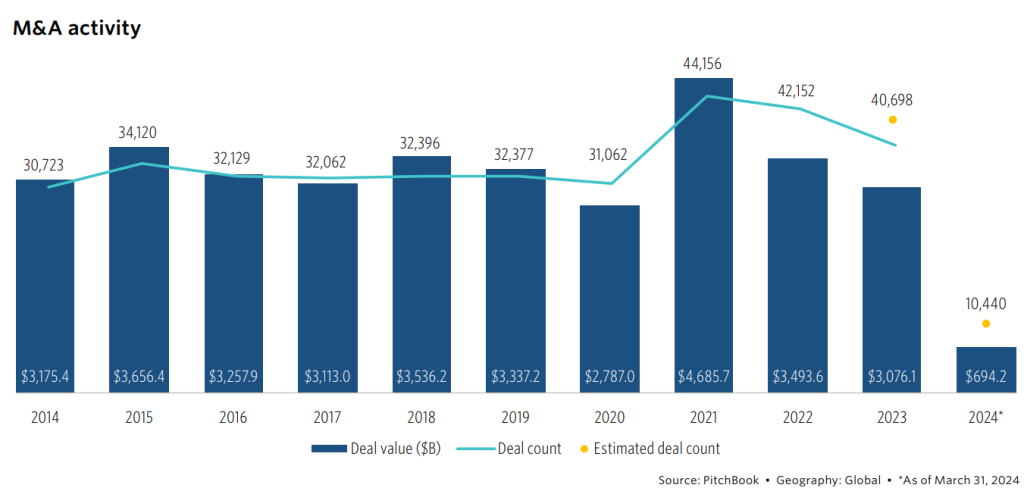
In its Global M&A Report for Q1, PitchBook notes M&A dealmaking is slowly on the mend after two consecutive years of declines. It reports deal activity actually rose 5% to 10% year-on-year in Q1, despite falling short of Q4 2023 totals.
“Deal multiples have remained stable, a sign that the valuation reset may be complete, and have room to move higher to catch up with elevated prices of public companies,” the report says.
A Goldman Sachs report notes that history shows that M&A markets undulate, but pullbacks tend to be reasonably short in duration.
In PitchBook’s report, Lead Analyst Tim Clarke agrees.
“Closing out 2023, global M&A had declined for two years straight. M&A has almost always bounded back from consecutive annual declines, and we do not think this year will be any exception. The prior two episodes of 2007-2008 and 2001-2002 registered total peak-to-trough declines of approximately 60% to 70%, whereas the present decline has measured 34.4% from 2021’s peak,” he says.
“We think we will look back on Q3 2023 as the trough in the current cycle, and Q1 2024 provided some support to that outlook. Against a relatively easy comparison a year ago, global M&A activity has risen by approximately 5% to 10% versus Q1 2023. This was not gangbuster volume by any means — and a deceleration from Q4 2023 — but an improvement nonetheless.”
Larger M&A deals are seemingly now recovering faster than other transactions, which are now playing out in developed Europe and the US. European M&A has been on a downward slide for several years as it faces surging inflation, higher interest rates, and the Russia-Ukraine war.
“However, a year-over-year increase in aggregate transaction values was driven by an upturn in $1 billion-plus purchases. In the first quarter, there were 32 deals with a transaction value in excess of $1 billion, more than in any 2023 quarter and nearly twice as many of the 17 announced in the year-ago period,” S&P Global reports.
There is anecdotal evidence that private equity firms are now becoming more active with exits, which could start driving M&A activity.
The report suggests that PE firms are continuing to retain a mountain of dry powder during a period of increased hold times of portfolio companies. Cheaper debt and higher equity prices can increase what buyers pay for targets and entice more private companies to go public.
“Higher valuations would create a more conducive backdrop for increased private equity investments exits, which have been muted since the second quarter of 2022. Increased private equity activity is a key factor in boosting M&A and equity issuance,” the report says.
Equity issuance is on the rise. As Mining.com.au reported, the amount raised from US equity issuance in Q1 2024 increased to US$39.78 billion, the highest quarterly total since Q4 2021 when US$102.93 billion was recorded.
The first quarter provides anecdotal evidence that PE firms are now becoming more active with exits with two of the largest IPOs out of Europe being private equity-backed companies. Although the IPO market has been somewhat dismal overall.
Still, the M&A Equity Offerings Market Report suggests IPO pipelines are growing, as companies become more comfortable pursuing public offerings, in line with executives of US companies leaning towards large M&A transactions.
The rise in large deals comes despite increased antitrust scrutiny, however many companies are reportedly confident they can navigate the approvals process albeit within an expected prolonged timeline to close.
As such, optimism is gradually growing around M&A and equity issuance.
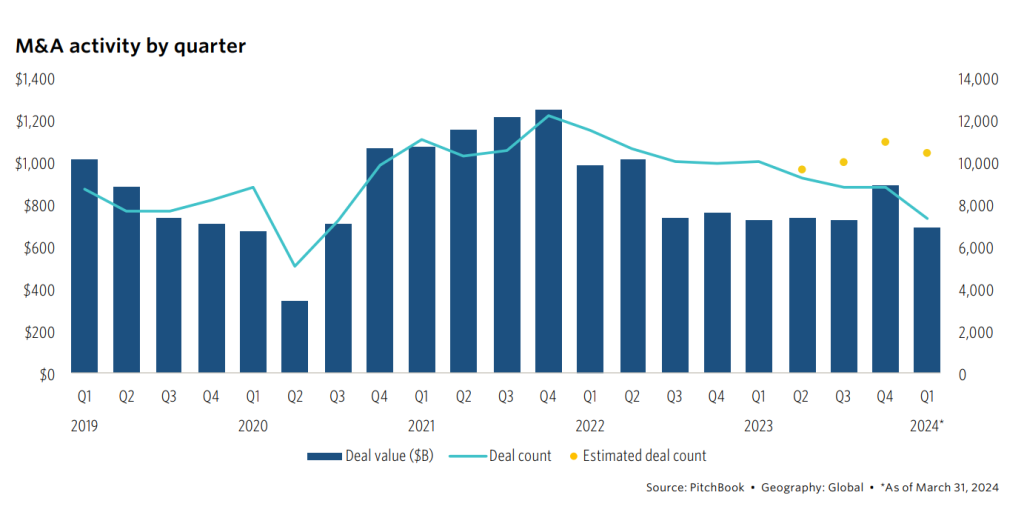
The drop in transactions in Q1 2024 is indicative of the headwinds global markets still face, which have plagued M&A activity since early 2022 when central banks started raising interest rates to contain inflation.
However, as S&P Global reports: “Although interest rates have remained high, other market indicators have been conducive for dealmaking.”
“The S&P 500 increased more than 10% in the first quarter and volatility remained subdued with the VIX — the Chicago Board Options Exchange S&P 500 volatility index — recording an average close of 13.7, down from 15.3 in the prior quarter and down from 20.7 in the first quarter of 2023.
When volatility is reduced and stock prices are rising, investors tend to have more risk appetite to support equity issuance and some issuers took advantage of the dynamics. In the US, the first-quarter total value of equity issuance reached its highest level since the first quarter of 2021. The volume was largely driven by follow-on activity as the total value of US initial public offerings remained subdued.”
Nicolas Moura, CFA Analyst, EMEA Private Capital says M&A is currently being affected by a push-and-pull effect but there is a growing expectation dealmaking is poised to ramp up.
“On the one hand, higher borrowing costs make it more costly to finance large acquisitions, pulling M&A appetite down. On the other hand, the lack of public listings and a correction in valuations play in favour of M&A,” Moura says.
“Nonetheless, we expect the pipeline of deals to grow in anticipation of lower rates, which will give a boost to M&A activity in future quarters.”
Write to Adam Orlando at Mining.com.au
Images: Unsplash & PitchBook


