


Cygnus Metals (ASX:CY5) believes potential remains for further discovery within the 10km fractionation corridor surrounding its Pegasus and Lyra deposits in Canada.
The renewed focus comes as the company has now received first assays from diamond drilling at the Pegasus discovery at its Auclair Lithium Project in the James Bay region, Quebec.
This season will be the first systematic exploration that will be conducted in this area with prospecting to begin in May. The program will focus on the 10km fractionation trend and area surrounding Pegasus and Lyra and will be vectored by ongoing structural interpretation of the magnetics, application of LiDAR and till geochemistry.
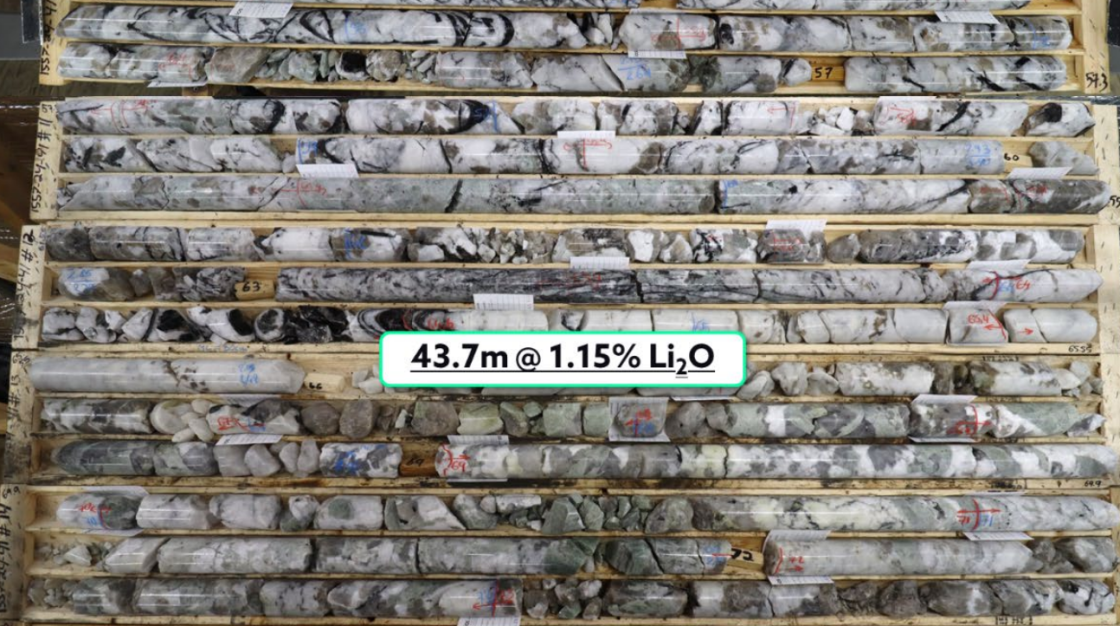
Recent assays confirm ‘significant’, thick mineralisation at Pegasus within 50m of the surface, with a highlight intersection of 43.7m (true width) @ 1.15% Li2O from 46.4m, including 4m @ 3% Li2O which includes 1m @ 5.9% Li2O.
Cygnus Metals says this result is the standout intersection drilled to date by the Company, with impressive widths and grade comparable to other major deposits in the region and globally. This recent result confirms the best visual estimated intersection from the diamond drilling conducted in Q1 2024, with visual estimates of 10-12% spodumene.
Additional results received to date confirm lithium mineralisation in line with expectations based on visual spodumene estimates. The company says generally, these intervals were associated with coarser spodumene mineralisation which has resulted in a nuggety grade distribution in the recent results.
While there is some initial variability, recent drilling has identified a definite trend of increased spodumene mineralisation and fractionation moving further along strike from the Pegasus outcrop.
This trend will be targeted with follow up drilling due to begin in June.
Cygnus says significant widths and grades received from diamond drillhole 1557-24-041 indicate substantial potential for the larger system at Auclair, which shows an optimal fractionation trend over at least 10km of strike and multiple spodumene pegmatite discoveries over 6km of strike.
Much of this trend remains underexplored and there is significant potential for further discovery in the surrounding area and within the 1.6km of unexplored ground between the Pegasus and Lyra outcrops.
Lyra, which returned rock chip results of up to 6.7% Li2O and is yet to be drill tested, is also thought to be shallow to moderate dipping and in the same orientation as Pegasus.

Cygnus reports the Pegasus pegmatite forms one large continuous dyke which has been defined over 300m of strike to date and with a moderate dip towards the north-west. Most of the pegmatite is blind and concealed beneath shallow glacial cover, with the only surface exposure identified to date being the discovery outcrop.
The company says there remains significant potential for further discovery within the ‘highly prospective’ 10km fractionation corridor surrounding Pegasus and Lyra. Much of this area remains unexplored as a result of the 2023 field season being curtailed by the extreme wildfires, and further shortened by early snow which occurred just days following the discovery of the Pegasus and Lyra outcrops.
All of which is new data being used for the first time since being collected last season.
Cygnus Metals is an emerging exploration company focused on advancing the Pontax Lithium (earning up to 70%), the Auclair Lithium and Sakami Lithium projects in the James Bay lithium district in Canada.
In addition, the company has REE and base metal projects at Bencubbin and Snake Rock in Western Australia.
Write to Adam Orlando at Mining.com.au
Images: Cygnus


