


Cohiba Minerals (ASX:CHK) has confirmed the potential for a ‘significant’ zinc deposit to exist following a detailed technical review at its Pernatty C Project, located within its greater Olympic Domain tenements in South Australia.
The company says re-logging of core and the technical review of zinc assays from drillhole PSDDH01 supports the potential for a ‘significant’ zinc deposit to exist at Pernatty C. They also confirm that ‘significant’ zinc intersections within the drillhole relate to a newly identified ‘major’ mineralising structure.
Cohiba reports this mineralising structure, named the ‘Giles Waterhole Fault’, represents a collection of low-angle, normal-fault controlled calcite-sphalerite fault-veins and spur-veins, which control the ‘significant’ intersections.
The company notes zinc grades returned from this structure are within economically acceptable ranges, and are well above anomalism expected from a grassroots exploration hole.
As of 8am AWST Cohiba Minerals’ share price had skyrocketed by 25%.
Speaking on the results of the review, Cohiba Minerals Executive Director and Chief Executive Officer (CEO) Andrew Graham says: “The detailed technical review has further reinforced our belief that the Pernatty C Project may be host to a significant zinc deposit.
The fact that the geophysical targets were not intersected during the first phase of drilling has provided impetus to fully investigate this area and to understand what type of depositional environment we are dealing with.
“The detailed technical review has further reinforced our belief that the Pernatty C Project may be host to a significant zinc deposit”
Whilst the initial results at PSDDH01 came as somewhat of a surprise it should be recognised that intersecting mineralisation of this nature on an early-stage exploration play is a major achievement.”
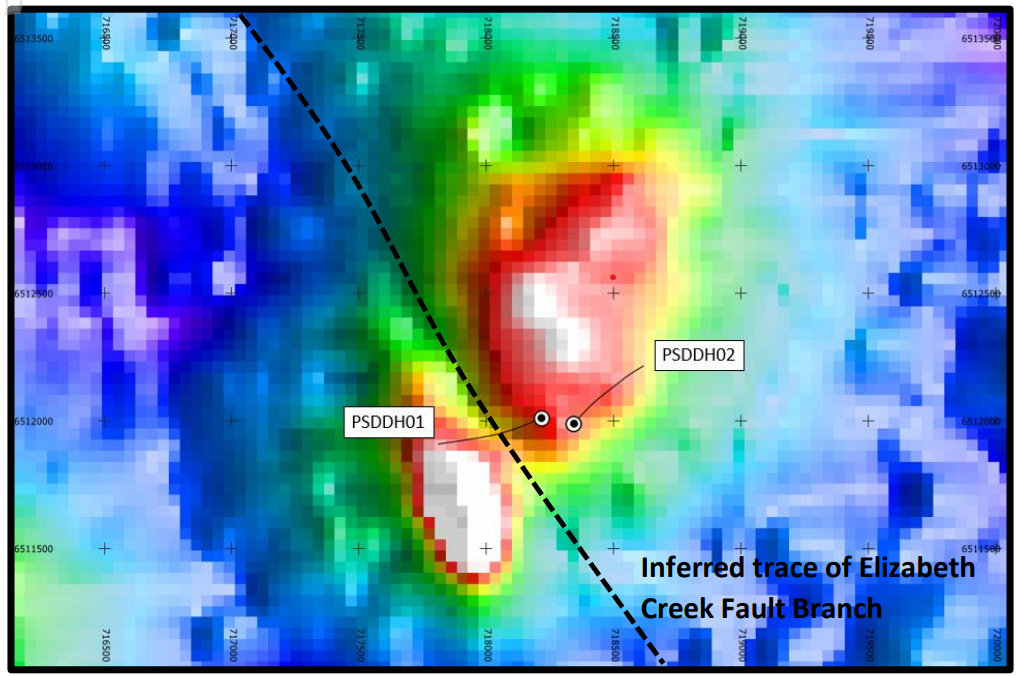
The company also notes this mineralised system has possibility of being peripheral to a ‘significant’ deposit, and that a magnetic anomaly, whose source was not intersected, is likely to be relaxed to the mineralisation.
It is the company’s belief that a manto-style target could exist in the surrounding tenements if the magnetic anomaly is due to an intrusion. Alternatively, another theory from Cohiba is that the anomaly relates to chlorite-magnetite alteration and could relate to ‘stronger’ alteration as observed in drillhole PSDDH01.
With results from the technical review and re-logging of core now received, Cohiba Minerals announced modelling of the geophysical magnetic anomaly has generated targets to follow up on.
Cohiba Minerals is an ASX-listed company primarily focused on investing in the resource sector through direct tenement acquisition, joint ventures, farm in agreements, and new project generation. The company currently holds a portfolio of exploration projects scattered throughout South Australia, Western Australia, and Queensland, with a key focus on its Olympic Domain tenements in South Australia.
The Olympic Domain tenements are situated in the Gawler Craton and comprise 8 exploration licences covering about 831km-square in the Horse Well (Pernatty B), Pernatty C, and Andamooka-Peninsula (Lake Torrens) areas. In particular, the Pernatty C project is located in the known copper producing area of Mt Gunson, which has been favourably compared to the Zambian Copper Belt (ZCB) deposits.
Other assets included in the company’s exploration arsenal include the Pyramid Lake and Wee Macgregor projects in Western Australia and Queensland respectively.
Images: Cohiba Minerals Ltd


