



Cohiba Minerals (ASX:CHK) reports drilling at the Horse Well prospect has successfully intersected the Bluebush Fault near its expected location, giving the company confidence to in the orientation of the fault for step-out drilling.
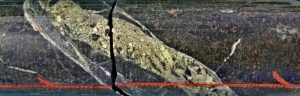
Cohiba reports that drilling at hole HWDD07 intersected the Bluebush Fault near the expected location, and that low level veining with chalcopyrite mineralisation was encountered through much of the hole associated with quartz veins and siderite matrix breccias.
The intersection of the Bluebush Fault is interpreted as extending it 200m from the nearest intersection bringing the total strike length of the drilled fault to 400m. This result has generated significantly increased confidence in the orientation of the fault allowing for increasingly aggressive step-out drilling in the future.
The company notes that detailed logging and sampling of the drill core is still underway.
HWDD07 was completed to a depth of 1,519.0m and was targeting the extension of the Bluebush Fault and associated copper mineralisation encountered in HWDD05, HWDD05, and HWDD05W1.
Bleaching and oxidation of mafic intrusion in the footwall of the upper Bluebush Fault associated with siderite veining, and vein and disseminated chalcopyrite, are indicative that the Bluebush fault has been used as a fluid conduit for mineralising fluids with increased oxidation compared to the three northernmost holes.
The company notes that brecciation, mostly with siderite and low level disseminated chalcopyrite matrix, is prominent associated with the Bluebush Fault and persistent breccia veining in the basement rocks throughout the hole.

Addressing the results, Cohiba CEO Andrew Graham said: “The Horse Well Prospect represents a key IOCG target zone within the Gawler Craton and we are committed to investigating it to the fullest extent possible.
HWDD07 was drilled with the express purpose of following up on the copper mineralization encountered along the Bluebush Fault in drillholes HWDD04, HWDD05, and HWDD05W1.
“HWDD07 successfully intersected the Bluebush Fault as interpreted, bringing the total strike length to more than 400m”
HWDD07 successfully intersected the Bluebush Fault as interpreted, bringing the total strike length to more than 400m. This has generated significantly increased confidence in the area and will enable the company to pursue an aggressive step-out program in the future.”
Bluebush prospect is 7km west of BHP’s up-and-coming Oak Dam deposit. The dominant mineralisation targets are giant kilometre scale breccia pipes that are cemented with the iron mineral haematite which contains the disseminated copper and gold mineralisation.
This event occurred millions of years ago at Olympic Dam, and the other deposits are considered to have a similar age concurrent with the eruption of the Gawler Range Volcanics.
The Olympic Domain is host to the world class copper-gold mines of Olympic Dam, Prominent Hill and Carrapateena.
Cohiba reports this terrain was partially eroded, and then submerged beneath the sea, where 1 billion years’ worth of flat lying sediments cover the basement rocks. Peering through the hundreds of metres of cover is the dominant exploration challenge, and relies on geophysics, generally variations in magnetic and gravity strength.
The Cohiba Minerals exploration model for Bluebush is that there is potential for the low-level copper mineralisation to develop into an economic deposit if two additional conditions are met – an increase in fracturing, rock porosity, and space to deposit the mineralisation; and a suitable geochemical reaction to precipitate iron, copper and gold from solution.
The Bluebush Fault has the potential to meet these criteria, as it was open during the time of copper mineralisation and was used as a pathway for those copper bearing minerals.
Additionally, the fault was used as a conduit for oxidised surface fluids which oxidised magnetite to haematite and can provide the geochemical reaction to precipitate precious metals.
Cohiba notes that the results of these events can already be observed in HWDD05, only lacking the scale of an economic deposit. Examples from other IOCG systems show that once these processes gain momentum, a positive feedback loop of self-generation is created, such that massive breccias develop.
Cohiba is listed on the Australian Securities Exchange (ASX) with the primary focus of investing in the resource sector through direct tenement acquisition, joint ventures, farm in arrangements and new project generation.
The company has projects located in South Australia, Western Australia, and Queensland with a key focus on its Olympic Domain tenements located in South Australia.
Write to Adam Orlando at Mining.com.au
Images: Cohiba Minerals Ltd


