

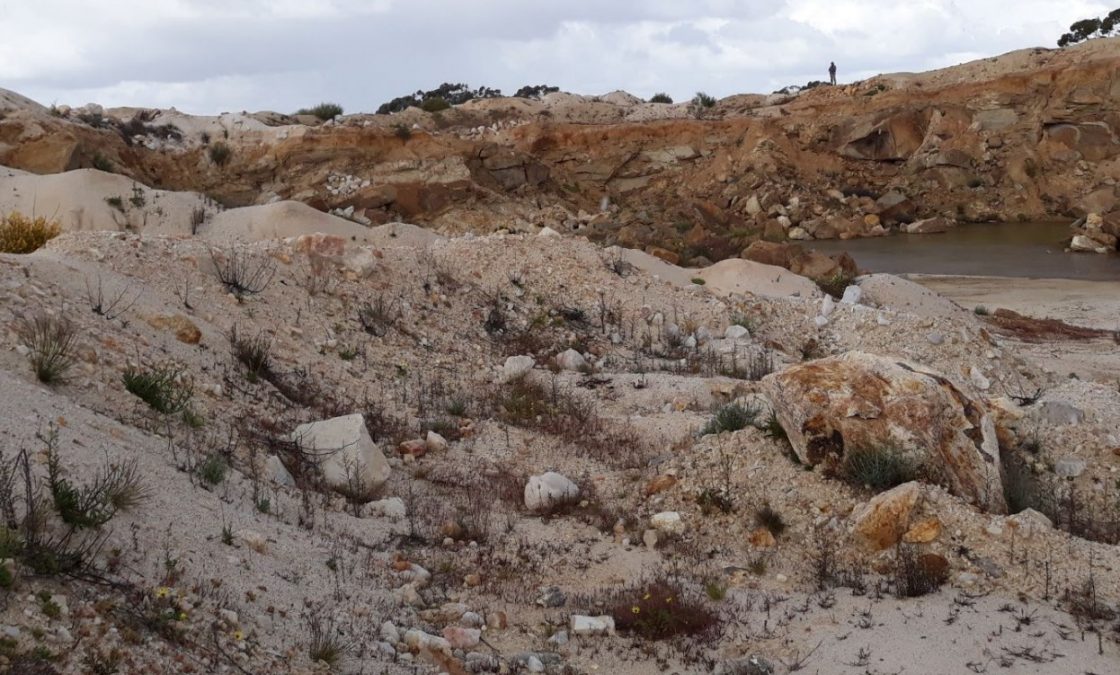
Codrus Minerals (ASX:CDR) reports the presence of ‘extremely high-grade’ Rare-Earth-Element (REE) mineralisation following grab sampling activities at its Karloning Project in Western Australia (WA).
Key assays include: 28,463ppm (2.85%) dysprosium oxide (Dy2O3), 64,100ppm (6.41%) niobium (Nb) and 186,000ppm (18.60%) tantalum (Ta).
The results, generated by 5 samples taken from the niobium-rich Karloning REE Project, have returned ‘outstanding’ REE grades that support the potential for the project to host ‘high-grade’ and high-value permanent magnet REEs dysprosium, neodymium, terbium and praseodymium within a large-scale pegmatite.
In addition, the pegmatite system also holds a ‘significant’ amount of niobium, a critical metal used in the steel industry with applications including wind turbines and high-performance batteries.
Exploration of the ‘large-scale’ pegmatite system is expected to commence shortly.
Codrus Minerals’ share price skyrocketed more than 90% during trade this morning before coming back down to trade 66.66% higher as of 9.45am AWST.

Commenting on the results, Codrus Minerals Managing Director, Shannan Bamforth says: “We are excited by the high grades returned from samples that exceeded the upper detection limit in the original assaying, as announced when we acquired the project last month. Seeing grades for heavy REE elements of this magnitude is very positive, particularly given that these metals are intrinsically linked to the decarbonisation thematic. This provides a very strong platform from which to launch our maiden exploration program on the project.
“Seeing grades for heavy REE elements of this magnitude is very positive…”
We believe the pegmatite has ‘significant’ scale, and assays for the four high grade grab samples has returned truly impressive grades of the four key REE’s required in the manufacture of permanent rare earth magnets.
We plan to commence ground-based exploration activities shortly, and the results will assist us to firm up targets for drilling in early 2023.
The company also notes that the large-scale pegmatite system at the project is estimated to be up to 1.5km long and up to 200m wide.
Meanwhile, it is reported that Codrus has pegged an additional tenure (E70/6306) adjacent to the south-western boundary of the Karloning tenement, which encompasses potential extensions to the pegmatite system.
Cobrus Minerals is an ASX-listed mineral exploration company that boasts ‘exciting’ projects in Western Australia and in the state of Oregon, US. The Karloning project was recently acquired by Codrus following its decision to enter into a farm-in and joint venture (JV) agreement with Talgomine Minerals to earn up to a 90% interest in the project.
The project is located about 30km north of the regional town of Mukinbudin and 260km northeast of the state’s capital city of Perth within WA’s Wheatbelt and presents the company with the opportunity to explore for high-value REEs used in the manufacture of high-strength permanent magnets.
With assays from the grab sampling program now returned, Codrus Minerals announces it will move forward the completion of either drone or ground magnetics, as well as ground radiometric surveys.
Results generated by these initial work programs are expected to underpin a maiden drilling program planned for Q1 CY2023.
Images: Codrus Minerals Ltd