


Australian diversified mineral exploration company Catalina Resources (ASX:CTN) is planning to extend existing rare earth element (REE), lithium, and gold mineralisation at the Dundas Project in Western Australia following an aircore (AC) drilling program.
The initial aircore (AC) drilling at the project has identified ‘robust’ and ‘high-grade’ clay hosted REE mineralisation. The program also identified a geochemical halo, indicating a potentially larger target at depth and along strike. Catalina is also planning to search for new ‘higher’ grade and wider widths of REEs, lithium, and gold mineralisation at Dundas.
Catalina says a 105-hole AC drill program was completed at the project in December 2022 for a total of 2,909m with an average depth of 27.7m. Assays from this program indicated ‘significant’ REE intersections up to 10m and reinforces Catalina’s belief that Dundas will emerge as a ‘significant’ asset in a prospective and underexplored location.
Catalina reports the assays display an ‘exceptional’ critical magnet metal (Nd-Pr + Dy-Tb) ratio to total TREOs. These 4 HREEs are the core ingredients for the manufacturing of permanent magnets which are used in electric motors and generators.
The company’s share price had risen 20% on the ASX as of 12.20pm AWST.
The company says the growth in permanent magnets is attributed to increased use in the automotive industry and electric vehicle drivetrains, and notes the Lynas Rare Earths’ (ASX:LYC) Mt Weld in Western Australia is the sole producer of REEs in Australia.
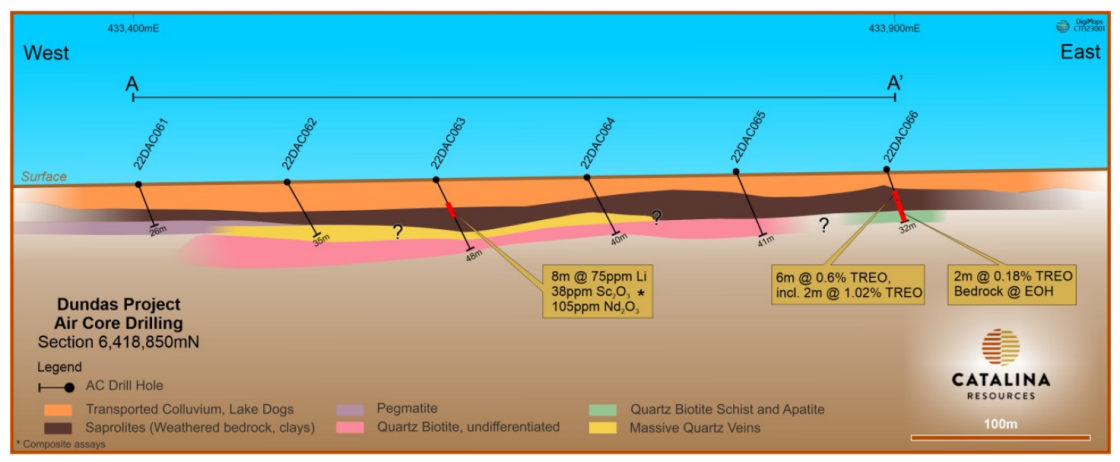
‘Significant’ REE enrichment in the regolith at Dundas is the result of weathering induced clay formation and the company says REEs can either be enriched or depleted in different depth horizons of the regolith. Additionally, the company notes the presence of anomalous REE mineralisation in bedrock in hole 22DAC066 below the regolith horizons suggests potential exists at Dundas for ‘higher-grade’, ‘higher’ commercial value, and hard fresh rock REE mineralisation.
‘Significant’ REE enrichment in the regolith at Dundas is the result of weathering induced clay formation and the company says REEs can either be enriched or depleted in different depth horizons of the regolith
Catalina says the last 2m re-split samples assayed 2m @ 0.18% TREO at the end of the hole. The company reports the re-split assays are markedly higher than the recently reported 4m composite samples. These re-splits were assayed through a high-temperature fusion method more complete than the mixed acid digestion used for the composite assays.
The re-split samples have been fused with sodium peroxide and subsequently the melt has been dissolved in dilute hydrochloric acid for analysis. Catalina says this procedure is particularly efficient for determining major element composition in the samples or determining the refractory mineral species.
Catalina Resources is an Australian diversified mineral exploration and mine development company focused on its portfolio of projects Western Australia, New South Wales, and Tasmania.
These projects include the Kookynie West, Laverton, and Dundas projects in Western Australia, the Lachlan Fold Belt Project in New South Wales, and the Nelson Bay River Project in Tasmania.
Images: Catalina Resources Ltd

