


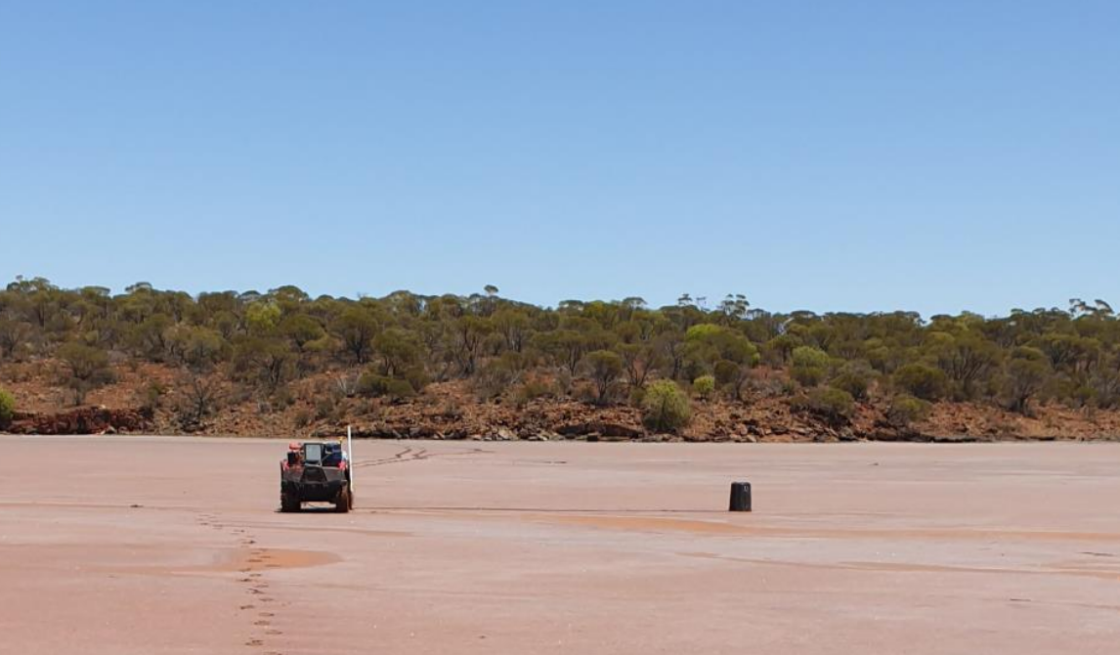
Exploration and development company Australian Silica Quartz Group (ASQ) has identified 3 late-time conductors through ground-based fixed loop electromagnetic (FLEM) surveys completed at the Koolyanobbing Metals Project in Western Australia.
The company says the FLEM surveys were completed by GEM Geophysics during December 2022 and January 2023 with supervision and interpretation by Australian Silica’s geophysics consultant Perth-based company Newexco Exploration.
Exploration conducted by Noranda Australia in 1980 identified the Island Gossan target. It consisted of an area of outcropping gossan developed within an interlayered sequence of felsic tuff, clastic sediments, chert, and banded iron formation (BIF) on an island within the Lake Seabrook salt lake.
This gossanous horizon was mapped by Norada over a strike length of 400m with widths up to 5m, and it observed pyrite, pyrrhotite, and oxidised chalcopyrite.
Rock chip sampling also recorded copper values up to 1,150 parts per million (ppm), and gold values of 0.04ppm. Ground magnetics confirmed the continuity of the gossanous horizon under the Lake Seabrook salt pan to the south, and although planned, drill testing was never completed.
Australian Silica reports the Island Gossan FLEM survey consisted of 2 lines (Local Grid: 32350 and 32450) and loop 22LSL7 was designed to explore the interpreted gossanous horizon for bedrock conductors. A ‘well-defined’ late-time anomaly was identified across both lines.
This late-time anomaly is ‘clearly’ separate from an identified mid-time response interpreted to be attributable to the conductive sediment layers of the salt lake
This late-time anomaly is ‘clearly’ separate from an identified mid-time response interpreted to be attributable to the conductive sediment layers of the salt lake. The Island Gossan conductor plate has a modelled conductance of 6400S, a length of 150m, and a depth extent of 227m.
Previous explorers Emu Nickel (ASX:EMU) completed a 27.5km versatile time domain electromagnetic (VTEM) airborne electromagnetic (AEM) survey in 2008 to test a 5km strike length of the western edge of the interpreted ultramafic contact within tenement E77.2684 to cover a 1km long nickel soil anomaly and a 1.5km gold in soils anomaly.
Several conductors were identified and followed up with rotary air blast (RAB) and reverse circulation (RC) drilling. Australian Silica reports it had this work reviewed by Newexco, which identified 2 ‘high-priority strong’ late-time anomalies and other lower-priority anomalies.
The company says the previous explorer attempted to drill test Anomaly VC4 but encountered difficulties with some planned holes abandoned and others moved. Newexco has concluded that the previous explorers’ drilling fell just short of the conductor and did not adequately test the target.
It also reports the previous explorers’ did not attempt to drill test VC5 due to drilling difficulties already encountered, and the position of the anomaly within the salt lake.
Australian Silica reports its VC4 and VC5 FLEM survey consisted of 5 lines and 2 loops designed to test the anomalies and improve conductor constraints for drilling.
At VC4, the FLEM survey identified a strike extensive mid-time source across multiple lines. Within the broader source, a zone of ‘higher’ conductance was identified in the late-time centred under line 34320.
A late-time model of VC4 was achieved with a good fit to lines 34320 and 34420. This was done with a 170m by 400m 1360S plate with a steep southwest dip.
Australian Silica reports the VC5 conductor was well defined across 3 lines by the FLEM survey. A model was produced with a strong fit across all 3 lines, with the dip and strike of the plate constrained to be consistent with the modelling of the VC4 anomaly. The final model is a 380m by 160m 3000S plate that is steeply dipping southwest, with a slight plunge to the south.
The company says it is currently planning a drilling program with the potential to combine a conductor test drill program with RC drilling of gold soil anomalies on the Golden Wishbone Gold Trend.
Other upcoming activities planned at the project include heritage clearance surveys, environmental approval applications for the VC4 and VC5 targets, and drill testing conductors.
Australian Silica Quartz Group is an Australian exploration and development company focused on developing several hard rock quartz and silica sands projects.
The company currently holds the Gingin Silica, Darling Range Bauxite, Lake Seabrook, South Sterling Nickel-Copper, Albany Silica, Koolyanobbing Metals, and the Esperance North Nickel-Copper-Gold projects in Western Australia.
It also holds the Mt Eliza, Pandanus Creek, and Douglas Range projects in Queensland.
Images: Australian Silica Quartz Group Ltd

