



The ASX opened its last trading session of the week marginally lower, led by modest losses in US markets overnight (AEDT) over increasing concerns around the direction of the economy.
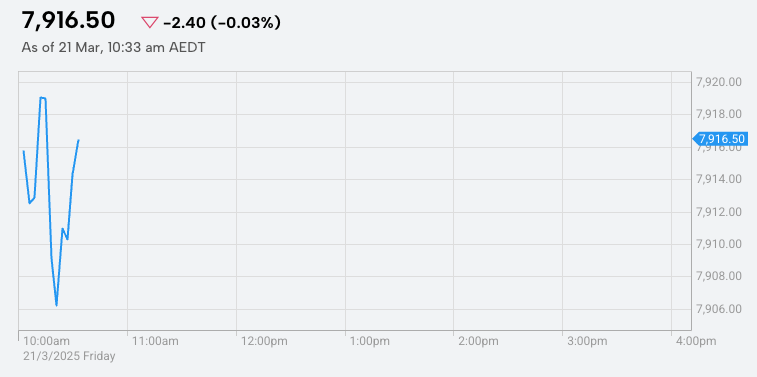
The S&P/ASX 200 edged down 2.4 points to 7,916.5 points by 10.30am AEDT.
The index is up 1.63% over the past five days but still down 2.97% since the start of 2025.
Sectors started the day mixed, with eight trending down. Utilities and energy were in the green, inching up 0.06% and 0.01%, respectively, while materials dipped 0.15% and industrials crept down 0.04%.
A weekly survey conducted by the American Association of Individual Investors shows 58.1% of investors are bearish on the stock market over the next six months which is well above the historical 31% average.
Over 50% believe there is a ‘higher than typical chance’ of a recession occurring before the end of the year and 21.7% say it is ‘highly likely’.
Meanwhile, in Australia February employment data surprised to the downside, falling 52,800 month over month.
This follows a gain of 30,500 jobs in January and goes against market expectations of a 30,000 gain for February.
ANZ Economist Aaron Luk says the print was well below market expectations with the Australian Bureau of Statistics noting that the fall was driven by “fewer older workers returning to work in February”.
The unemployment rate, however, remains steady at 4.1%.
ANZ is not expecting the jobs data to have a material impact on the Reserve Bank of Australia’s monetary policy decisions moving forward.
Economics and Research FX Analyst Felix Ryan says the labour market fundamentals remain solid, with an overall robust trend in employment growth, a low unemployment rate and an elevated level of job advertisements.
“We maintain our stance that this easing cycle will be a shallow one, with only one more rate cut to come in August,” he says.
On the commodities front, copper briefly broke above the US$10,000 ($15,866) a tonne mark as traders continue to weigh the effect of US trade tariffs.
Uranium miners Boss Energy (ASX:BOE) and Deep Yellow (ASX:DYL) again found themselves in the top movers early in the session. Boss Energy added 3.15% to trade at $2.79 and Deep Yellow advanced 2.71% to $1.14.
Fellow uranium producer Paladin Energy (ASX:PDN), however, lost ground after reporting that unseasonal rains had impacted production at its Langer Heinrich Mine in Namibia. The news sent the miner down 5.13% to $6.48.
Paladin has temporarily suspended operations and the full impact will be assesses when conditions have stabilised.
The S&P/ASX200 is Australia’s leading share market index and contains the top 200 ASX-listed companies in terms of market capitalisation, and accounts for about 80% of the country’s equity market. The index is designed to measure the performance of the 200 largest index-eligible stocks listed on the ASX by float-adjusted market capitalisation.
It is recognised as the institutional investable benchmark in the country.
Write to Angela East at Mining.com.au
Images: ASX


