


Astral Resources (ASX:AAR) says latest assays returned support a potential increase in resource confidence to the indicated category from the Mandilla Gold Project in Western Australia.
Managing Director Marc Ducler says previously reported diamond drilling, completed during the December 2023 quarter, is likely to support the increase in confidence of the Theia deposit at depth.
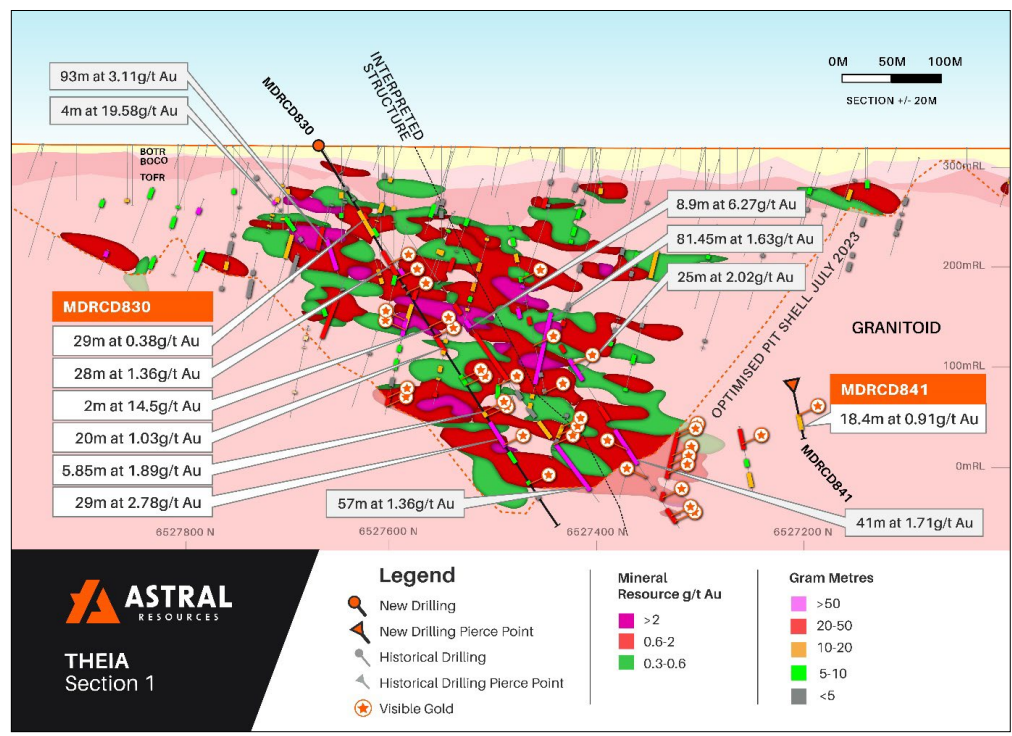
The final 3 holes of the Theia diamond drilling program have returned wide, ‘high-grade’ intercepts, including 29m at 2.78g/t gold, supporting a potential increase in resource confidence to the indicated resources category.
The $53.93 million market capitalisation company conducted an updated Mineral Resource Estimate (MRE) in July 2023, which resulted in 37 million tonnes at 1.1 grams per tonne gold for 1.27 million ounces of contained gold for Mandilla.
Ducler says: “With the latest DD hole, MDRCD830, returning 221 gram-metres over its length, this means that, over the 6-hole program, an average of 137 gram-metres of gold over the length of the hole was achieved — an outstanding result.
The geology team has wasted no time in getting back to work this year with a 2,500m aircore program underway at Feysville and a 2,500m reverse circulation (RC) program scheduled to commence at Kamperman in mid-February.”
Meanwhile, a 2,500 metre AC exploration program testing regional extensions to known shears in the western portion of the tenement package at Feysville is currently underway.
Following completion of the AC program, a 21-hole, 2,500m RC program at Kamperman is expected to commence in mid-February. Astral says this program is designed on an 090 azimuth, which is slightly oblique to the stratigraphy but interpreted to be perpendicular to the trend of gold mineralisation intercepted in previous drilling.
The Kamperman prospect drilling program is designed on an 090 azimuth, which is slightly oblique to the stratigraphy but interpreted to be perpendicular to the trend of gold mineralisation intercepted in previous drilling.
The Mandilla Gold Project includes the Theia, Iris, Eos and Hestia deposits.
Gold mineralisation at Theia and Iris is comprised of structurally controlled quartz vein arrays and hydrothermal alteration close to the western margin of the Emu Rocks Granite and locally in contact with sediments of the Spargoville Group.
Significant northwest to west-northwest-trending structures along the western flank of the project are interpreted from aeromagnetic data to cut through the granitic intrusion. Astral says these structures are considered important in localising gold mineralisation at Theia, which now has a mineralised footprint extending over a strike length of more than 1.6km.
A second sub-parallel structure hosts gold mineralisation at the Iris deposit. The mineralised footprint at Iris extends over a strike length of approximately 600 metres, combining with Theia to form a mineralised zone extending over a strike length of more than 2.2km.
At Eos, located further to the south-east, a relatively shallow ‘high-grade’ mineralised palaeochannel deposit has been identified by the company which extends over a length of about 600m. A primary gold source is also present with further drilling required to determine both the nature and structural controls on mineralisation and its extent.
Mineralisation delineated over some 800m of strike at the Hestia deposit, located about 500m west of Theia, is associated with a shear zone adjacent to a mafic/sediment contact, interpreted to be part of the major north-south trending group of thrust faults known as the Spargoville Shear Corridor.
Astral Resources is a Perth-based gold and base metals explorer focused on its assets in Western Australia.
As of 30 September 2023, the company had $4.1 million cash at hand, according to its latest quarterly report.
Write to Aaliyah Rogan at Mining.com.au
Images: Astral Resources


