



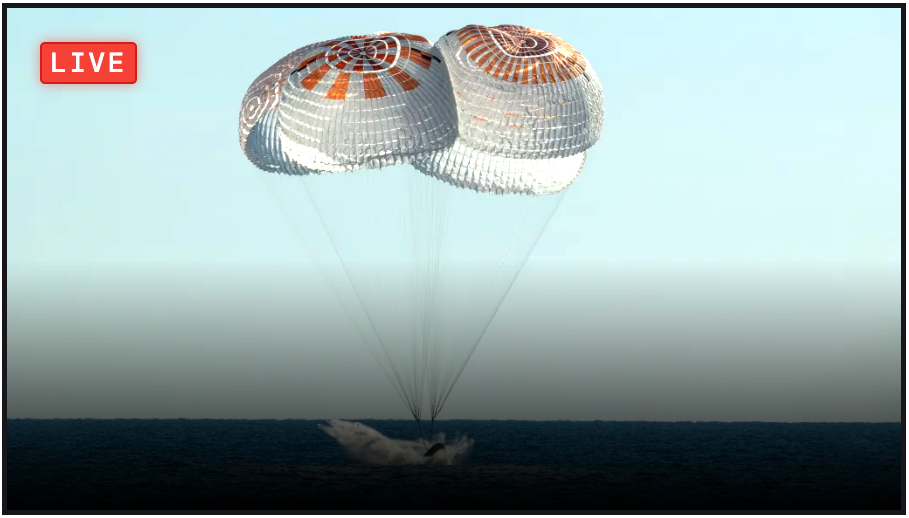
After nine long months in space NASA astronauts Suni Williams and Butch Wilmore have this morning (Australia time) landed back on Earth, with fellow astronaut Nick Hague and Roscosmos cosmonaut Aleksandr Gorbunov.
Williams and Wilmore gained global attention as their planned short stay in space ballooned into a more than nine-month ordeal.
Press in the US is reporting Williams, Wilmore, Hague, and Gorbunov spent Tuesday morning and afternoon in orbit in the roughly 4m-wide gumdrop-shaped spacecraft.
The capsule carried the astronauts from the space station – which orbits about 400km above Earth – toward the thick inner layer of the planet’s atmosphere before gently splashing down in the Trump-named Gulf of America.
Mining plays an important part in space travel.
According to ScienceDirect.com spacecraft structures use materials primarily for the specific strength/density they provide, and the specific elastic modulus/density, while other properties like ductility, conductivity, thermal expansion, and corrosion resistance are also taken into consideration.
For example, a thin layer of gold on astronauts’ visors protects them from solar radiation, as well as used in electronics like on Earth. Gold is an excellent conductor of electricity. The precious metal is incredibly soft and malleable with as little as an ounce turning into wire 80km long.
Spacecraft parts have gold-coated polyester film, which reflects infrared radiation and helps stabilise spacecraft temperatures.
Meanwhile, titanium is used in spacecraft structures because it’s as strong as steel but almost 50% lighter. Titanium is often alloyed with metals such as aluminium, molybdenum, and iron. These alloys are exceptionally strong and able to withstand the extreme temperatures of space.
These are just some of the many minerals and metals mined needed to make space travel a reality.
Write to Adam Orlando at Mining.com.au
Images: NASA


