


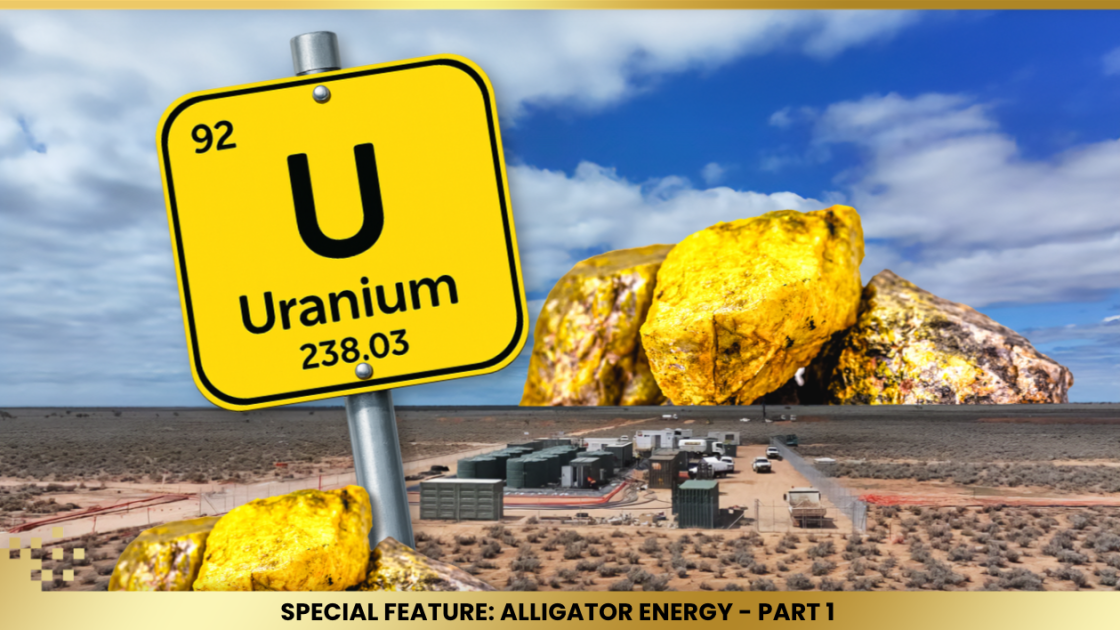
This article is a sponsored feature from Mining.com.au partner Alligator Energy. It is not financial advice. Talk to a registered financial expert before making investment decisions.
Last year (2025) marked a major inflection point for Alligator Energy (ASX:AGE) and in particular its Samphire Uranium Project in South Australia.
The year culminated in the December completion of the construction of its pilot plant at Samphire, confirming the conclusion of stage one and two commissioning and the practical completion of the pilot plan – achieved safely, on schedule, and under budget.
As CEO Andrea Marsland-Smith describes to Mining.com.au, these were “monumental steps” to derisk the project through securing the retention lease and progressing construction of the field recovery trial (FRT) plant on time and on budget.
The initial FRT results are extremely important to further derisk Samphire from an economic perspective, as well as from a technical perspective through confirmation of the in-situ recovery (ISR) viability in real field conditions.
“From an economic perspective, the FRT is critical for derisking the key assumptions we’ve used in our 2023 scoping study particularly around recoveries, reagent consumption, flow rates, operating costs, and overall productivity,” Marsland-Smith tells this news service.
“The FRT results will then feed directly into the BFS planned for completion Q1 2027, by providing higher confidence inputs that underpin the financial model and operating strategy.
“It will also help us refine the development plan and, importantly, the mining lease application, based on the most prospective and economically attractive areas.”
Ultimately, strong FRT results would be a key milestone in derisking Samphire and should support a meaningful re-rate by investors, as the project moves from concept and modelling into demonstrated field performance and bankable study level confidence.
Alligator will begin field recovery trials work at Samphire in February 2026. Control of the site has been transferred back to the company for pre-operation activities, which include stage three dry and stage four wet commissioning, beginning in January 2026.
Looking ahead, the next few quarters are expected to be highly active for Alligator, with multiple workstreams advancing concurrently – including ongoing permitting activities, resource growth drilling, updated Mineral Resource Estimate, and feasibility studies.

With a strong cash position of almost $21 million, a simplified portfolio, and an experienced leadership team in place, the CEO notes the company is well positioned to execute on its strategy and progress toward becoming Australia’s next uranium producer.
As Marsland-Smith explains to Mining.com.au, Alligator’s progress couldn’t come at a better time. Uranium supply is constrained to a small set of countries, led by Kazakhstan, Canada, Namibia, US, and Australia meaning there are only a few jurisdictions providing substantial supply plus developers trying to bring new pounds to market.
“Geopolitics and supply chain constraints have pushed utilities toward longer-term contracting and jurisdictional risk screening,” she says.
“From Alligator’s point of view we have positioned ourselves as an Australian ISR-focused developer with our flagship Samphire Uranium Project (South Australia) coming to market 2030/31 in a safe, tier one uranium mining jurisdiction with a proven approvals process.
“That’s a very specific slot in the global competitive landscape being an ISR development in a stable jurisdiction as utilities re-contract.”
The company is also advancing its Big Lake Project as a second growth leg, explicitly targeting formations analogous to other South Australia ISR mining districts to the south. It is a proof-of-concept play for uranium in Lake Eyre Basin sediments above the Cooper hydrocarbon basin.
“So, in the broader landscape, Big Lake is positioned as a longer-dated exploration-to-development option that could extend Alligator beyond a single-asset story if it continues to de-risk,” the CEO adds.
Reality bites
When asked what the fundamentals look like this year and out to 2030, Marsland-Smith says the uranium market backdrop is a very strong tailwind for Alligator’s development decisions “because it’s a great time to be advancing one of the relatively few projects, not just in Australia but globally, that has a realistic pathway to turn on production by 2030 to help meet that growing demand”.
This tailwind can be seen in the increased appetite for uranium exposure not just from investors but also from utilities. Utilities are moving back into longer-term contracting, as the market heads into a tightening supply demand balance.
“We’ve seen that reflected in the long-term contract price increasing from around US$80/lb at the start of 2025 to approximately US$88/lb currently,” the CEO says.
“South Australia’s supportive regulatory environment is extremely important to Samphire’s progression as it is the only jurisdiction in Australia that currently supports uranium mining, and it’s a proven regulatory framework – with five uranium mines already permitted in the state.
That regulatory certainty matters as it reduces jurisdictional risk and gives us a clear pathway to progress Samphire through the approvals process. It is also a key reason why we are confident Samphire is well positioned to become Australia’s next uranium mine.”

Billionaire business magnate Warren Gilman, who runs Queens Road Capital (TSX:QRC), a TSX-listed investment firm, based out of Hong Kong and focused on investing in private and public resources companies, echoes Marsland-Smith’s sentiments.
Gilman says uranium is supply-constrained with that scarcity underpinning long-term value, as reported. With nuclear gaining tailwinds and is increasingly seen as essential for the green energy transition and for energy security, he’s seeing increasing government support for the industry, reinforcing its strategic role.
Gilman’s investment philosophy focuses less on demand forecasts and more on supply constraints. He sees the current environment as one of the best in two decades for junior miners.
“Rising commodity prices have transformed previously marginal projects into highly attractive prospects,” Gilman says.
As a result, juniors can access a much broader and deeper investor base, which means exploration companies are able to advance projects that otherwise might’ve struggled to attract attention just a year ago.
“Rising commodity prices have transformed previously marginal projects into highly attractive prospects”
While Alligator Energy does not fall into that category, it is certainly one of the juniors to benefit from renewed investor interest in uranium, particularly in Australia.
As Marsland-Smith reiterates to Mining.com.au, Australia is highly relevant and importantly, uranium mining is permitted in South Australia. This is important. Australia currently has confusion and archaic legislation around uranium mining and exploration.
Presently, exploration and mining for the silvery grey metal are only permitted in South Australia, the Northern Territory, and Tasmania. Exploration is allowed in Queensland and New South Wales, but mining uranium is not.
In 2008, Western Australia opened the door to allow uranium mining – but the state government has implemented a ‘no uranium’ condition on future mining leases. Projects granted state ministerial approval by the previous government will still be allowed to progress. Yet there’s a condition issued in which no future mining leases will be issued. Permitting is allowed but for only four previously approved projects to proceed in the state.
Adding to these inconsistencies, the government in Western Australia prefers there’s no uranium mining in the state, which also prohibits U3O8 exports through its ports with future production instead poised to be shipped via Darwin or Adelaide.
As renowned resources and commodities investor Rick Rule once detailed to Mining.com.au, Australia’s rich endowment of uranium has created wealth and revenues for many countries – except for Australia itself.
The legendary investor first offered a caveat that he’s “broadly pro-nuclear and broadly anti-government” before detailing his views on the inconsistent policies for uranium exploration and development and those of federal Labor’s anti-nuclear stance.
Currently in Australia, nuclear power generation is prohibited federally.
“Australia has a wonderful uranium endowment, both in terms of natural resources, but also in terms of human resources. It’s interesting that perhaps as a consequence of the ‘three mines policy’, Australian people, humans, professionals, have brought wealth and revenues to countries around the world, with the possible exception, of course, of Australia,” Rule told this news service.
“It might be that Australian voters would like to deal with that inconsistency.”

Power plays: Global outlook
Global asset manager Sprott reports that 2025 was a tough year for the uranium spot price, with range-bound trading masking improving fundamentals.
“Term pricing has finally moved higher on light contracting volumes, reflecting a market environment where key producers are already sold forward multiple years of production. With policy uncertainty fading for utilities, we believe an improvement in long-term contracting volumes will drive 2026,” according to the report.
“The uranium spot price appears well-supported at current levels, with potential for a catch-up trade in 2026. Uranium miners fared better in 2025 as bullish equity investors looked beyond the lackluster contracting activity and focused on the compelling industry fundamentals.”
The global asset manager says policy and investment signals are aligning for a stronger 2026.
“The uranium spot price appears well-supported at current levels, with potential for a catch-up trade in 2026″
With global uranium mine production falling short of the world’s uranium reactor requirements, Sprott forecasts a supply deficit to build over the next decade, and near-term supply being hindered by long lead times and high capital intensity.
“We believe that restarts and new mines in development are critical. The uranium price target as an incentive level for further restarts and greenfield development is a moving target, and we believe that we will need higher uranium prices to incentivize enough production to meet forecasted deficits,” Sprott reports.
“Over the long term, increased demand in the face of an uncertain uranium supply may likely continue supporting a sustained bull market.”

Congregation of uranium players
Within this context, of all the states and territories in Australia to be developing a uranium project, South Australia certainly is one to facilitate rather than frustrate the process. Hence why Alligator Energy is advancing Samphire advances towards completing a Definitive Feasibility Study (DFS).
“In Australia, it’s highly relevant that uranium mining is permitted in South Australia. When global capital is looking for investable supply, that level of jurisdictional certainty really matters,” Marsland-Smith says.
“So while the project still needs to clear the usual hurdles: technical work, approvals, community confidence, and financing, the broader market environment is far more supportive than it has been for quite some time.
“We have already secured our retention lease, which enables us to conduct the field recovery trial at Samphire and is a significant milestone in its own right. From here it becomes a matter of scaling the work we’ve already done under the Retention Lease framework and progressing through the next stage into a mining lease.”
Alligator Energy has now kicked off the DFS and will be keeping the market up to date as it progresses. From here, the economic factors derived from the field trial will go into completing the Bankable Feasibility Study (BFS) economic model by Q1 2027 for a full-scale ISR operation.

The Samphire Project is located 20km from Whyalla – an industrial hub (iron/steel), with regional infrastructure, skilled labour, and local engineering/services – important because ISR project equivalents are remote, infrastructure-light, or reliant on long supply chains.
Samphire has a Resource of 18Mlbs at Blackbush (May 2025 MRE) to support a start-up operation with staged expansion, and a Scoping Study framing 1.2Mlbs pounds per annum and potential DFS upside. The orebody is shallow (<100m), which the CEO says leads to cheaper sustaining capex once in full operation.
The asset has around 78% of its resource in the indicated JORC category. This is driven by the density of the drill spacing, which provides a more granular understanding of the ore body and thereby a high level of resource integrity and accuracy which is required for detailed wellfield design to be input into the BFS.
In mid-December 2025, Alligator Energy achieved practical completion of the pilot plant for the Samphire Uranium Project on schedule. The CEO says this is strong validation of the construction and commissioning plan, particularly given the logistical and operational complexity of building a new pilot plant.
Cost performance was equally strong, she adds, saying with the construction completed under budget, which demonstrates effective procurement, tight contractor oversight, and consistent control of project scope.

Alligator stalking Samphire BFS
Meanwhile, the company is not looking to offload any other uranium assets in 2026 and will focus on progressing key value drivers, namely development at Samphire and exploration at Big Lake, as reported.
After entering into a $7.5 million binding asset sale agreement with DevEx Resources (ASX:DEV) in December 2025 to sell its non-core Northern Territory uranium assets, Marsland-Smith says Alligator is now turning work undertaken in the past three years into value-defining outcomes, with Samphire very much front and centre.
Divesting the Northern Territory uranium assets was an important step towards delivering two clear outcomes, she adds.

“Firstly, to strengthen the balance sheet, giving us additional flexibility to fund and accelerate our core work programs, and to sharpen our strategy and send a clear message to the market that we are serious about our focus – with that focus firmly on Samphire and Big Lake, both located in South Australia,” the CEO continues.
“Samphire is our near-term development opportunity, while Big Lake represents the growth story within the business and our longer-term upside.
“By simplifying the portfolio, we’ve aligned capital, people, and execution effort behind the projects we believe offer the best pathway to value creation in the near and medium term for our shareholders.”
Looking ahead to Q2 2026, at Samphire, Alligator Energy will be progressing key de-risking steps along the in-situ recovery pathway, as well as growing the resource. At Big Lake, the focus will be following up on the results from its maiden 2024 program, with more holes in the ground in 2026.
Upcoming newsflow includes first results from the field recovery trial this quarter (Q1 2026); an updated MRE for Samphire Q2 2026; and throughout this year continuous updates on results from drilling campaigns at both Samphire and Big Lake.
Write to Adam Orlando at Mining.com.au
Images: Alligator & Mining.com.au


