

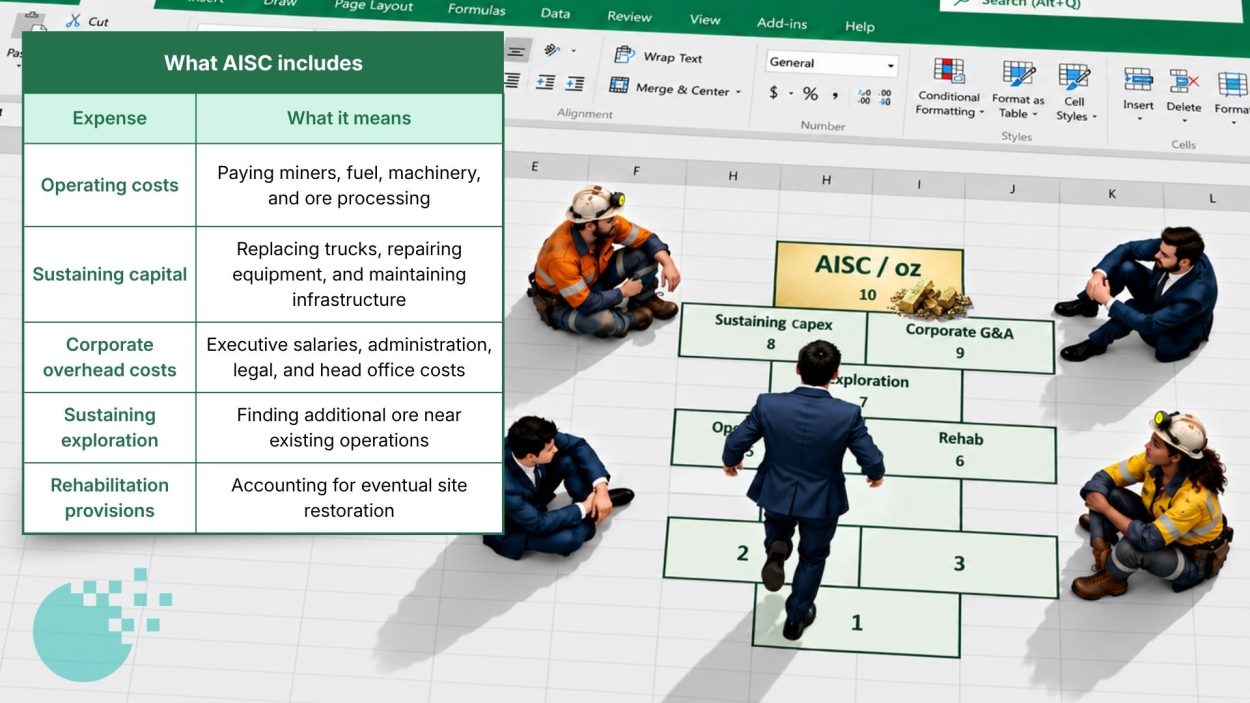
The key profitability measure for comparing gold miners.
Context and background
When a gold miner reports its quarterly results, one figure tends to dominate the analysis: all-in sustaining cost, almost always shortened to AISC.
In gold mining, AISC measures the cost per ounce of sustaining current production. It combines cash operating costs with sustaining capital, corporate overhead, sustaining exploration, and reclamation-related costs.
Investors, analysts, mining professionals, company executives, consultants, and suppliers use the metric to assess a mine’s operating performance, compare costs across producers, and gauge its margin resilience if the gold price falls.
AISC is also one of the most frequently misunderstood numbers in gold mining disclosure. Understanding how the World Gold Council introduced the measure, which costs it includes and excludes, where company-to-company comparisons can be misleading, and how typical industry AISC levels vary is essential to using it effectively.
When applied consistently, AISC provides a more complete view of the costs of sustaining gold production than older cash-cost measures. It can help investors assess profitability, cost pressures, and margin resilience across gold producers, provided they account for differences in how companies report and reconcile the figure.
Why AISC was created by the World Gold Council
Before 2013, the standard cost metric in gold mining was cash cost per ounce. Cash cost captured direct operating expenses — mining, processing, site administration, royalties — but excluded the capital spending required simply to keep a mine running at current output levels. Two mines reporting the same cash costs could have very different underlying economics if one required significantly more spending on sustaining infrastructure than the other.
The World Gold Council defined the AISC metric in June 2013, working with member companies to develop a standard definition that would give investors a more complete and consistent picture of what a mine must spend to maintain current production. AISC measures the true cost of producing an ounce of gold while maintaining operations. More than 90% of gold producers now report AISC alongside their financial results, and it has been the standard peer-comparison metric across the sector since 2013.
What AISC includes
The World Gold Council’s formula builds on cash operating costs, adding several layers to provide a practical definition of AISC that includes sustaining capital expenditure (capex) and corporate general and administrative (G&A) costs:
Cash operating costs are the direct costs of running the mine: mining labour, fuel, explosives, processing chemicals, site maintenance, and mine-site administration. Royalties and production taxes are included here, since they represent an unavoidable cost of production tied to revenue. In practice, these costs often range from US$750 ($1,068) to US$1,100 per ounce.
Sustaining capital expenditure is the most significant addition that distinguishes AISC from its predecessor. Every operating mine requires ongoing capital investment just to stay at its current production level: replacing worn equipment, maintaining and rehabilitating underground or open-pit infrastructure, improving tailings storage capacity, and upgrading processing plant components. This is capital expenditure required to maintain existing operations, rather than expand them. Excluding it from cash costs was a key reason those measures understated the full cost of sustaining production. Sustaining capex typically adds around US$250–400 per ounce.
Corporate G&A expenses are part of AISC and allocate a share of head office costs to each operating mine. These include executive salaries, legal costs, investor relations, and other overhead costs that support the business as a whole. The allocation method varies between companies, which creates one of the more significant sources of inconsistency in AISC comparisons.
Sustaining exploration covers drilling and geological work aimed at extending the known ore reserve at an existing mine — infill drilling, reserve conversion, and near-mine exploration designed to maintain the mine’s production life. Greenfields exploration for new deposits is excluded.
Reclamation and closure costs represent the ongoing accrual of provisions for mine rehabilitation. These reflect the estimated cost of restoring the site once mining is complete, spread across the mine’s production life.
The formula divides the total of these components by the number of gold ounces sold in the period, producing a single per-ounce figure reported in US dollars per ounce sold, though companies also commonly discuss it on a per-ounce-of-gold-produced basis.
What AISC deliberately excludes in capital expenditures
AISC covers sustaining activities only. Several significant cost categories are deliberately excluded from the metric.
Growth capital — which covers spending on new mines, major expansions, or significant new infrastructure — is excluded, with initial mine development treated as non-sustaining rather than included in AISC. Under common World Gold Council guidance, a major project must increase production by at least 10% to be treated as such. A company spending heavily to build a second mine or expand throughput at an existing operation doesn’t include that capital in its AISC, even though the spending is real and the cash is leaving the business. This is why AISC is not a substitute for reading the cash flow statement. A company reporting a low AISC while spending aggressively on growth capital may be consuming far more cash than the per-ounce figure suggests.
Non-sustaining exploration — along with costs for new operations and major projects — is also excluded. Debt servicing costs are excluded from AISC, as the metric does not account for interest or tax payments. These costs relate to a company’s capital structure rather than the day-to-day costs of sustaining mine operations, a distinction that is particularly relevant for producers carrying significant project finance debt.
Similarly, expenditure on developing access to a new orebody or an unaccessed mining zone generally falls outside AISC when it relates to new mine development rather than sustaining existing production.
The distinction between AISC and what the World Gold Council calls “all-in cost” is worth knowing. All-in cost adds growth capital, non-sustaining exploration, and other expansionary items back to AISC to give a broader picture of total cash outflow. It’s less widely reported than AISC but gives a more complete view of capital allocation across the business.
Where AISC comparisons break down
AISC is a non-GAAP (generally accepted accounting principles) measure, meaning it is not prescribed by a mandatory accounting standard and allows companies some discretion in how they classify sustaining costs. The World Gold Council’s guidance provides a framework for calculating the metric, but companies should provide sufficient disclosure and reconciliation for readers to assess how closely their reporting aligns with it.
Some definitional flexibility remains, meaning AISC is not perfectly comparable between companies without reviewing the supporting notes. For example, corporate donations may be treated as sustaining costs when they support ongoing operations and help maintain a social licence to operate.
Corporate G&A costs are part of AISC, including sustaining capital expenditures and head office costs needed to support the corporate structure and obligations of a public company. A large, diversified producer with multiple mines can spread head office costs across a bigger production base, reducing the per-ounce G&A charge compared to a single-mine operator of similar size. This makes large producers look structurally cheaper than small ones on a per-ounce basis even when the underlying mine economics are similar.
By-product credits are another source of variation. Gold mines that also produce silver, copper, or other metals typically offset the revenue from those by-products against their total cost to arrive at a lower net AISC. A mine producing significant copper alongside gold may report a very low or even negative AISC after by-product credits, which is accurate in one sense but makes comparison with a pure gold producer difficult. Companies should disclose their by-product credit assumptions alongside AISC, and investors should check whether a particularly low AISC is a function of genuine cost discipline or a high-value by-product stream.
The treatment of stockpiled ore creates a further complication. Mining costs associated with ore placed in a stockpile rather than sent directly to the processing plant may be capitalised instead of expensed in the current period, deferring their recognition in AISC. As a result, a mine building its stockpile may report lower current-period AISC, even though its underlying cost structure has not improved.
What AISC levels actually mean
The industry median AISC was approximately US$1,709 per ounce at the end of 2025, having risen from around US$1,000 per ounce in 2021, driven by labour cost inflation, higher diesel prices, and royalties tied to higher gold prices.
The industry’s cost curve is wide. The lowest-cost operations globally report AISC below US$1,000 per ounce, while the highest-cost producers can exceed US$2,000 per ounce. With gold trading above US$3,000 per ounce for much of 2025, even higher-cost producers were generating meaningful margins. This helps explain why cost discipline tends to receive less attention during periods of strong gold prices than when prices fall.
AISC relative to the gold price determines the margin available to a producer. A mine with AISC of US$1,200 per ounce when gold is at US$3,000 is generating US$1,800 per ounce in margin before growth capital, interest, and tax — a very different business from one with AISC of US$2,200 and the same gold price. Low-cost operations are also more resilient: they remain profitable through a wider range of gold price scenarios, and their margins expand most rapidly when prices rise.
How to use AISC when comparing companies in the mining industry
AISC is most useful as a starting point rather than a conclusion. It helps compare the cost structures and operating efficiency of different mining companies but does not tell the full story.
When two companies report similar AISC figures, but one is expanding production through significant capital spending while the other is not, their free cash flow profiles can differ substantially despite matching headline costs.
Company-specific factors, including corporate structure and reporting methods, can also affect comparability. For example, how a company accounts for its direct interests in underlying assets may influence whether its reported AISC is presented on a consistent basis with its peers.
The most practical approach is to read the AISC figure, then read the reconciliation table that accompanies it in the quarterly report, where companies break down exactly what has been included and what by-product credits have been applied.
Any significant deviation from the standard World Gold Council components — or an unusually low figure explained primarily by by-product credits — is worth understanding before drawing conclusions about cost competitiveness. Investors also use it to rank mines across operating sites on the cost curve.
Tracking a company’s AISC over time can be more useful than comparing a single reporting period across multiple producers, as consistency in how costs are classified is generally greater within a company’s own reporting than across the sector.
For example, a producer whose AISC has risen by 10% annually over three years, while gold prices have increased at a slower rate, presents a different investment proposition from one that has kept costs flat over the same period.
Cost classifications may also need to be reassessed as projects progress and work is completed. Sustained AISC trends can therefore provide valuable insight when assessing operating performance and making investment decisions in the mining sector.
Conclusion
AISC is the gold mining industry’s standard measure of the fully loaded cost of sustaining current production. It covers direct operating costs, sustaining capital, corporate overheads, sustaining exploration, and reclamation provisions.
Introduced in 2013, the metric addressed a key limitation of cash cost, which excluded the capital required to maintain existing production and therefore understated the full cost of sustaining a mine.
While AISC is widely used and provides a useful basis for comparison, its non-GAAP nature allows some differences in how companies classify and report costs. Variations in corporate G&A allocations, by-product credit treatment, and capital expenditure classifications can make headline figures misleading without reviewing the supporting disclosures.
Used alongside a company’s cash flow statement and capital expenditure breakdown, AISC remains a valuable tool for assessing the operating economics of a gold mining operation.
Write to Tyler Jefferson at Mining.com.au
Main image: Mining.com.au