


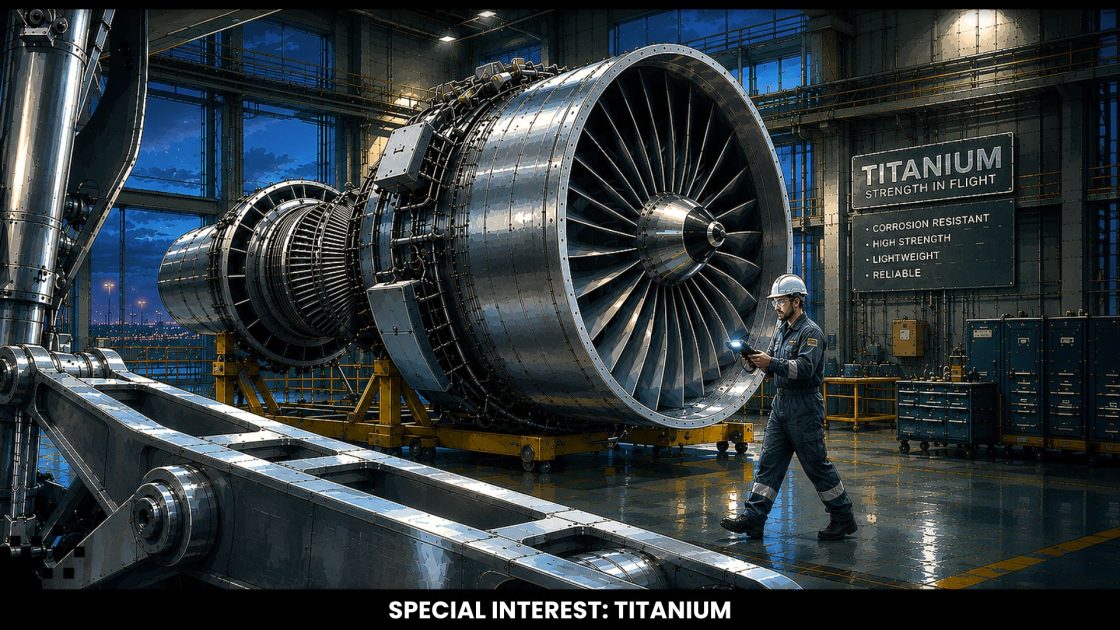
Light-weight, corrosion resistant, and exceptionally strong, titanium has long been regarded as one of the world’s most versatile industrial materials.
While the metal is best known for its use in aerospace, defence, and medical applications, around 90% of global titanium consumption is in the form of titanium dioxide. Titanium dioxide is a critical ingredient in everyday products, primarily paint, plastics, paper, and coatings.
As demand continues to grow across traditional industries and emerging technology, attention turns to where the next generation of titanium supply will come from.
According to Grand View Research, the global titanium market size was valued at US$2.4 billion ($3.4 billion) in 2023. The market is projected to grow from US$2.9 billion this year to US$3.7 billion by 2030, at a compound annual growth rate of 6.2%.
Growth in travel and tourism has led to an expansion of the aerospace segment, propelling the demand for titanium.
That shift is creating new opportunities for developers seeking to bring large-scale projects into production. Among them is Empire Metals (AIM:EEE), which is advancing its flagship Pitfield Titanium Project located in Western Australia.
In October 2025, Empire Metals delivered Pitfield’s maiden mineral resource estimate, totalling 2.2 billion tonnes @ 5.1% titanium dioxide for 113 million tonnes (Mt) — making it the “largest and highest grade” resource globally.
“We do believe that Pitfield will be a disruptor in the sense that, we’re not intending to be the world’s biggest producer of titanium,” Managing Director Shaun Bunn tells Mining.com.au.
“Our focus is very much on trying to gain market share in the higher value side of the industry. So we’re talking about architectural paints where you need a specific quality of pigment.
“That’s where I see that the Chinese supply can’t dominate.”

China’s dominance
China heavily dominates the global titanium supply chain, controlling over half of the world’s titanium sponge production, while also hosting the largest ilmenite reserves.
Comparatively, Australia accounts for around 19% of the global ilmenite production, which can be found in mineral sand deposits on the east, west, and southern coastlines of the country.
“[Australia] is probably the biggest titanium resource base,” Bunn says.
Besides Empire Metals owning the largest titanium resource project in the world, Australia also hosts Tronox (NYSE:TROX), which is the only vertically integrated company in Western Australia that mines, separates, refines, and manufactures titanium dioxide products.
Tronox extracts mineral sands to produce ‘high-grade’ titanium feedstocks, which are then used to manufacture pigments for paints, plastics, and coatings.
Iluka Resources (ASX:ILU) is also an international producer of titanium dioxide feedstocks, primarily extracting and processing ilmenite for pigment and other customers. The company’s Australian operations centre on extracting and processing heavy minerals for use in paints, coatings, and aerospace material.

Bunn explains this is an interesting anomaly about the titanium industry.
“It’s connected, but it’s connected by different companies — so who owns the resource doesn’t own the processing plant, and who owns the processing plant doesn’t make the pigment,” he says.
Another company is McLaren Minerals (ASX:MML), owner of the McLaren Titanium Project in Western Australia. The McLaren Project’s Prefeasibility Study, conducted in January 2026, confirms the project to generate $2.78 billion in revenue and $899.7 million in earnings before interest, taxes, depreciation, and amortisation over a 15.9-year mine life.
Earlier this month, the titanium-focused explorer and developer completed 663 holes for 11,568m of drilling, as part of a stage one Bankable Feasibility Study. The program aims to infill historical data and improve confidence for a mineral resource update, followed by a maiden ore reserve.
Some of the results, received in June, have returned grades up to 34.6% heavy minerals, with 27% of the latest results grading greater than 4% heavy minerals and averaging 10.3% heavy minerals.
Previously speaking to Mining.com.au, Managing Director Simon Finnis says all of this work leads to the ability to mine the project in bulk.
“Mine it cheaply and obviously reduce those overburden costs that tend to stack up,” Finnis told this news service.
The McLaren Project hosts an indicated and inferred resource of 529Mt @ 4.5% heavy mineral for 23.7Mt in situ heavy minerals.

Creating opportunities
The global titanium market faces severe vulnerabilities due to a highly concentrated supply chain for titanium sponge, surging aerospace and defence demands, and prolonged certification processes for new suppliers.
One of the present problems is the US-Iran conflict and closing of the Strait of Hormuz, as that has caused sulphur prices to rise, meaning the cost of acid is getting more expensive.
Bunn adds that this drives up energy prices and the cost of trying to process pigments is becoming more costly.
“The increase in costs, those cost pressures, they’ve been happening for a long time,” he says.
As of 1 July 2026, the Shanghai Metals Market (SMM) China titanium dioxide index closed at ¥15,732 ($3,321) per tonne, down 4.4% from early June. The titanium dioxide market operating rate remained high at 78.67% in June, with production down 2.72% month-on-month, and producer inventory also down 5.4% month-on-month.
SMM reports that customs data showed that titanium dioxide exports in May 2026 totalled 152,800 tonnes, representing a 21.05% decrease month-on-month, while cumulative year-on-year growth was still up 12.55%.

Beyond pigment
While titanium dioxide currently dominates consumption, Empire Metals’ Shaun Bunn believes the greatest opportunity could lie in expanding the use of titanium metal itself.
Bunn explains that if a company is able to make titanium metal and sell that metal at a more competitive price in comparison to steel, demand will “go through the roof”.
“You look at the applications, its weight-to-strength ratio. It’s half the weight of steel, but the same strength,” he says.
“So you could use it in electric vehicles [EVs]. Everyone complains how far their EV goes before you have to recharge it. Imagine if you could make it half the weight.”
Titanium is generally used in EVs for battery casings, underbody protective shields, and lithium-titanate battery anodes for fast charging. The metal is also roughly 45% lighter than steel, which is considered crucial for extending EV range.
Empire Metals is currently focusing on engineering studies, while also looking at capital and operating costs to build a plant at the Pitfield Project.
As previously reported, the company is set for an “avalanche of activity”, amid awaiting to confirm the metallurgical flowsheet announced in June. Empire Metals is also preparing to deliver an updated resource estimate during the current quarter.
Titanium serves as an industrial metal with enormous potential, yet its supply chain has remained relatively concentrated and slow to evolve.
As manufacturers seek more secure supply, geopolitical risks reshape critical minerals markets and demand continues to rise across aerospace, defence, and advanced manufacturing, new sources of production are becoming increasingly valuable.
For Empire Metals, the opportunity extends beyond developing another mine. If Pitfield can demonstrate a commercially competitive pathway from resource to refined product, it could help diversify global titanium supply and position Australia as a far more influential player in a market that has historically been dominated elsewhere.
Write to Aaliyah Rogan at Mining.com.au
Images: Mining.com.au, Empire Metals, Iluka Resources, & McLaren Minerals


