


With over US$1 billion ($1.5 billion) in investment required to meet tin demand in less than five years, explorers are calling on governments to step up their support of the industry.
“It’s a big number, and the truth is the industry isn’t there yet,” Dr Graham Carman, CEO of Canadian explorer and developer Tinka Resources (TSX-V:TK) tells Mining.com.au.
“Tin is essential for everything from solder to semiconductors, but it doesn’t get the same level of investment attention as other critical metals like lithium or copper. The key challenge is a lack of advanced, investment-ready projects.”
The value of the required investment has been calculated by the International Tin Association (ITA), which forecasts tin consumption will climb to 428,000 tonnes in 2030 from 357,000 tonnes in 2023.
However, ITA anticipates demand will outstrip supply by 2028, reaching a market deficit of 13,000 tonnes by 2030.
“The existing pipeline of tin projects is too thin, and investment has been insufficient in recent years, far below reaching the estimated US$1.07 billion required to bring the required mine capacity online,” Senior Market Analyst Tom Langston says.
Over half of tin demand comes from its use as a solder, however this also exposes the metal to the high-demand renewable energy technologies, semiconductors, artificial intelligence, data centres and electric vehicles.
Around a third of that new demand is expected to come from electric vehicles – which require three times more tin than internal combustion engine vehicles.
Joe David, Managing Director of Queensland-headquartered Elementos (ASX:ELT), says tin supply has been underinvested in for the last 40 years.
“Historically there were low-cost alluvial and eluvial deposits which could ramp up and down easily, but these deposits have been mined out,” he tells Mining.com.au.
“This has left tin supply very reliant on only a few major producing countries – all located in regions of lower reliability, sustainability and governance.”
Major producers concentrated in risky regions
Major producing countries including Myanmar, Indonesia, China, the Democratic Republic of the Congo (DRC) – and central Africa, Peru and Bolivia have all witnessed significant supply shocks in the past four years.
Supply disruptions this year have been the result of armed conflict in the eastern DRC, mining bans and earthquakes in Myanmar, gas explosions in Malaysia and Indonesia’s crackdown on illegal tin mining.
“It’s hard to see these regions rapidly solving their supply issues quickly, as many are not directly tin mining specific,” David says.
“Therefore we estimate that the industry will continue to struggle to maintain even the current primary tin mining levels in the next few years, let alone go close to meeting increasing supply.”

These supply disruptions forced the London Metal Exchange (LME) tin price up over 33% to a three-year high of around US$38,000 a tonne in April. At the time of writing LME tin was around US$36,184 a tonne.
Another factor contributing to the lack of new tin projects in recent years is rising inflation across the mining industry in general.
This means the tin price needs to be higher to incentivise new production.
“We’re seeing significant inflation across the mining sector — everything from energy and labour to construction materials,” Tinka’s Carman says.
“Based on those realities, we think the sustainable long-term incentive price for new tin projects is somewhere in the US$30,000 to US$35,000 per tonne range.
“The positive news is that tin has been trading around these upper levels for much of the past year, which supports renewed confidence in project financing.”
Industry behind the eight ball
Elementos’ David says the tin industry is generally poorly placed to meet the projected 2030 demand levels.
“Aside from Elementos, which is rapidly maturing its two tin projects, there are only a handful of serious listed tin developers out there and even if they all get developed before 2030 – which is currently doubtful – we will still have major shortfalls in required investment,” he notes.
David says Elementos’ flagship Oropesa Tin Project in Spain and Cleveland Tin Project in Tasmania both provide “robust investment returns” at US$30,000 a tonne, and remain bankable in the lower US$20,000-a-tonne range.
A Definitive Feasibility Study on the Oropesa project, released in April 2025, places the all-in sustaining cost at US$15,000 a tonne.
“But we have two of the better projects out there right now, so I imagine for others these numbers would be higher,” David adds.
Elementos is advancing project financing talks for Oropesa and the associated smelting assets in Spain.
Europe and North America (US, Canada, and Mexico) have zero primary tin supply and Australia produces only about 3%. Europe is currently highly exposed to the global market dynamics, with about 85% of its tin metal demands being imported mostly from Indonesia, Malaysia, Peru, Brazil and China, leading to concerns among many within the European Union (EU) and downstream manufacturers.
Europe’s only previously producing tin mine, Penouta in Spain, ceased operation in late 2023 with the owners still evaluating the path back to production.
When Penouta was briefly operational it was producing a tin, tantalum and niobium concentrate from low grade ores.
“The industry is rapidly chasing lower and lower feedstock to fill this current and forecast supply gap,” David explains.
“Reportedly tin concentrates as low as 5-10% tin are being shipped around the world to Asian tin smelters, this is down from recent threshold minimums of 40-45% tin.”
Old tailings offer one avenue of hope
This is prompting the reevaluation of historic tailings dams and low-grade stockpiles to eke out more supply.
Elementos is pursuing that avenue at its Cleveland Tin Project in Tasmania, which is a past-producing underground mine operational between 1908 and 1917 and between 1968 and 1986.
Ore mined during those periods totalled 5.65 million tonnes @ 0.68% tin and 0.28% copper, producing 23,519 tonnes of tin and 9,691 tonnes of copper.
The mine still hosts indicated and inferred resources of 7.47 million tonnes @ 0.75% tin and 0.3% copper, tailings reserves of 3.7 million tonnes @ 0.29% tin and 0.13% copper, and tungsten resources of 3.97 million tonnes @ 0.28%.

While tin is listed as a critical mineral in the UK, US, Canada, Korea, China and India, it is only categorised as a ‘strategic mineral’ by the Australian and Indonesian governments.
Strategic minerals are not considered vulnerable enough from a supply chain perspective to meet the criteria for these governments’ critical minerals lists.
David says Elementos has been engaging with the Australian and EU governments to encourage them to lift tin into their respective critical mineral lists – a move that would open up more avenues for funding.
Some Australian states, like Tasmania, already include tin on their critical minerals lists.
In mid-October the Tasmanian Government announced a new federal funding agreement to advance a study into a common user processing facility for critical minerals.
The focus of the Feasibility Study will be on the state’s northwest, using tin and tungsten as a working example.
“This shows a proactivity we aren’t used to in the private sector and for Elementos which is developing the Cleveland Tin Mine, containing both tin and tungsten resources in the northwest of Tasmania, this is of great economic encouragement,” David says.
Tasmania positioning as a tin hub
Stellar Resources (ASX:SRZ) also has tin projects in Tasmania, including its cornerstone Heemskirk Tin Project and East Renison Project located adjacent to Australia’s largest producing tin mine — the Renison Tin Mine jointly owned by Metals X (ASX:MLX) and China’s Yunnan Tin Group (SHE:000960).
The company expanded its presence in Tasmania in early October with the acquisition of the Granite Tor Project.
Stellar’s ambition is to become a top 10 global producer through the initial development of Heemskirk, where recent resource infill drilling hit a 25m wide zone of mineralisation that included grades of up to 2.75% tin.
The company is advancing a resource conversion program as part of its Prefeasibility Study.
“We are currently systematically targeting areas within the current inferred resource with the specific goal of converting them to the higher confidence indicated category, and these high grades demonstrate the success of this approach,” Managing Director Simon Taylor says.
Elementos, meanwhile, is ramping up its activities in Tasmania in parallel to progressing the development of the Oropesa project, where the company has opened up its data room to “major strategic and adequately qualified parties” following the release of the DFS.
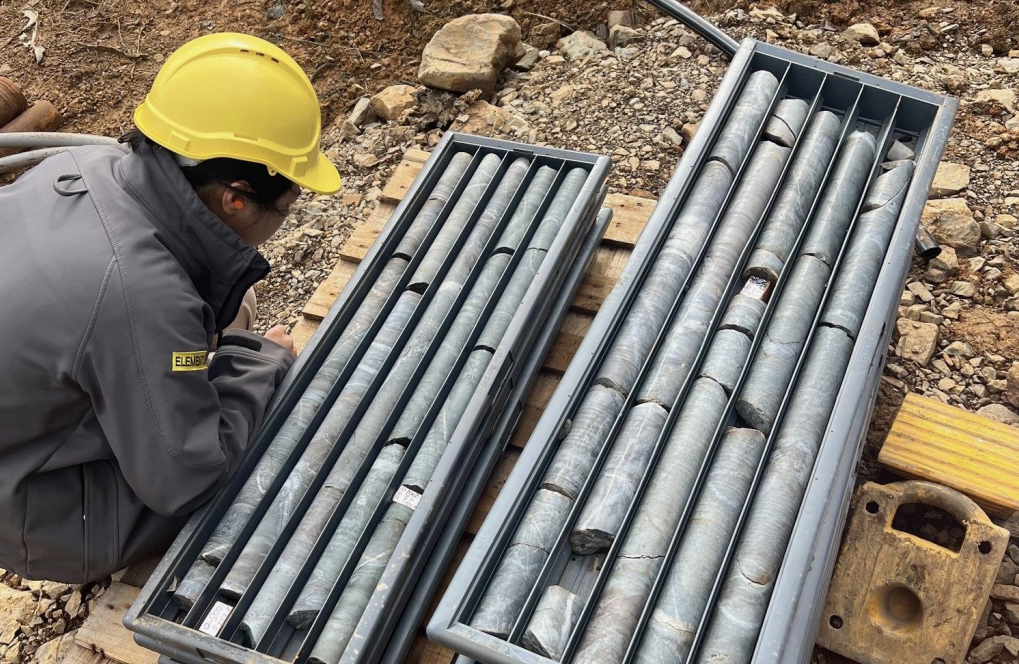
The DFS, based on a 1.4-million-tonne-per-year open cut mining project, estimates Oropesa will produce an average 3,405 tonnes of contained tin per year, as tin ingot, for sale into the global market from Europe.
Elementos has also signed a term sheet to acquire a 50% interest in Iberian Smelting, which owns the Robledallano Tin Smelter, 220km by road from Oropesa.
At a tin price of US$37,700 per tonne, the Oropesa project would have a pre-tax net present value, at an 8% discount rate, of $555 million and a pre-tax internal rate of return of 40.4%.
Tinka, meanwhile, is advancing its Ayawilca Zinc-Silver-Tin Project in Peru, which comprises a tin zone hosting indicated resources of 1.4 million tonnes @ 0.72% tin and inferred resources of 12.7 million tonnes @ 0.76% tin.
Recognising strategic importance of secure tin supply
“From a tin perspective, our goal is clear: to position Ayawilca as part of the global solution to the looming tin shortfall, along with its other metals including zinc and silver,” Carman says.
“Over the next few years, we plan to build on these resources through expansion drilling, focusing on high-grade areas, metallurgical optimisation, and de-risking the project development.
“Partnerships or offtake agreements with downstream groups who recognise the strategic importance of secure tin supply will be an option at some point.”
Carman adds that whether Ayawilca is developed as a standalone tin operation or integrated with our zinc-silver resources, it has the potential to become a meaningful new source of tin in the Western hemisphere.

He sees Western governments ramping up their investments in the tin sector with the growing realisation that tin is critical to the technologies driving their clean-energy transition and digital economy.
“There’s growing momentum to secure domestic or allied supply chains for critical minerals. We’ve seen that with lithium and rare earths, and now it’s extending to tin,” he says.
“Programs offering grants, low-cost financing, or partnerships can make a real difference in early stage development.
“Peru already has a strong mining framework, but we’re also keeping an eye on opportunities for international cooperation and strategic partnerships that could help accelerate Ayawilca’s tin potential.”
Investor sentiment is also starting to pick up, as is evidenced by Tinka’s recently completed oversubscribed C$14 million ($15.2 million) non-brokered private placement.
Investors reassessing ‘scarcity value’
Carman believes investors are starting to recognise tin’s scarcity value.
“There are only a handful of deposits globally that are both technically robust and located in good mining jurisdictions — and Ayawilca is one of them,” he says.
“As demand continues to grow, especially from the electronics and renewable energy sectors, I expect to see capital markets become more receptive to tin-focused stories.
“That’s already starting to happen, and we believe it will accelerate as the supply gap becomes clearer.”
In May, Metals X acquired a 19.98% stake in Elementos via a $5 million strategic investment.
Metals X has a 50% stake in the Renison Tin Operation in Tasmania, which the company says is the largest tin producer in Australia and one of the world’s largest and highest grade tin mines.
The miner also has a portfolio of investments and assets from exploration through to development.
Elementos’ David agrees the shift in investor sentiment is already underway.
“Despite tin often being overlooked as a metal for investment, tin’s price rise this year and distressed supply situation is starting to attract investor interest in the equity markets,” he tells this news service.
“As one of the only tin developers with a completed Definitive Feasibility Study, JORC ore reserve and rights to a tin smelter – all situated within an OECD country – I can confirm that the tin and investor industry is taking significant notice of Elementos.
“I hold few doubts that we will be able to arrange competitive equity, debt and offtake to fund the development of the Oropesa Tin Project.”
Write to Angela East at Mining.com.au
Images: Mining.com.au, London Metal Exchange, Elementos & Tinka Resources