


Sparc Technologies (ASX:SPN) has entered into a binding strategic partnership agreement with the Queensland University of Technology (QUT) to identify and undertake new projects in the sustainable battery metals sector.
The companies report that is an umbrella agreement that will support a long-term partnership and commitment between the parties, affording Sparc the first right of refusal to commercialise technologies developed from projects Sparc undertakes with QUT.
It also provides a framework for long-term cooperation whereby Sparc and QUT agree to work together to identify and undertake new projects.
The strategic partnership is not subject to any material conditions precedent. The initial term of the agreement is 3 years and the main objective is to develop functional materials using graphene and carbon material and related manufacturing process technologies, for a range of applications including the coatings, composites, cementacious and energy industries.
There are no cash payment obligations between the parties. While Sparc sees the agreement as having the potential to create long-term value, it does not expect the agreement to have any direct financial impacts on the company in the near-term.
Addressing the agreement, Sparc Managing Director Mike Bartels commented: “Sparc is excited to join with QUT in a strategic partnership, commencing with a project in the battery anode space with the development of a novel process for the production of hard carbon.
Using readily available, sustainable bio-waste material will provide Sparc with a strong environmental value proposition when compared with conventional sources of hard carbon.
“We will be targeting the production of materials for the high growth market of sodium-ion batteries which is displaying significant promise as an alternative to lithium-ion batteries”
We will be targeting the production of materials for the high growth market of sodium-ion batteries which is displaying significant promise as an alternative to lithium-ion batteries. In addition to enhanced safety for industrial scale energy storage, of great significance is the fact that the materials used in Sodium ion batteries are accessible and not challenged in supply as is the case with lithium-ion batteries.
The Sustainable Hard Carbon Anode project compliments existing knowledge and skills Sparc has developed through its graphene expertise and the extension of this into renewable energy technologies is a natural fit with Sparc’s photocatalytic green hydrogen project.”
QUT Lead researcher Associate Professor Deepak Dubal, School of Chemistry and Physics commented that QUT welcomes Sparc as a partner with the first project being associated with sustainably sourced bio-waste producing anode material.
“We expect this will open the door to many more exciting R&D opportunities between us.”
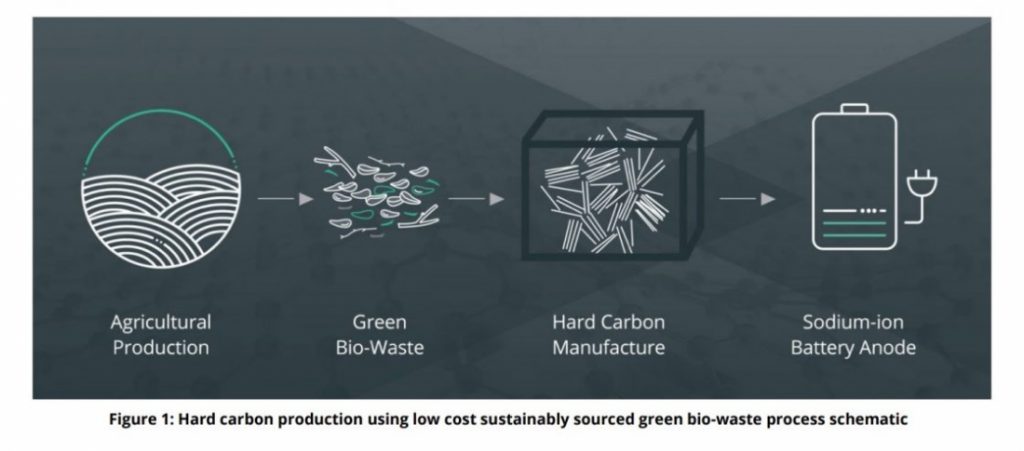
Concurrent with signing the Strategic Partnership Agreement, Sparc has commenced a project with QUT that will develop a novel process for the production of hard carbon using low cost sustainably sourced green bio-waste targeting the sodium-ion battery industry.
The hard carbon materials will be characterised and tested in a sodium-ion cell format at QUT’s ‘world-class’ facilities for battery development and testing, including the National Battery Testing Centre and Central Analytical Research Facility (CARF).
Sparc has also engaged an experienced battery technology consultant to advise on the project and to assist with commercialisation.
Wood Mackenzie expects Sodium ion batteries to take some of LFP’s share in passenger EVs and energy storage, reaching 20GWh by 2030 in its base-case scenario, according to a report in PV Magazine.
Sparc Technologies is an Australian company pioneering new technologies to disrupt and transform industry while seeking to deliver a more sustainable world. It has established offices in Europe and North America.
Graphene, a major focus for Sparc, is a 2-dimensional material made of carbon atoms arranged in a hexagonal lattice which creates unique and powerful properties that can be imparted on products to improve performance.
The company is commercialising graphene in a number of applications including graphene-based additives for the marine and protective coatings market along with applications in the renewable energy and construction materials sectors.
Write to Adam Orlando at Mining.com.au
Images: Sparc Technologies Ltd