


Everyone has been talking about the importance of lithium, copper, and rare earths, but the global energy transition relies on a much larger mineral ecosystem.
As the world races to build flexible, low-carbon energy systems, global demand for headline critical minerals, along with bulk and industrial materials, is rising.
Silica sand being one of them.
According to the International Energy Agency (IEA), renewable electricity generation is expected to rise by roughly 1,050 terawatts-hours (TWh) each year. Of this, more than 600TWh on average is set to come from solar photovoltaic (PV) generation annually through to 2030.
In 2025, solar PV recorded the largest year-on-year increase in global electricity generation, at 620TWh, compared with 450TWh in 2024.
The IEA expects solar PV generation to overtake wind and nuclear this year and hydropower by 2029.
Behind that expansion sits an extensive list of materials that rarely receive the same attention as lithium or copper.
Silica sand, limestone, tellurium, indium, and gallium all play key roles in modern energy and technology supply chains — highlighting that the energy transition is not simply a story about critical minerals, but about the availability of the right materials at the right quality.
From sand to solar… and more
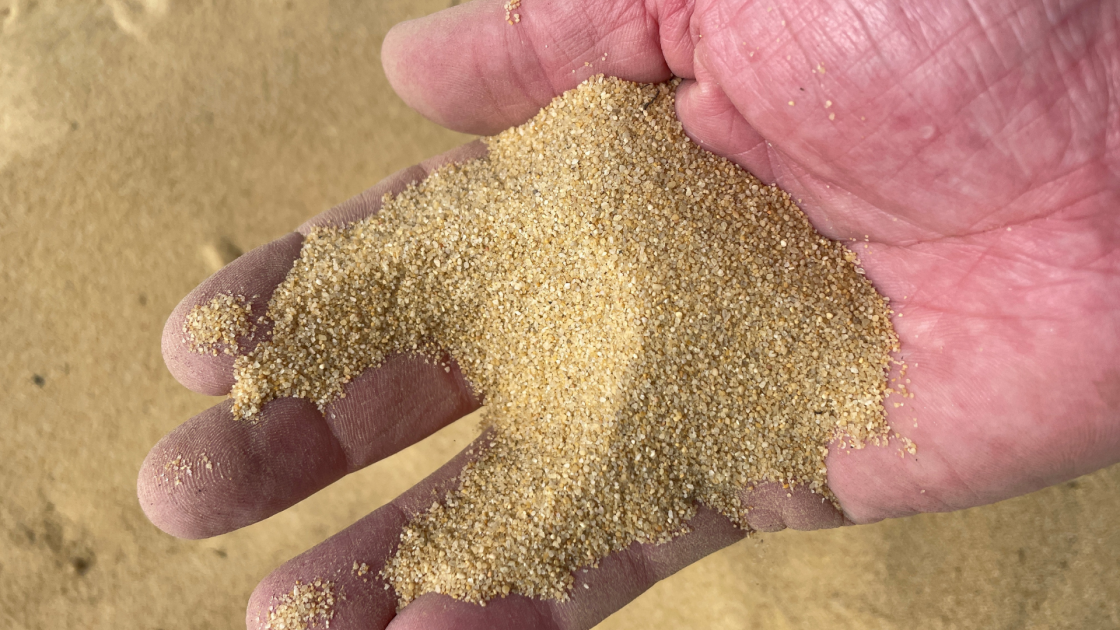
Silica sand is a vital, low-cost raw material used in renewable energy applications, including manufacture of solar PV panels and high-temperature thermal energy storage.
High-purity silica is processed into ultra-clear glass and polysilicon, essential for solar PV panels. But its application extends far beyond renewable energy into speciality glass, precision optics, semiconductor chips, and advanced manufacturing.
That contrast is important as silica may be abundant, but high-purity silica is not.
Deposits naturally low in impurities — particularly iron — and capable of meeting the stringent specifications required for high-value industrial applications are considerably harder to find.
That is increasingly turning purity into a competitive advantage for silica developers and explorers.
Australia is particularly well-positioned, as the nation hosts some of the largest high-grade silica sand deposits in the world, primarily in Queensland and Western Australia.
In 2024, Australia exported US$216 million ($302.38 million) worth of silica sands and quartz, making it the second-largest exporter in the world, according to the Observatory of Economic Complexity (OEC).
Despite this strong position in global trade, silica sand and quartz ranked 99th among Australia’s roughly 5,000 exported products in 2024.

While a top-100 ranking shows the commodity’s existing importance to Australia’s export market, it also points to the potential for the sector to become more significant as demand for high-quality silica rises across construction, glassmaking, solar panels, and other industrial applications.
Australia’s major export destinations in 2024 included China, Japan, Chinese Taipei, South Korea, and the Philippines.
That opportunity is not limited to international markets, with Australia’s domestic silica sand market expected to expand. IMARC Group reports that the market was valued at US$537.3 million in 2025 and is forecast to reach around US$885 million by 2034, exhibiting a compound annual growth rate of 5.53% during 2026–2034.
With Australia already ranking among the world’s leading exporters, the projected growth in domestic demand could provide another leg of expansion for the nation’s silica sector.
Previously speaking to Mining.com.au, VRX Silica (ASX:VRX) CEO Tony Swiericzuk said the silica sand market was massive, with global demand in the hundreds of billions of tonnes annually when construction and reclamation sand is included.
“As you move up in quality, the higher qualities (more than 99% silica), you start to move into industrial uses such as ceramics, foundries, water filtration, and more,” Swiericzuk told this news service.
Based on these figures, Australia has the resources, mining expertise, and geopolitical position to remain a key supplier of the less-discussed material.
Eyeing the high-purity opportunity
VRX Silica is one company seeking to capture the silica sand opportunity, with five projects across WA.
The company’s most advanced asset, the Arrowsmith North Silica Sand Project, is targeting first production in 2027, subject to environmental approvals.
Arrowsmith North has a total mineral resource of 513 million tonnes (Mt) @ 98% silicon dioxide (SiO2), and an ore reserve of 221Mt @ 99.5% SiO2.
“We’ve got 50% of Arrowsmith North product under offtake and there’s much more demand there because customers see Australia as low sovereign risk,” Swiericzuk says.
“They see us as a future reliable, consistent producer of both volume and quality.”
A previously conducted Bankable Feasibility Study outlines a post-tax net present value of $179 million and an internal rate of return of 31%. Based on an initial 25-year mine life, the study estimates the project will yield $2.7 billion in revenue.
In mid-July 2026, the company received binding commitments from Nebari Natural Resources Credit Fund II and Delphi Group to raise a total of $4.5 million in two strategic equity placements.
Nebari has committed to subscribing for $3.5 million, while Delphi Group has committed for the remaining $1 million.
“Having these major institutions on our register is a significant step forward for VRX, consistent with our planned strategy to introduce more institutions to our register as we plan for the transformation to developer-producer,” Swiericzuk says.
“VRX looks forward to working together with the Nebari and Delphi teams as we progress to the construction phase of our Arrowsmith North Silica Sand Project and accelerate development of our world-class Muchea Silica Sand Project.”
VRX Silica also owns the Muchea Silica Sand Project, located 50km north of Perth. The project has an ‘outstanding’ grade of 99.9% SiO2, which the company says makes it suited to supplying sand to the growing ultra-clear solar-panel glass industry.
Muchea has an indicated and inferred resource of 208Mt @ 99.6% SiO2, and an ore reserve of 18.7Mt at more than 99.9% SiO2.
The company is continuing development at Muchea following the WA Government’s approval of a land swap proposal, as this news service reported.
As part of the proposal, VRX has applied for a replacement mining lease over 721 hectares of land currently within a restricted file notation area (FNA).
VRX Silica will relinquish its existing mining lease, freeing 818 hectares from the current lease area. The company says the newly available land is expected to be incorporated into the FNA area, increasing the tonnage of ‘high-grade’ silica sand available for mining.
But while Australia is positioning itself as a potential low-risk supplier of high-purity silica, developments overseas show just how far the material’s potential could extend.
When sand meets semiconductors
Homerun Resources (TSX-V:HMR) is taking the silica story beyond solar glass and into some of the world’s most advanced technology supply chains.
The company is developing its Santa Maria Eterna (SME) Silica Valley Project in Bahia, Brazil, around high-purity, low-iron silica resources.
Earlier this week, the company expanded its strategy to supply high-purity silica feedstock into fused silica, silicon, and silicon carbide integrated photonics, advanced telecommunications, and quantum networking industries.
Homerum is working in partnership with the University of California, Davis, in the US, to process the high-purity SME silica sand into fused silica, silicon, and silicon carbide suitable for semiconductor feedstocks and substrates.
The high-purity silica sourced from SME undergoes pre-treatment to ensure particle uniformity and homogeneity before the material is irradiated using a pulsed laser system.
This news comes after Homerun shipped purified silica exceeding 99.99% silicon dioxide to prospective customers for product qualification following a bulk sample test work on Brazilian material.
Homerun says the bulk sample test work supports the reproducibility of the purification process and provides feedstock for continued advanced materials research.
The company’s strategy is another example of companies attempting to capture more of the value chain rather than simply selling silica as a bulk material.
As solar deployment accelerates, semiconductor and photonics demand grows, and countries seek to build more resilient supply chains, the grain of sand could become a critical piece of the global technology and energy puzzle.
For a mining industry accustomed to searching for the next lithium, copper, or rare earths boom, silica sand offers a reminder that sometimes the most strategic commodities are not the ones making the most noise.
Write to Aaliyah Rogan at Mining.com.au
Images:


