Far North Queensland has a mining history as colourful as its tropical landscapes. Nearly 1 million ounces (Moz) of gold were shipped from Cooktown between 1873 and 1877 when the settlement was home to 65 pubs for just 4,000 residents.
But as alluvial gold ran out, so did those thirsty miners.
Now a new generation of explorers and developers is looking to unlock the region’s potential as critical minerals offer fresh opportunities.
Queensland’s Far North already has a workforce skilled in modern mining techniques, as well as ports and other infrastructure supporting a well-established industry. That includes Rio Tinto’s (ASX:RIO) massive and expanding bauxite operations in Cape York.
As well as its established resources industry plus the potential still in the ground, the region is a priority for the pro-development state government.
Queensland introduced new tools in August to support critical minerals projects and other developments considered strategically important to the state.
The legislation gives ministers new powers to fast-track high-priority projects. It also empowers the Coordinator-General to bring together developers, government agencies, councils, and infrastructure providers to plan essential services such as power, water, transport, and housing.
That matters for Far North Queensland, where projects can be spread across large distances and require cooperation between mining companies, government agencies, and regional communities.
Ark sets sights on multi-mineral revenue stream
Ark Mines’ (ASX:AHK) Sandy Mitchell resource 230km northwest of Cairns is a strong example of the type of project the new laws are designed to support.
The company just released a Scoping Study for the rare earths and heavy minerals project. Forecast average annual revenue is about $348 million, with garnet contributing $181 million, $78 million from monazite and mica products a further $69 million. Life-of-mine revenue is projected to reach $8.39 billion over a potential 26-year operation.
One of the major source minerals of the world’s light rare earth elements, monazite hosts high-value neodymium, praseodymium, dysprosium, and terbium used in permanent magnets.
Garnet is better known as a gemstone used in jewellery, but most of it is used in industrial applications such as abrasives and ceramics.
Mica has wide-ranging uses, from electrical and thermal insulation to providing UV protection in paints and even shimmer in makeup.
Biotite, muscovite, zircon, xenotime, and titanium minerals — all used in industrial and electronics manufacturing — will add to the revenue pool.

Ark’s Scoping Study comes hot on the heels of last month’s mineral resource estimate (MRE) update. The company announced a whopping 428% resource lift to 379.4 million tonnes (Mt) at 5,430 parts per million monazite equivalent, with 97% classified in the higher confidence measured and indicated categories.
The interpreted mineralised domain has expanded to 23.3km2, but that area represents only about 14% of Ark’s 169km2 tenure.
Since the resource update, metallurgical testwork by the Australian Nuclear Science and Technology Organisation (ANSTO) has returned highly encouraging 99.6% light rare earth (LRE) extraction from Sandy Mitchell monazite.
Ark now plans to move straight into Prefeasibility Study and JORC ore reserve work.
EQ Resources rides tungsten wave
Tungsten has emerged as one of the hottest commodities of the past year. Its price has soared to US$2,700–2,900 ($3,828–4,111) per metric ton unit (or 10kg) of ammonium paratungstate — approximately 355% above its October 2025 price.
Just as dominant producer China tightened exports, defence demand surged. And the US, in particular, is chasing alternative supply for the metal used in military hardware, as well as industrial machinery.
EQ Resources’ (ASX:EQR) Mt Carbine mine is the largest of Australia’s three active tungsten producers. Located near Mareeba in the Tablelands area, Mt Carbine hosts an in situ resource of more than 41Mt at 0.23% tungsten trioxide (WO3), containing 9.38 million metric ton units (mtu) of tungsten.
The operations combining open-pit mining and historical stockpile retreatment had a strong September 2026 quarter, with production up 31% over the previous three months, to 17,145mtu.
That production contributed to EQ Resources’ record revenue of $158.8 million for the quarter from consolidated sales volumes of 49,715mtu — a 101% increase quarter-on-quarter.

EQ Resources is now investing $39 million in an expansion designed to double crushing capacity to 2Mt a year. Commissioning is expected to begin in the March 2027 quarter.
Record production from EQ Resources’ Barruecopardo operation in Spain, along with contributions from Mt Carbine, led to record quarterly revenue.
Iltani Resources discovers its niche mineral alongside silver
Iltani Resources (ASX:ILT) is advancing its Orient Silver-Indium Project near Herberton as surging indium prices put the spotlight on the niche metal.
One of the least abundant elements in the earth’s crust, indium is often a byproduct of zinc processing.
Most indium is then used to make indium tin oxide, which is an important part of touchscreens, flat screen TVs, and solar panels.

But like many other critical minerals, indium production is dominated by China, making alternative sources increasingly attractive as manufacturers look to diversify supply amid expanding demand.
That’s being reflected in prices, with 99.99%-purity indium selling for around US$710/kg at the end of October 2026, almost doubling from a year ago.
Orient’s maiden MRE, announced in October 2025, stands at 62.5Mt at 81.5 grams per tonne silver equivalent (AgEq), with a higher-grade core of 34.2Mt at 110.4g/t AgEq.
The current resource contains 45.9Moz of silver, 725 tonnes of indium, 341,000 tonnes of lead, and 421,000 tonnes of zinc.
After some highly encouraging results last month from a 110-hole drilling program, Itani has updated resource estimates for Orient East and Orient West scheduled in the coming months.
These estimates will inform a Scoping Study expected in early 2027. Further drilling is also planned to follow up on mineralisation outside the current resource areas. With a view to the study’s economics, Iltani sent sorted material from Orient to Core Metallurgy in Brisbane for flotation testwork after receiving positive ore sorting results in October.
Metro Mining in top tier neighbourhood
Another producing mine in Far North Queensland is Metro Mining’s (ASX:MMI) Bauxite Hills. It’s about 95km north of Rio’s massive operations in the Weipa bauxite province, one of the world’s major bauxite-producing regions.
Operating since April 2018, Bauxite Hills has an estimated ore reserve of 69.6Mt and a total mineral resource of 107.4Mt, down from late 2024 estimates due to mining depletion.
From the western side of Cape York, Metro ships the ‘high-grade’ bauxite to China, where it is used to produce alumina and aluminium.
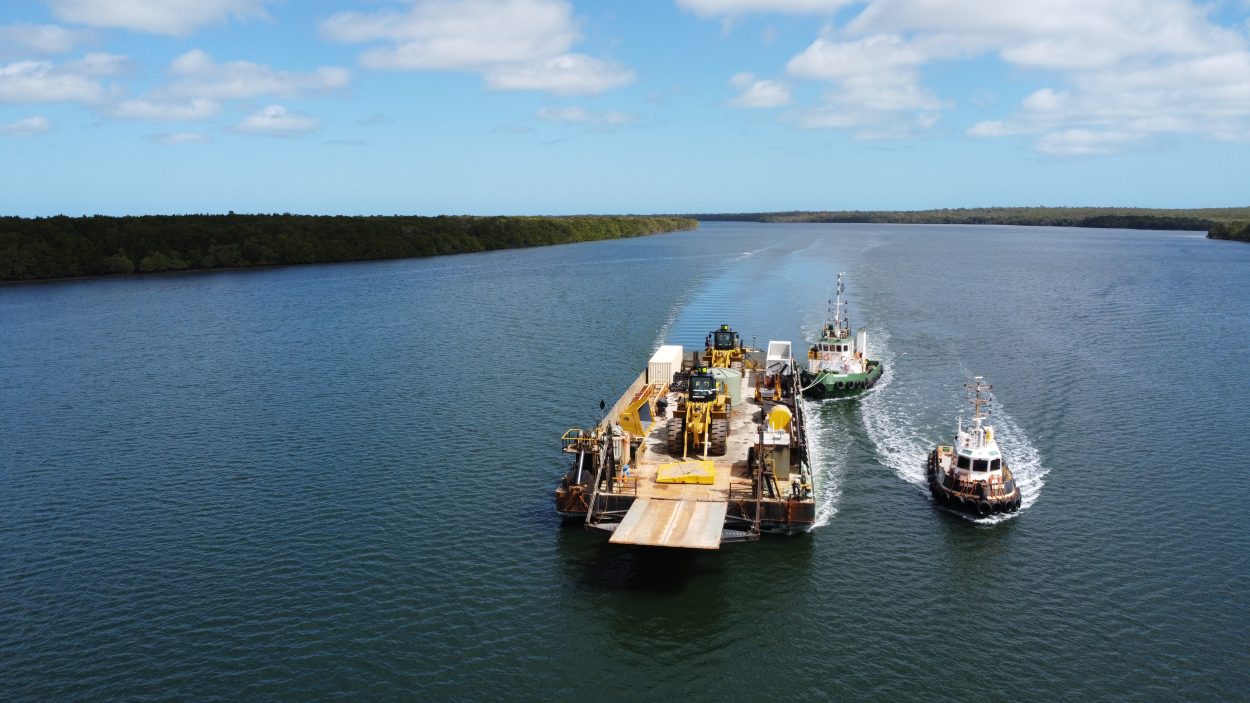
Operations in September were affected by constraints in the Skardon River barging channel after a mid-month sandbank collapse. Despite this, shipments still reached 756,000 wet metric tonnes (WMT) in August 2026, with year-to-date shipped volume totaling 4.013 million WMT.
Aside from a maintenance program that started this month (October 2026), Metro is progressing feasibility studies to support approvals for dredging. The company hopes this will provide a longer-term solution to channel constraints, in collaboration with government-owned Ports North.

Write to Christina Wagstaff at Mining.com.au
Main image: Unsplash