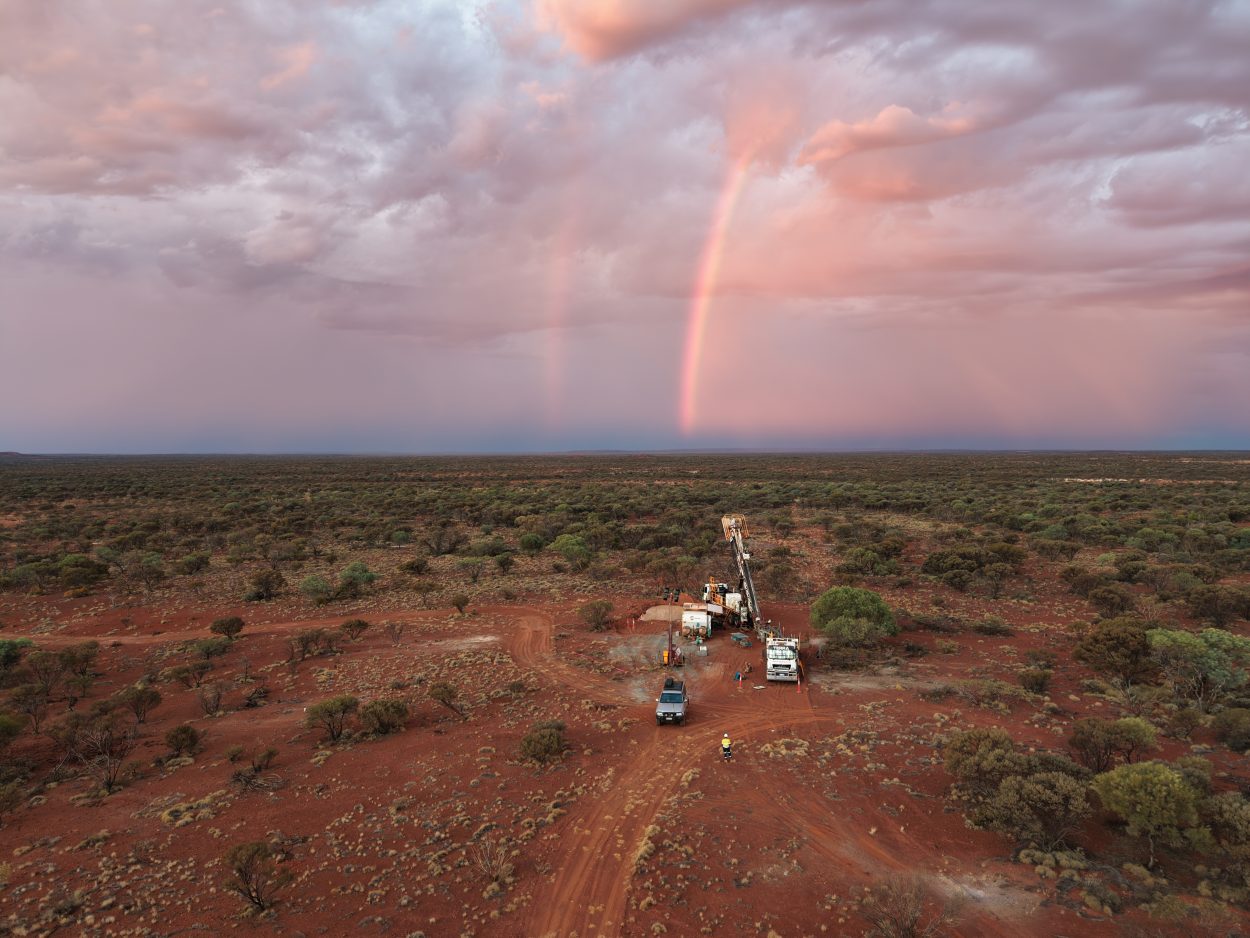
Western Australia’s Gascoyne has been picked over by prospectors venturing north from the Goldfields for more than a century. Now better known for its more relaxed style of tourism, the region is attracting a new generation of explorers with fresh techniques and insights.
The biggest historical find in the Gascoyne was made by a pastoralist whose discovery in 1956 led to the development of the Star of Mangaroon gold mine. Between 1960 and 1983, the mine produced 7,464 ounces of gold (Au) at a highly enviable grade of 34.8 grams per tonne Au.
Since acquiring Mangaroon in 2022, Dreadnought Resources (ASX:DRE) has been reviving the project as a gold, niobium, and rare earths asset. The company has carried out the first systematic modern geochemical and geophysical campaigns across approximately 80km of prospective strike.
Dreadnought is also exploring the asset’s nickel-copper-platinum group elements potential with Canadian major Teck Resources (TSX:TECK.B).
South of Mangaroon, Benz Mining (ASX:BNZ) has identified what could be one of WA’s more significant gold discoveries in recent years at its Glenburgh Project.
Backed by a $150 million capital raising, Benz has started a planned 450,000m drill program. Chair Evan Cranston describes it as “one of Australia’s most aggressive gold exploration campaigns”, with an exploration target of 485–540 million tonnes (Mt) for a contained 10.1–12 million ounces (Moz).
Corazon’s new insights open up overlooked ground
Following its geological breakthrough last year, Corazon Mining (ASX:CZN) is expanding its gold portfolio in southeast Gascoyne and the neighbouring Bryah-Padbury region.
At its Two Pools Project, Corazon identified a 20km-long, 3–6km-wide greenstone belt, previously misclassified as granite, after reinterpreting historical information and reprocessing magnetic data.
Corazon then acquired an additional 50km² of ground immediately northeast of Two Pools, where soil and rock chip sampling provided further evidence of gold prospectivity.

Two Pools sits within the Plutonic–Marymia Greenstone Belt, home to major gold deposits including Catalyst Metals’ (ASX:CYL) Plutonic mine, which produced 104,000 ounces Au in 2024–25, and the Trident mine.
Trident has a reserve of 6.2Mt @ 5.4g/t Au for 1.1Moz, making it the second-largest deposit on the Plutonic Belt. Mineralisation extends beneath overthrust granite at Trident, as it does at Two Pools.
‘High-grade’ hits put Feather Cap on the map
Further south, Corazon’s Feather Cap Gold Project sits in the Bryah–Padbury Basin, near Great Boulder Resources’ (ASX:GBR) Peak Hill Project, which hosts 9.4Mt @ 1.6g/t Au for 481,000 ounces. Feather Cap is also close to Westgold Resources’ (ASX:WGX) Fortnum processing hub.
Maiden drilling at Feather Cap’s Wembley prospect returned encouraging results, including 4m @ 10.6g/t Au from 66m and 4m @ 9.2g/t Au from 65m. Importantly, the results confirm and extend shallow mineralisation along the historical Wembley Line.
Feather Cap’s Durack East prospect, also known as Jigsaw, follows a gold trend extending about 3km along strike from Great Boulder’s Durack deposit, which hosts a JORC mineral resource estimate of 2.4Mt @ 1.2g/t Au. Historical drilling at Durack East returned 20m @ 3.01g/t Au, including 4m @ 10.7g/t Au.

Corazon also expanded its portfolio into the neighbouring Eastern Goldfields, completing the $25.7 million acquisition of the Chalice Gold Project from Westgold in July. Significantly, the producer retains a 19.9% stake in Corazon.
Initial assays from the maiden drilling program at Chalice Gold returned ‘broad’ gold zones, including 4m @ 9.93g/t Au.
Dalaroo uncovers gold potential alongside rare earths
Dalaroo Metals (ASX:DAL) initially targeted base metals at its Lyons River Project before turning to lithium as the Gascoyne became a hot spot for critical minerals.
In 2022–23, the company re-examined historical soil sampling data and identified multiple lithium anomalies and rare earth element (REE) targets.
Subsequent aircore drilling campaigns at the 838km² property identified a primary hydrothermal gold system over a strike length of at least 200m. The results revealed previously unrecognised gold potential in the underlying rocks.
Lyons River lies within the Mutherbukin zone of the Upper Gascoyne. That’s the same neighbourhood as Benz Mining’s Glenburgh, which is located near the boundary between the northern domain of the Glenburgh Terrane and the southern edge of the Mutherbukin zone.
Dalaroo has also identified two significant REE anomalies worthy of follow-up exploration. One returned peak total rare earth oxide (TREO) grades of 2,025 parts per million (ppm) across an anomaly extending more than 3km. The other recorded grades of up to 1,043ppm TREO over a 2.2km strike, coinciding with a prominent thorium anomaly.
Lyons River is part of Dalaroo Metals’ broader gold and critical minerals portfolio, which also includes the Watheroo Project in WA and assets in Côte d’Ivoire and Greenland.

Write to Christina Wagstaff at Mining.com.au