


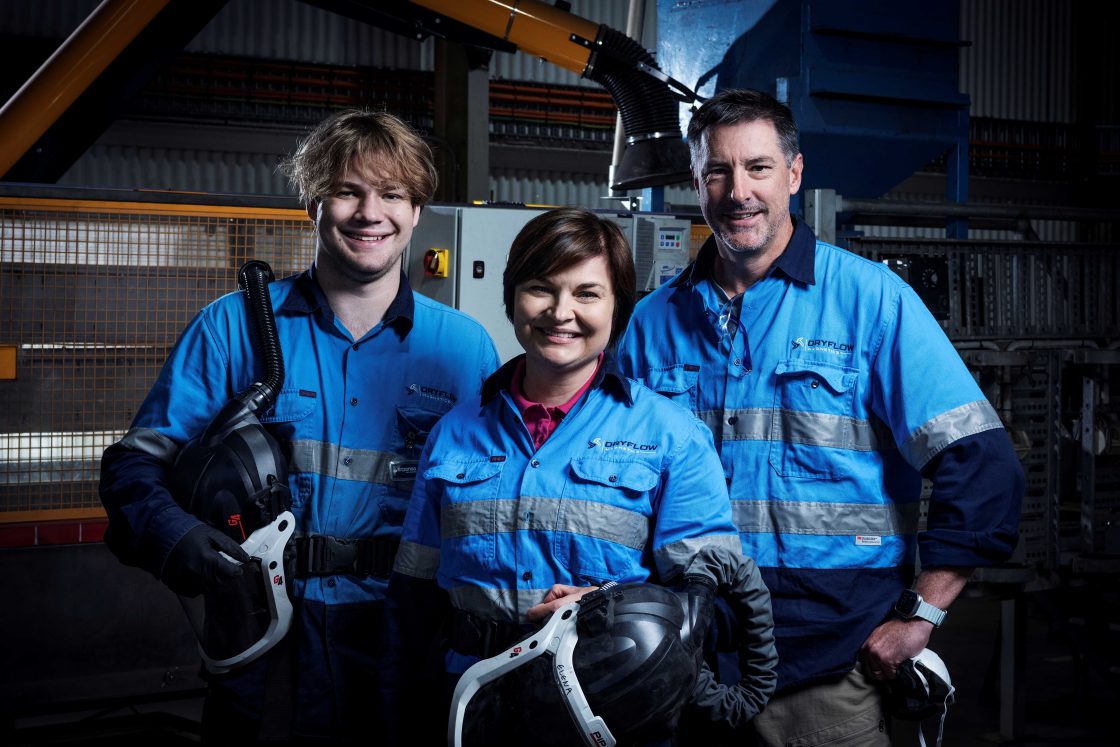
DryFlow Magnetics is accelerating the deployment of its “game-changing” dry magnetics technology for producing green steel grade iron concentrate and recovering critical minerals.
This news comes after DryFlow extended a $10 million seed round investment, backed by major institutional investors Orion Industrial Ventures, Virescent Ventures, and Taronga Ventures.
The industrial tech company will install its first commercial pilot plant on an active South Australian mine site, where it is set to trial production of Australia’s first high-purity iron ore concentrate in partnership with Peak Iron Mines at the Buzzard Mine and Hawks Nest iron ore project.
DryFlow’s waterless process has been extensively and independently validated and tested on ores from across Australia. As a result, the company is looking at starting Australia’s green steel industry.
CEO Brett Boynton says the green steel industry needs high-purity iron ore concentrate, and right now Australia does not produce it.
“Our competitors in Brazil, Canada, and Europe are all using wet processing technologies to produce high-purity iron ore concentrates,” Boynton says.
“This isn’t an option in Australia, but DryFlow’s technology changes the future for the industry. We can unlock billions of tonnes of stranded mineral resources and produce the exacting high-grade iron ore concentrate steelmakers are switching to.
“By removing the need for process water, we also do it more efficiently, cost effectively, and sustainably.”

Bedrock of the economy
Australia is the world’s largest iron ore producer and exporter, providing more than 36% of the world’s supply.
As Mining.com.au reported, Federal Resources Minister Madeleine King says iron ore is the bedrock of the nation’s economy and exports are predominantly out of the Pilbara region — an important component of the federal economy and budget.
In 2024–25, almost 50% of mining jobs in Western Australia were iron ore related, representing a record figure of almost 65,500 full-time-equivalent positions.
Despite iron ore’s significance, DryFlow says globally iron ore grades are declining and as global steelmakers race to decarbonise, the demand for high-purity iron concentrate is forecast to grow rapidly.
Conventional wet processing methods are both water and energy intensive, which is considered a barrier in the arid and remote Australian iron ore regions, such as the Pilbara. DryFlow says its technology changes that equation.
According to the Superpower Institute, Australia has an opportunity to upgrade exported iron ores to higher grade for green iron and capture a market worth $386 billion annually by 2060. This figure represents more than three times the value of today’s iron ore industry — $116 billion in 2024–25.
Grade and why it matters
Iron grade refers to the percentage of iron contained within the ore. Higher-grade iron ore contains more iron per tonne, which improves efficiency in steelmaking, as this news service reported.
Comparatively, lower-grade ore contains less iron and requires more processing, which increases costs for steel producers.
Quality affects pricing and marketability for miners. Higher-grade, low-impurity products are preferred by steel producers seeking to improve efficiency and reduce emissions. Meanwhile, lower-quality products are typically more exposed to price volatility and may face greater competition.
Further, DryFlow’s technology is also able to unlock critical minerals. The company is fielding inbound interest and recently secured its first customer in the US, where federal and state governments are pushing to unlock critical mineral deposits, including cobalt, nickel, and rare earths in legacy mine tailings.
Boynton says DryFlow’s operating model had been designed to accelerate adoption.
“We offer separation as a service, installing our technology on a customer’s site, and charging a tolling fee only on the ore processed,” the CEO says.
“There’s no upfront capital outlay for the miner, no technology risk, and a significantly simpler flowsheet to produce high-purity ore. We enable the customer to make more from less, with a lower capital and operating cost producing a higher-value product for market.
“We value-add the mine’s current production, and we can reprocess low-grade stockpiles and tailings, recovering lost iron units or other minerals. Improving margins attracts a lot of attention in the industry, where miners have been battling with rapidly escalating production costs.”
DryFlow Magnetics is an Australian industrial technology company focused on pioneering patented dry magnetic separation for mineral processing. Backed by grant funding from the CSIRO and South Australian Government, DryFlow aims to reshape sustainable mining in water-stressed regions.
Write to Aaliyah Rogan at Mining.com.au
Images: DryFlow Magnetics & iStock


