


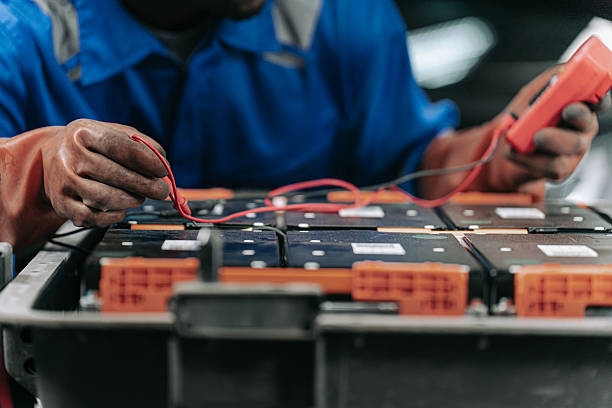
Chinese companies are investing US$6 billion ($8.56 billion) in Morocco’s battery supply chain, highlighting how trade policy, shifting manufacturing hubs, and electric vehicle (EV) demand are reshaping the outlook for critical minerals.
The companies are investing in battery cells and cathode materials, helping develop the industrial capacity needed to support a more integrated EV supply chain outside China.
Shanghai Metals Market (SMM) reports that the lithium sourcing arrangements for the planned battery and cathode plants have not been disclosed. This makes it difficult to determine how much additional demand the investment could generate for lithium producers.
The investment comes as the European Union (EU) imposes additional duties on Chinese-made EVs, prompting manufacturers to reassess where vehicles and their components are produced.
For the mining sector, this raises questions about where future battery-grade lithium production will be located and how quickly it will expand.
China currently makes more than seven in 10 of the world’s electric cars. In 2024, the nation produced more than 12 million EVs, of which 1.25 million were exported, predominantly to Europe.
At the same time, the EU introduced additional duties of up to 35% on Chinese-made EVs, on top of an existing 10% import tariff, to protect domestic manufacturers from subsidised imports.
The measure adds complexity to the trade relationship between China and Europe. It prompts manufacturers to explore production locations that offer access to international markets while reducing exposure to trade restrictions.
Morocco’s manufacturing base
Morocco has emerged as one destination with a substantial automotive manufacturing base, with Renault and Stellantis operating in the country.
Renault and Stellantis anchor Morocco’s automotive manufacturing sector, which exported US$17 billion worth of vehicles and parts in 2024. This figure makes Morocco one of the EU’s largest automotive trading partners, ahead of China.
The country produced 560,000 vehicles in 2024, with only around 50,000, or 9%, being electric.
This highlights the potential for EV and battery manufacturing to expand from a relatively small base in Morocco.
SMM reports that the federal government has spent two decades developing industrial zones and export infrastructure to attract manufacturers.
Tanger Med and Morocco’s trade links with Europe have strengthened the country’s appeal as a manufacturing and logistics hub.
Morocco holds approximately 68% of the world’s phosphate rock reserves and also produces cobalt, with both minerals used in battery supply chains.
Lithium market faces pressures
Morocco’s industrial expansion comes amid growing uncertainty over lithium prices.
On 12 October, the most active lithium carbonate contract on the Guangzhou Futures Exchange touched ¥104,680 ($22,355) per tonne, its lowest level since 17 December 2025.
The contract subsequently recovered some losses to close daytime trading at ¥104,740 per tonne, down 11.8% — its steepest daily fall since March.
The decline followed a China-EU agreement on hybrid vehicle exports, raising concerns about the outlook for Chinese automotive exports and future lithium demand, according to SMM.
Lithium carbonate futures also fell from their May peak of ¥209,980 per tonne, with uncertainty surrounding demand in 2027 weighing on market sentiment.
Supply-side developments also add another variable.
The anticipated restart of Contemporary Amperex Technology’s (HKG:3750) Jianxiawo mine has remained a focus for market participants, with speculation about its operating status influencing sentiment.
The combination of demand uncertainty and changing expectations for supply highlight the competing forces shaping the lithium market.
On the one hand, expanding battery manufacturing in Morocco could create an additional market for lithium chemicals outside China. On the other, slower EV export growth, uncertain consumer demand, and potential changes in mine supply could weigh on lithium prices.
Write to Aaliyah Rogan at Mining.com.au
Main image: iStock


