



China remains the world’s leading gold producer and consumer, while a series of significant discoveries is adding to its already substantial resource base. From central China to the Jiaodong Peninsula, these deposits are drawing attention to the country’s exploration potential and what it could mean for future global gold supply.
Executive summary: why China’s latest gold discovery matters now
Chinese geologists have outlined what appears to be one of the largest gold discovery clusters announced anywhere on Earth in the 21st century. The headline figure: China discovered more than 1,000 tonnes of gold in central China’s Hunan Province in 2024, centred on the Wangu goldfield in Pingjiang County. Separately, the Taishang-Shuiwangzhuang gold deposit in Shandong’s Jiaodong Peninsula has been classified as supergiant at more than 700 tonnes of contained gold.
Another gold deposit of more than 40 tonnes — the Dadonggou deposit — was found in Gansu in October 2024. Collectively, recent gold discoveries may be worth more than $80 billion at prevailing gold prices, a figure that has captured the attention of the global gold market.
Record gold discoveries have bolstered China’s global market influence and carry immediate implications for future mine supply, exploration strategy across Asia and beyond, and potentially for gold prices over the coming decade. This story examines deposit geology, the major players involved, project economics, ESG risks, and what the discovery could mean for Australian gold miners and global investors. For broader context, our earlier coverage explored how a massive China discovery could change the global gold market.

China’s rise to gold dominance: context for the new discoveries
China has been the world’s leading gold producer since 2007, when it overtook South Africa with roughly 276 tonnes of output. The People’s Republic has held that position ever since, and China’s gold-mining industry has transformed from small-scale to highly regulated and advanced operations. China accounts for about 10% of global production and has significantly increased investment in mineral exploration in recent years.
Key milestones in that rise:
- 2007: China becomes top gold producer globally
- 2013–15: Peak consolidation — thousands of unsafe small mines closed, favouring larger operators
- 2022: Output reaches approximately 403 tonnes
- 2024: China produced 377.24 tonnes of gold, a 0.56% increase year-on-year. Domestic gold consumption reached 985.31 tonnes.
Regionally, gold mining concentrates in Shandong, Henan, Fujian, and Liaoning Province, with newer growth in Guizhou, Yunnan, Xinjiang, Inner Mongolia, and Tibet where Chinese miners have teamed up to explore mineral wealth.
The country’s resource base supports the emergence of large mining companies capable of deploying capital-intensive deep drilling, and China aims to reduce reliance on gold imports through domestic discoveries — a core element of Beijing’s natural resources security strategy.
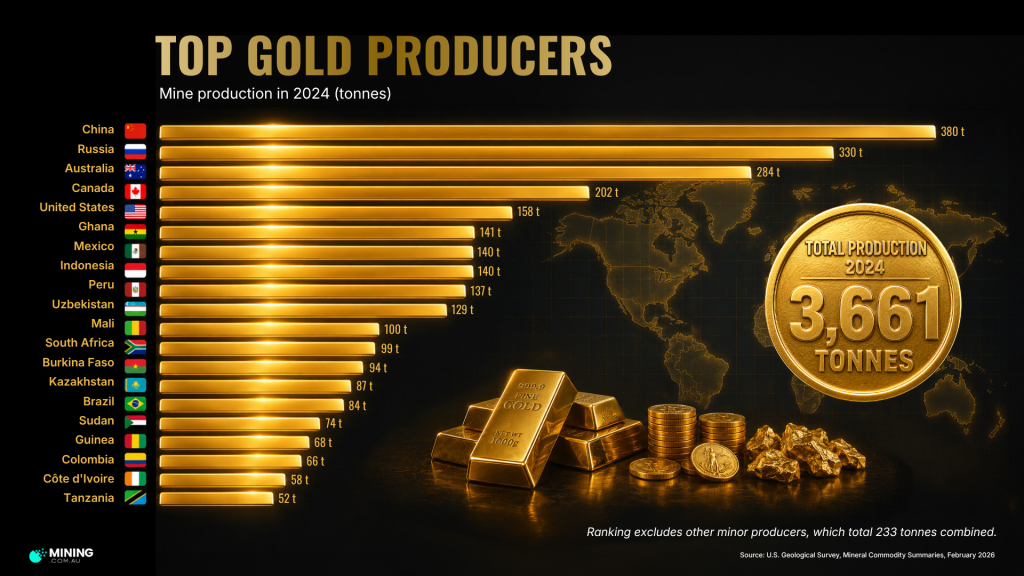
As our graphic on China’s leading global gold production illustrates, the country’s dominance is now structural rather than cyclical.
Unpacking China’s latest ‘supergiant’ gold discovery
The Jiaodong gold province — specifically the Jiaodong Peninsula in Shandong Province — is identified as the most significant gold-mining region in China. Major gold reserves are located there, and the deep exploration shift has fundamentally changed how China approaches mining in the region.
The key details of the deposits are:
- Taishang-Shuiwangzhuang — supergiant gold deposit (more than 700 tonnes of gold) in northwestern Jiaodong. Host rocks include Mesozoic granites and older gneisses; mineralisation is controlled by the Zhaoping fault zone with orebodies up to 72m thick and strike lengths reaching 5.8km. Average grades sit around 3.14 grams per tonne, with visible gold and occasional ‘high-grade’ intervals exceeding 100g/t.
- Jiaodong deep zones — combined proven gold reserves of approximately 1,300 tonnes across Sizhuang, Jiaojia, Matang, Xincheng, and Shaling-Qianchen, discovered via systematic drilling from 500m to 2,000m depth.
- Wangu goldfield, Hunan Province — more than 1,000 tonnes of gold discovered in 2024, making it the single largest gold deposit announcement in the country’s history. Ore prospecting expert Liu Yongjun and vice head Chen Rulin have been cited in Chinese state reporting on the discovery.
- Dadonggou deposit, Gansu — an additional gold orebody of more than 40 tonnes identified in October 2024.
Deep drilling techniques now target gold deposits at depths up to 3km. Advanced technologies in exploration include AI and 3D geological modelling, and AI technologies are enhancing accuracy in predicting underground orebodies — a sign that the country’s exploration toolkit has matured rapidly.
Higher-grade deposits can support more efficient gold extraction, as more gold can be recovered from a given amount of ore. These deposits compare favourably with the world’s 10 largest gold mines, including Muruntau in Uzbekistan, Grasberg in New Guinea (Papua, Indonesia), and Nevada Gold Mines in the US, though readers should notice that most Chinese figures reflect geological resources rather than JORC- or NI 43-101-compliant reserves.

Major players, mine development, and project economics
State-backed enterprises dominate the largest gold mine developments tied to these discoveries. The principal operators include:
| Company | Role | Notable activity |
| Shandong Gold Group (SSE:600547) | Provincial state-owned enterprise (SOE), listed | ¥71.32 billion ($14.75 billion) asset consolidation announced in 2026 |
| China National Gold Group | Central SOE | Largest domestic gold producer |
| Zijin Mining (SSE:601899) | Listed diversified miner | Backing AI funds for mining technology and active overseas |
Shandong Gold’s consolidation brings multiple mine licences and exploration rights — including estimated ore reserves at LuDi gold mine of ~42.45 million tonnes — under a single listed entity, signalling multi-decade mine-life ambitions. Massive recent gold discoveries have triggered infrastructure developments in mining regions, particularly road, power, and water supply projects needed for deep underground operations.
Project economics remain estimated at this stage. All-in sustaining costs for comparable Shandong operations historically sit in the lower half of the global cost curve for near-surface ore, but deeper sulphide veining at 1,000m-plus will escalate costs.
China’s broader outbound gold-mining strategy — with domestic companies producing roughly 72 tonnes from overseas mines annually in 2024, up about 19% year-on-year — suggests the new wealth of domestic reserves could both fund further international expansion and reduce pressure to acquire foreign assets. The country is stepping up exploration in its broader resource security push.
Market and strategic implications for global gold prices and supply
China’s largest gold discovery arrives during a period of elevated gold prices, robust central bank buying from Russia to Chile, and heightened investor interest in the precious metal as a safe-haven asset. Gold demand for bars and coins rose by more than 24% year-on-year in 2024, highlighting increased investor appetite for physical gold.
China’s gold discoveries have had a cumulative economic impact rather than a single-source windfall — new supply will filter onto the planet’s markets gradually. Near-term impact on gold prices is expected to be muted because development timelines for deep, supergiant gold deposits typically span five to 10 years. The country is heavily dependent on domestic consumption to absorb additional gold ore: as both the largest gold producer and consumer, export restrictions mean most output stays onshore.
The Shanghai Gold Exchange and Shanghai Futures Exchange give producers tools to manage hedging strategies and manage exposure as new production comes online. Deep-sea mining exploration has also expanded significantly in recent years, though its contribution to gold supply remains marginal.
For Australia, the picture is nuanced. Australian miners may face modest competition for capital, but technology and equipment export opportunities could form a valuable trade opportunity, particularly as Chinese operations push deeper. Whether in Chile, Papua New Guinea, or the Asia–Pacific more broadly, the discovery is expected to suggest a reorientation of regional exploration strategies.
Two scenarios are possible: additional supply could place some downward pressure on gold prices over the next decade, or sustained demand — including central bank purchases — could absorb the extra supply with limited impact on prices. Historically, the world has absorbed large new supply when demand fundamentals remain intact.

Environmental, social, and regulatory dimensions of China’s gold expansion
New exploration policies emphasise environmental sustainability in mining operations, and China‘s regulatory framework has tightened considerably over the past decade. Developing a supergiant gold deposit at depth raises several challenges geologists and operators must address:
- Land and tailings — large open pits and underground developments generate significant waste rock; tailings management and acid-rock drainage are priority risks at surface and at depth.
- Chemical use — cyanide-based processing of gold ore remains standard; stricter controls on lixiviant handling and discharge have occurred under updated ‘green mine’ certification requirements.
- Water and ecosystems — water consumption for processing in densely populated Shandong or in Hunan Province demands accurate environmental impact assessments before mining approvals are granted.
- Community and employment — discoveries in relatively developed regions reduce remoteness risk, but land-access negotiations, resettlement, and benefit sharing with local governments remain prominent.
Safety governance is a central concern. China’s earlier consolidation drive shut down thousands of small, unsafe operations, and a sign of continued reform is the requirement for full safety-production licences before scaling capacity — several of the mines in Shandong Gold’s 2026 consolidation still await these permits.
For international partners and investors, ESG disclosure, climate-risk reporting, and responsible gold-sourcing certifications will determine whether production from these discoveries gains long-term acceptance in global markets.
China’s gold expansion is a story that is still being written. For investors and explorers tracking the world’s next wave of mine supply, the accurate reading of Chinese resource estimates — and the timeline from discovery to production — will be the critical variable to watch.
Subscribe to Mining.com.au‘s Daily Drill newsletter for ongoing coverage of China’s gold developments and their implications for Australian miners.


