


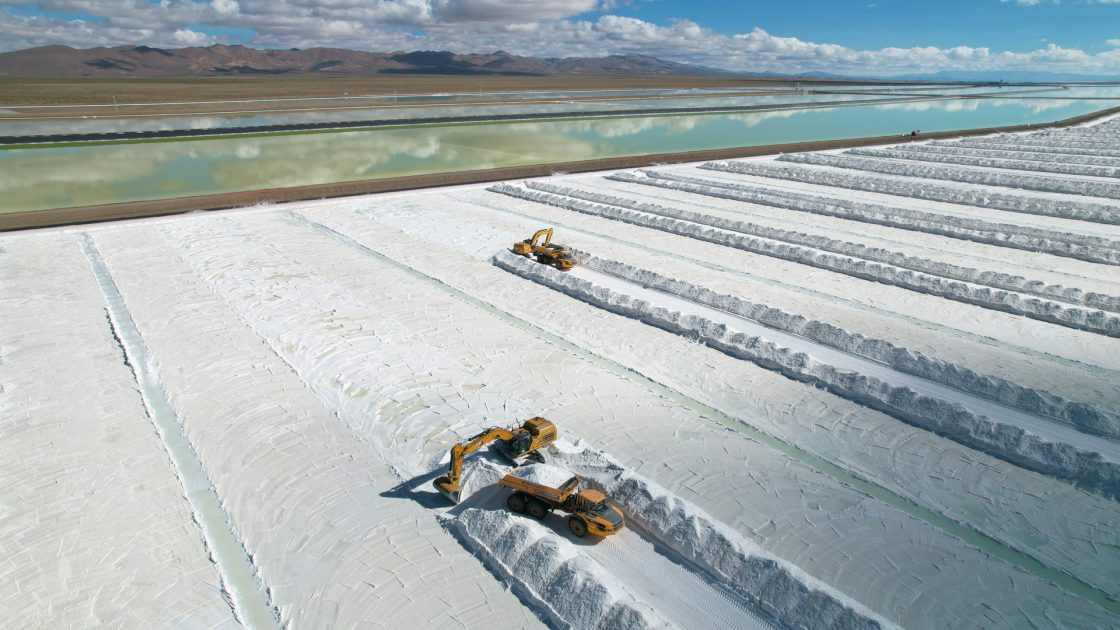
Though the price of lithium has sunk considerably in recent years, production of the once-hyped battery metal seems to be booming in one corner of the world especially: Argentina.
According to the country’s Chamber of Mining Entrepreneurs (CAEM), lithium carbonate production capacity has almost tripled over the last two years, from some 34,000 tonnes in 2022 to nearly 124,000 tonnes now.
Currently the world’s fourth-largest lithium producer — behind Australia, Chile, and China — Argentina now has four projects in production, including the new Centenario Ratones plant in the northern province of Salta.
“The recent inauguration of Centenario Ratones, the fourth lithium production plant in our country and the first in Salta, adds to a series of new projects and expansions that tripled installed capacity in just two years,” CAEM said in a statement earlier this week.
But what’s behind this sharp uptick in capacity? And can Argentina keep up the momentum?
Laying the launch pad
The most immediate explanation for Argentina’s ballooning production capacity is simply that there are more projects compared to previous years. That, according to Lake Resources (ASX:LKE) CEO David Dickson, is no accident, with many final investment decisions made prior to lithium’s price decline.
“The current level of production in Argentina is more a reflection of actions taken by developers in response to the increased pricing levels seen in 2022 and the early part of 2023,” Dickson tells Mining.com.au.
“However, this growth does reflect growing demand globally and emphasises that the Lithium Triangle” — a region of the Andes rich in lithium reserves — “and more importantly, Argentina, will play a significant part of the lithium supply in future years.”
Based in Sydney, Lake Resources operates the Kachi Project in Catamarca province, which — thanks to a resource measuring 10.6 million tonnes of lithium carbonate equivalent (LCE) — is expected to generate US$21 billion (A$31.3 billion) in revenue over its 25-year life.
But as Aaron Revelle — CEO of Pursuit Minerals (ASX:PUR), which is hunting for lithium at the Rio Grande Sur Project in Salta province — explains, each new project has also been boosted by the expertise gained through the development of previous ones.
“The majority of these projects have been in the market for some time, with Eramet’s Centenario and Lithium Argentina’s (NYSE:LAAC) Cauchari Olaroz having both been in development for several years through multiple price cycles,” Revelle says.
“The growing long-term demand for lithium and the complexity in new projects being brought online — combined with the ease of operating in-country and the need for end user products, being lithium carbonate and lithium hydroxide over spodumene hard rock alternatives — would have been factors aiding these projects.”

A joint venture between Paris-based Eramet (EPA:ERA) and Chinese steelmaker Tsingshan, the Centenario Ratones plant is expected to produce roughly 21,700 tonnes of LCE by 2025.
Notably, the plant is slated to use an innovative technique known as direct lithium extraction (DLE), which is helping to produce lithium cleaner, faster, and cheaper with less water consumption.
Unlike more established methods of extraction, there are no football field-sized brine pools from which lithium is separated by evaporation. It’s an important development for global production goals, given 70% of the world’s lithium is found in brine, rather than rock or clay.
“This inauguration confirms our technological and sustainable leadership across the entire lithium value chain, from exploration to extraction and processing,” Eramet CEO Christel Bories said at the start of July.
“This success is the result of a collective achievement, combining the expertise and commitment of our teams, our partnership with Tsingshan, the support of Argentina’s regional and national authorities and a strong and respectful relationship built with local communities since the start of the project.”
Dickson holds a similar opinion on the importance of DLE in the future success of the global lithium trade. Having recently returned from the Fastmarkets Lithium Supply and Battery Raw Materials Conference in Las Vegas at the end of June, he’s seen the buzz over DLE gather pace.
“Discussions with leading industry players at Fastmarkets focused on the ascendency of DLE processing,” Dickson says.
“The consensus was that the processing of hard rock lithium, outside of China, is vulnerable to cost overruns and competition from China. The mining can be profitable, but the processing is problematic.”
The political factor
Another key factor in the rise of Argentina’s lithium sector is President Javier Milei, the pro-business, pro-foreign investment former economist who took office in December last year.
During his campaign, the ‘chainsaw president’ — so-called for wielding the tool at rallies while pledging to slash public spending — swore to “end Argentina’s decay” with his ‘anarcho-capitalist’ principles.
“The changes our country needs are drastic,” Milei said shortly after being elected. “There is no room for gradualism.”
Under his initial package of measures, Milei devalued Argentina’s currency — the peso — by 50%, slashed state subsidies for fuel, and cut the number of government ministries by half. The sharp reduction in spending helped Argentina swing from a fiscal deficit of 2 trillion pesos ($3.23 billion) in December last year to a surplus of almost 265 billion pesos in April. It’s also helped inflation fall from a whopping 25.5% in December to just 4.2% in May. However, that figure rose marginally to 4.6% in June.

Pursuit’s Revelle says although Milei’s policies have already had a substantial impact on Argentina’s economy, there are likely long-term changes still to come.
“Over the longer-term, many international companies will be focused on the currency controls and how this plays out, with many expecting favourable policies to be implemented and the eventual lifting of currency controls,” he tells Mining.com.au.
Lake’s Dickson was similarly optimistic about Milei’s policies, noting that a number of bills have already been passed to boost foreign investment in key sectors.
“More specifically, the government has now issued and approved the ‘RIGI’ bill,” Dickson says.
At the end of June, Argentina’s lower house of Congress passed a law granting special legislative powers to the federal government, which intends to deregulate some industries, privatise some companies, and ease the flow of capital.
The RIGI section of the bill — also known as the Incentive Regime for Large Investments — affords the forestry, infrastructure, technology, oil and gas, energy, mining, steelmaking, and tourism sectors certain tax benefits, as well as more relaxed capital controls compared to other areas of the economy.
“The full impact of these changes will be seen over the coming months and years, but does position Argentina to attract foreign investment,” Dickson adds.
Maintaining the pace
While this is all good news for Argentina’s miners and explorers, keeping the momentum going will be key. But how that momentum ends up looking is of course subject to a huge suite of factors, including lithium pricing, political forces, geopolitical tension, the evolution of the electric vehicle market, and much more.
“Lithium projects are highly technical and take years to be brought online at large commercial scales. Naturally, a depression in the lithium price might delay growth,” Revelle says.
“However, as higher-cost mines — such as Chinese lepidolite mines — come offline due to not being profitable or sustainable in the current environment, Argentine brines will be well-positioned to take their place. Oversupply in the market is always a risk to strong growth, but in the current price environment Argentine brines are well-positioned for long-term sustainable growth.”
Some analysts, such as Morgan Stanley’s Adam Jonas, have also suggested we may be in the throes of a global electric vehicle “recession” that could threaten global lithium demand. This, he added, is particularly prevalent in the US where EV penetration stalled at 7.5%, according to a report published at the start of July.
“Comparatively, during COVID, EV prices were increasing every day with panic buying of these vehicles ensuing,” the report said.
“There was a shortage of vehicles globally and demand was greater than supply for a year or so over this time. There were also large rental car fleets going on large shopping sprees which added to this demand.”
Dickson, however, was more optimistic.
“Ultimately, EV penetration will be driven in large part by legislation across the globe,” he says.
“However, there will be the emergence of the ‘energy storage’ market which could add to an increased demand for lithium. Then you must factor in the impact of tariffs as the EU and US build up their own EV and energy storage capacity.
“What we are seeing is a resetting of strategy to take account of these new political realities.”
In any case, now is undeniably a good time to be part of Argentina’s lithium sector. But things move quickly these days, and the country’s next few years, particularly with Milei at the helm, will be interesting to watch.
Write to Oliver Gray at Mining.com.au
Images: Lithium Argentina, Our World in Data, Eramet, Casa Rosada Presidencia


