


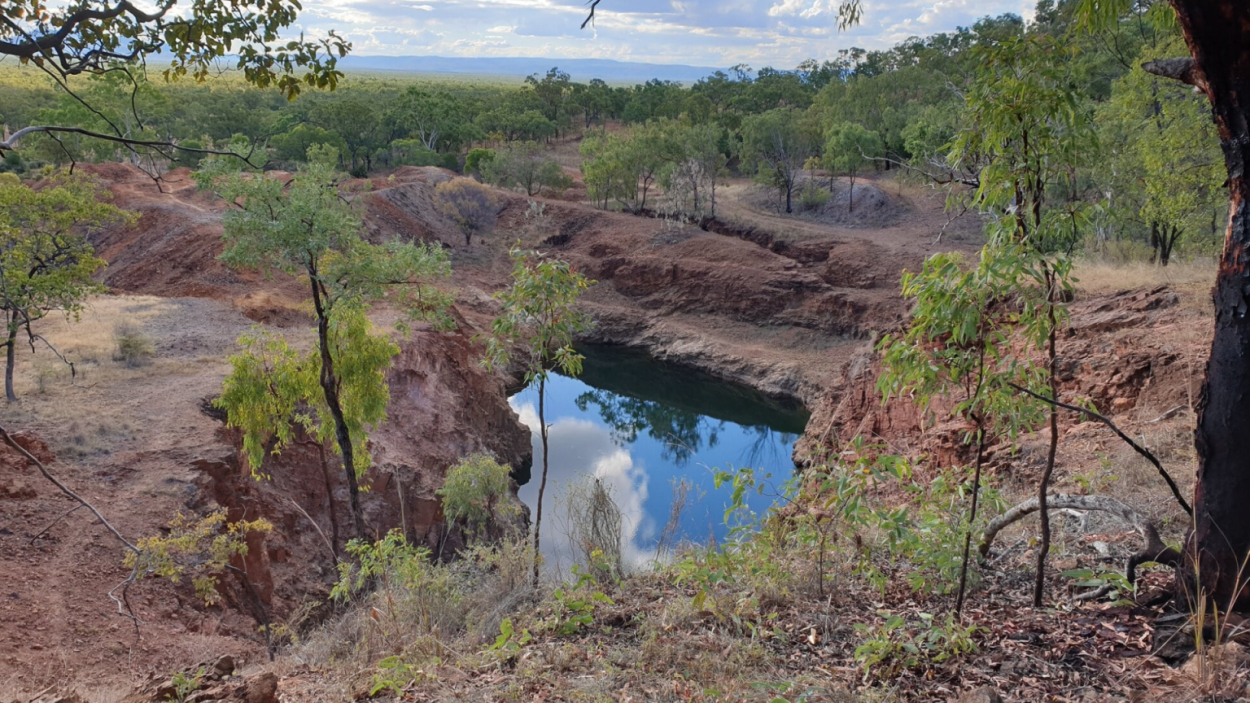
Ballymore Resources (ASX:BMR) is expecting to complete an induced polarisation (IP) survey at its Mount Molloy Project in Queensland within three weeks.
The company is running the survey with Planetary Geophysics at the 100%-owned project, about 50km northwest of Cairns.
The program covers five east-west lines, each about 2km long and spaced 200m apart, for about 10 line-kilometres. It investigates sulphide-bearing zones to a depth of about 200m.
The survey targets a prominent electromagnetic (EM) conductor that extends at least 1,000m north of the historic mine, coinciding with a copper-in-soil anomaly.
The conductor takes in the undrilled Adit Hill target. Meanwhile, a second shallow conductor sits about 1.5km north-northwest of the mine awaiting ground-checking. Both were identified in a 2024 SkyTEM airborne EM survey.
Prospectors discovered copper at Mount Molloy in 1883, with intermittent mining until 1942.
Historical records indicate the operation produced about 3,900 tonnes of copper metal at 8.7% copper, with previous workers interpreting the deposit as a volcanic-hosted massive sulphide system.
Historical drilling totals 41 holes for 4,386m, with only five holes exceeding 200m depth. Hole NPDH-5 returned 13m @ 1.21% copper (Cu), 4.31% zinc (Zn), and 34.6 grams per tonne silver (Ag) from 67m.
The company has not independently verified the historical data, and intervals are downhole widths.
Ballymore’s own work includes 21 rock-chip samples, of which 18 grade above 1% copper. The best sample returned 31.81% Cu, 2.28% Zn, and 300g/t Ag.
Soil sampling defines a copper anomaly of about 1,000m by 300m. Rock-chip samples are selective and do not necessarily represent grade at depth.
The company will integrate the survey results with existing EM, soil, and geological data to prioritise drill targets.
Managing Director David A-Izzeddin says the new data will provide greater geological clarity.
“The IP survey will help us refine these targets and determine where drilling has the greatest potential to discover additional copper-zinc mineralisation,” A-Izzeddin explains.
The company expects to complete the survey in November 2026. The project has no mineral resource or ore reserve.
It notes that geophysical anomalies are not evidence of economic mineralisation until tested by drilling.
Ballymore Resources also holds the Dittmer Project near Proserpine, which is its flagship asset.
Write to JC Villarba at Mining.com.au
Images: Ballymore Resources


